Application guide by addaScanCompare the inspection task, imaging conditions and validation steps with your own production line.
- Task
- Associating barcodes with touching parcels
- Decision focus
- Barcode scan tunnel
- Workflow
- Create individual object regions and events.
- Validation
- Side-by-side parcels with nearby labels
Separate parcel boundaries before assigning code reads
Original explanatory diagrams show the product states and inspection questions. They are schematics, not captured inspection results.
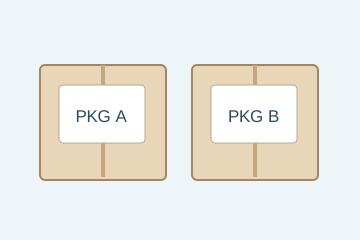
Each parcel has an unambiguous code association.
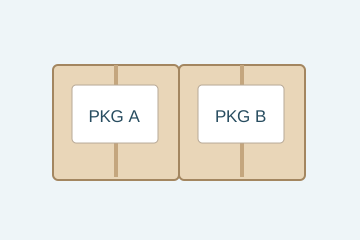
Boundaries need geometric evidence.
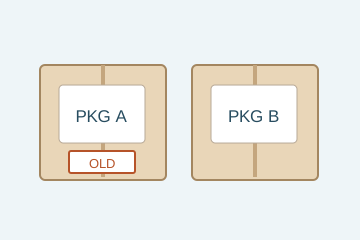
A rule selects the authoritative identifier.
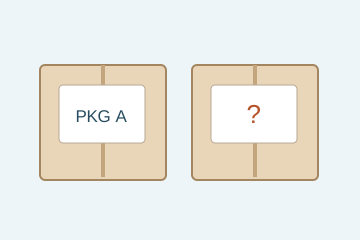
The object still requires tracking and recovery.
Select an image to view it at full size.
Associate a parcel code only when its owning parcel is known
Explore Barcode scan tunnel and Carton and pallet verification to connect this inspection task with the wider station requirements.
Swipe across the table to compare all columns →
| Decision | Evidence to use | Rule to agree |
|---|---|---|
| Object detected | Create a parcel event with a valid region. | Do not discard objects without readable codes. |
| Code associated | Bind a candidate label to the correct region. | Hold ambiguous assignments. |
| Identity accepted | Apply label-selection and downstream rules. | Avoid silently choosing the first decoded code. |
Align image, depth and conveyor coordinates
Synchronise the colour or intensity image with depth and motion information. Transform code locations into the same coordinate system as the parcel regions. Check whether the complete label belongs to one region; proximity to a centre is weak evidence when labels cross boundaries or soft bags overlap.
Define which label is current where old shipping labels remain visible. Content rules can select a candidate, but cannot resolve physical ownership when the parcel boundary is unknown. Mechanical separation may be the necessary solution for same-height touching cartons or inseparable soft packs. More segmentation confidence is not a substitute for observed separation.
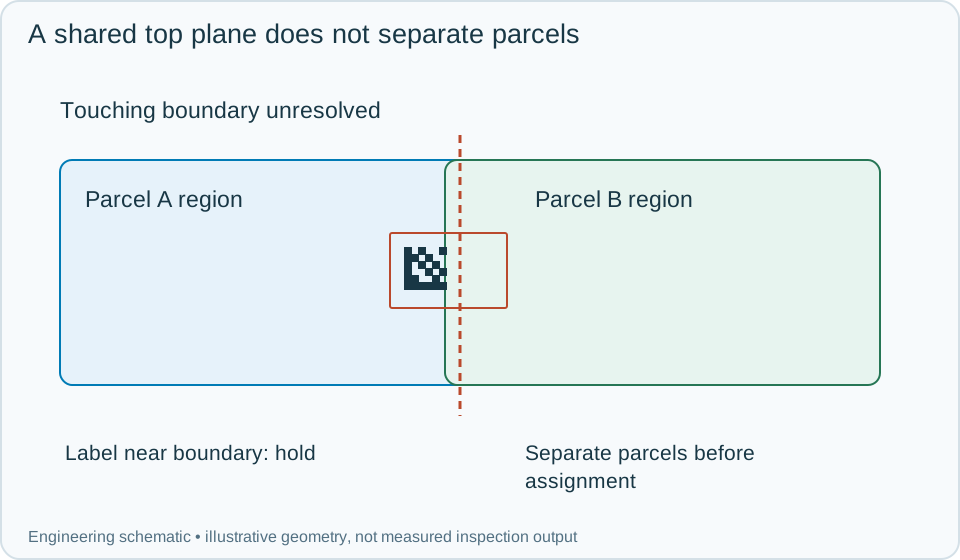
On a small screen, scroll across the diagram to inspect the labels.
Swipe across the table to compare all columns →
| Approach | Useful when | What to validate |
|---|---|---|
| Image-based separation | Boundaries are visible with useful contrast. | Challenge touching same-colour boxes. |
| Depth-assisted separation | Height helps distinguish adjacent objects. | Test equal-height and flexible parcels. |
| Singulation plus reading | Dense flow remains ambiguous. | Assess mechanical spacing and exception capacity. |
Worked example: two touching cartons share one apparent top surface
In an illustrative image, depth produces one level surface across two cartons. Two barcodes decode, but the system has no validated boundary that assigns each to an individual carton. Hold the association and separate the parcels before creating independent routing events.
After separation, acquire new synchronised views and associate each accepted current label with its own parcel. Preserve the earlier ambiguous event for reconciliation. If a label still extends across a boundary, require another view or manual resolution rather than choosing the nearest centre. A successful association must reach the correct physical diverter event; retain object regions, label locations and sorter acknowledgement so a decoded string cannot be mistaken for completed routing.
Swipe across the table to compare all columns →
| Observed evidence | Inspection decision | Action and retained record |
|---|---|---|
| Two touching cartons have a shared top height and no reliable separating boundary. | Depth does not establish two labelled objects. | Hold association, mechanically separate them and reacquire synchronised images before generating independent routing events. |
| A label straddles candidate object regions or a soft bag overlaps another. | Label ownership unresolved. | Preserve regions and code coordinates, use another qualified view or controlled manual resolution and avoid nearest-centre guessing. |
| A readable old label and a current label both belong to one resolved parcel. | Identifier selection still needs the active business rule. | Keep candidates and the selected-label reason, validate current routing content and bind the accepted code to that parcel's diverter event. |
What happens when a barcode cannot be assigned to one parcel?
- 01Detect the parcelsCreate individual object regions and events.
- 02Read visible codesCapture labels in the same scene reference.
- 03Associate and trackMaintain code-to-parcel identity through movement.
- 04Route uncertain objectsRecover no-reads and ambiguous associations.
Track the parcel through subsequent frames and hand over one accepted identity to the downstream system. Decide which label is authoritative when several are visible, and what to do with duplicate identifiers, unreadable labels or uncertain boundaries. A no-read parcel still needs its own tracked event so it can be diverted for recovery.
Validate failures of separation as well as reading
Challenge same-height cartons, overlapping soft bags, old labels, cross-boundary labels and delayed depth frames. Verify that incomplete association blocks the affected automatic route.
Compare 2D and 3D arrangements on actual boundary evidence and synchronisation. Depth adds useful geometry where differences are visible, but the acceptance plan must include conditions that require mechanical singulation or an identified exception route.
Swipe across the table to compare all columns →
| Challenge | What the trial should establish |
|---|---|
| Side-by-side parcels with nearby labels | Measure wrong-object associations. |
| Same-height touching boxes | Challenge boundary detection. |
| Multiple labels and duplicate codes | Verify identifier selection. |
| Unlabelled parcel and tracking interruption | Keep the exception attached to its object. |
When touching parcels need physical separation
Dense parallel flow may need singulation if reliable object separation cannot be established. A quoted reader decode rate does not describe code-to-parcel association accuracy. Validate wrong associations and missing parcel events separately from unreadable codes.
Use Barcode verification and grading to develop the related acceptance and integration questions for your trial.
Parcel spacing and code layouts to test
Use the logistics and distribution guide to consider parcel spacing, tracking and the downstream decision that needs a reliable code-to-parcel association.
Provide mixed parcel sizes, touching and overlapping examples, old and current labels, same-height boxes, flexible bags and the routing/exception-handling requirements.
Use the optical and recovery challenges above when applying the architecture choices in HIKROBOT and other vision solutions comparison.
Scope and budget
The barcode scan tunnel scope and cost factors helps scope code coverage, parcel tracking and any physical separation needed to resolve touching items.
Testing and handover
Include a readable code with ambiguous parcel ownership in the testing and handover process; reading success alone cannot release the parcel record.