Application guide by addaScanCompare the inspection task, imaging conditions and validation steps with your own production line.
- Inspection task
- Cell code and voltage-record binding
- Decision focus
- cell code and voltage-record binding
- Station planning
- Use fixture coordinates to constrain both tools
- Illustrative scenario
- code A is read while cell B is probed
Robot-mounted reading before code-to-test association
The application images show the physical product and imaging conditions. The engineering diagram below explains the inspection logic and recovery decisions.
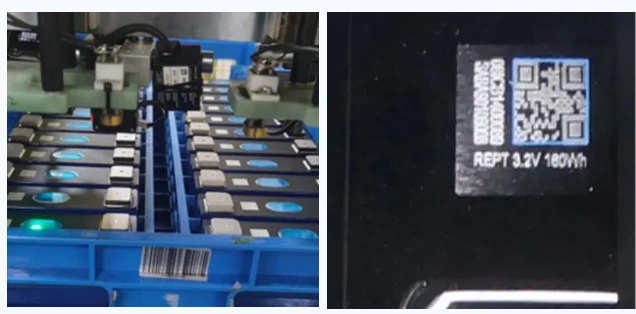
Installation and marked code image from the voltage-record association application.
Select an image to view it at full size.
Bind the voltage to the cell that was actually measured
Swipe across the table to compare all columns →
| Condition | Approach to evaluate | Selection check |
|---|---|---|
| Robot visits each cell | Evaluate repeatable pose and trigger timing. | Check that neighbouring cells cannot supply the accepted code. |
| Changing surface reflection | Evaluate a bounded parameter sequence. | Record worst-case decision time, not just the first success. |
| Voltage-to-code binding | Use a shared cell-event identifier. | Challenge missing, repeated and out-of-order results. |
Use fixture coordinates to constrain both tools
Identify the tray and its orientation, then map each cell position to the robot program. The code-reading region should exclude neighbouring cells where possible. The voltage tool must report completion for the commanded position, rather than leaving its previous value in a register. Record the robot position reference and tool status with the event so a plausible voltage cannot conceal a positioning error.
A wider camera view may make code acquisition easier but increases the chance of reading a neighbour. Constrain the region or associate the decoded symbol with the expected fixture location. If cell movement between reading and probing cannot be excluded, add a position confirmation or move the operations to a controlled fixture. More decoding power does not resolve an uncertain physical association.
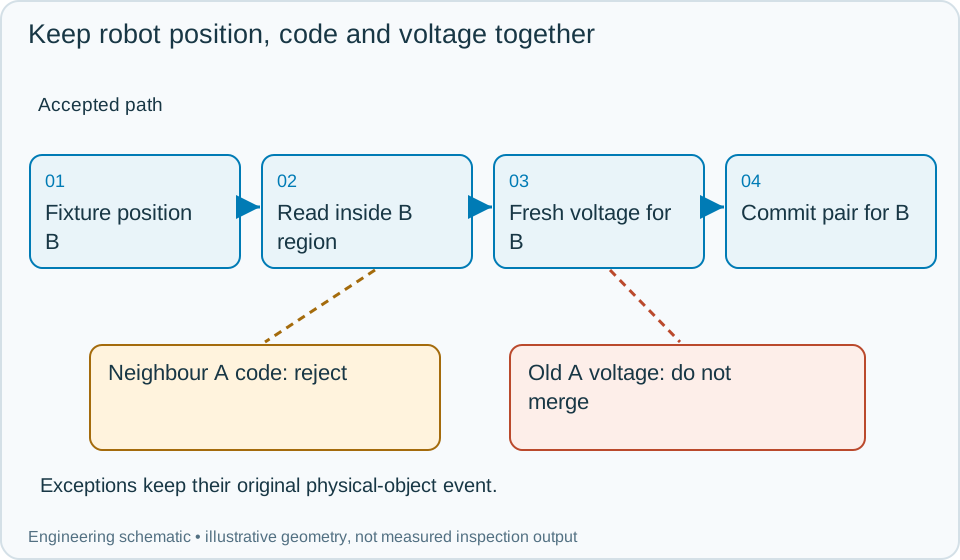
On a small screen, scroll across the diagram to inspect the labels.
Worked example: code A is read while cell B is probed
In an illustrative tray, the robot is instructed to measure position B. A code at adjacent position A appears in the image and decodes successfully. Its image coordinates fall outside B's allowed region, so the event must not accept it as B's identity. Hold the operation, verify tray orientation and acquire a correctly constrained view before probing or committing the result.
After a valid read of B, trigger the voltage measurement and wait for a fresh completion linked to B's event. A delayed measurement from A must remain associated with A even if B is now active. Submit only the pair of accepted identity and completed measurement. If a probe-contact fault requires a remeasurement, preserve the first attempt and create a new measurement attempt under B; do not silently replace the cell code or combine the best values from different cells. Release or advance only after the chosen result and its binding are confirmed.
Swipe across the table to compare all columns →
| Observed evidence | Inspection decision | Action and retained record |
|---|---|---|
| A decoded symbol lies at neighbouring fixture position A while B is commanded. | Wrong physical association despite a valid string. | Reject that candidate, retain image coordinates and robot reference, then obtain B's identity before accepting a voltage measurement pair. |
| A voltage result appears without a fresh completion for the current cell event. | Stale or unbound measurement. | Keep the tool status and attempt identifier, prevent submission and repeat the controlled measurement while the correct cell position remains established. |
| Probe contact fails and a new measurement is authorised for the same cell. | New measurement attempt under the existing cell identity. | Preserve the earlier failure, bind the selected valid result explicitly and confirm submission before moving to the next position. |
Challenge movement, stale values and partial repeats
Test an empty position, a neighbouring visible code, a failed probe contact, a delayed read and a tray change during an unfinished cycle. Expected behaviour should be specific: missing position blocks measurement, an out-of-region code is rejected, and an incomplete measurement blocks submission.
Retain the tray ID, position, cell event, read image, measurement attempt, units, tool status and submission acknowledgement. The vision layer establishes the observed identity and position; voltage accuracy and contact validity need the measurement system's own verification. Treat a robot stop as a recovery boundary and reconcile the current position before resuming the sequence.
Swipe across the table to compare all columns →
| Challenge | What to verify |
|---|---|
| Adjacent readable cells | Verify the intended cell is selected. |
| Reflective surface variants | Test every allowed parameter sequence. |
| Robot retry after no-read | Keep the same cell event until resolved. |
| Delayed voltage result | Prevent it from attaching to the next code. |
Code samples and voltage-record interfaces
Provide the robot path, tray map, code positions, test-equipment interface and the required record-binding rules.
Use the barcode verification grading guide to develop the next step.
Translate these view and interface requirements into equipment choices with code reader selection.
Define the wider inspection responsibility in dpm code reading.
Use the optical and recovery challenges above when applying the architecture choices in vision-system comparison guide.
Scope and budget
Use the vision system cost guide to assess code reading and the extra work required to associate robot, tray and voltage-test events.
Testing and handover
The testing and handover process should test delayed measurements, retries and a rejected association without overwriting the previous cell record.
The envelope verification project illustrates why an identifier must stay attached to the correct processing event. Review its identity-matching and FAT scope when defining code-to-test associations.