Application guide by addaScanCompare the inspection task, imaging conditions and validation steps with your own production line.
- Task
- Yoghurt cup lid presence and alignment
- Decision focus
- Seal inspection
- Workflow
- Establish the cup-based reference.
- Validation
- Good wet and glossy lids
Locate the lid against the cup opening
Original explanatory diagrams show the product states and inspection questions. They are schematics, not captured inspection results.
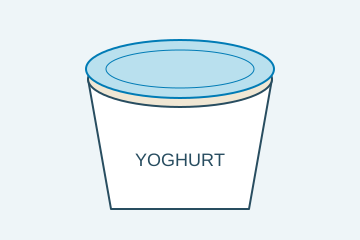
The lid covers the expected cup opening.
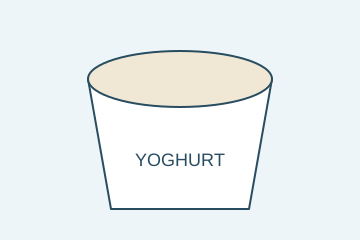
The opening remains uncovered.
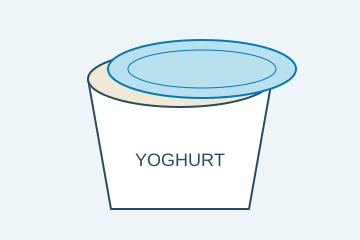
Compare the lid edge with the cup reference.
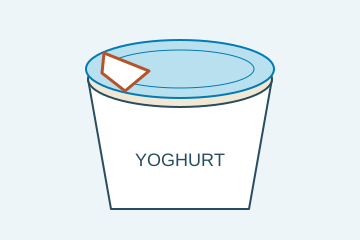
A visible fold interrupts the intended margin.
Select an image to view it at full size.
Measure lid coverage against the cup rim
Explore Fill level, cap and seal inspection and Yoghurt cup inspection to connect this inspection task with the wider station requirements.
Swipe across the table to compare all columns →
| Decision | Evidence to use | Rule to agree |
|---|---|---|
| Lid present | Confirm the required lid region exists. | Reject an uncovered cup. |
| Lid aligned | Compare lid position with the located cup. | Do not use artwork alone as the datum. |
| Margin visible and acceptable | Assess the agreed edge region. | Hold obscured or visibly defective margins. |
Use separate cup and lid contours
Define the required sealing ring from the cup geometry and map the membrane edge around it. Exclude the approved pull-tab shape from inappropriate circularity checks while still evaluating the relevant seal area. Condensation can obscure edges or create false highlights; validate whether the image contains enough evidence before measuring displacement.
A top view is useful for presence and coverage. Additional views or height information may be needed for lifted edges, depending on their visibility. Neither a complete visible overlap nor a flat-looking membrane alone proves seal integrity. Assign leak or seal-strength requirements to their corresponding tests.
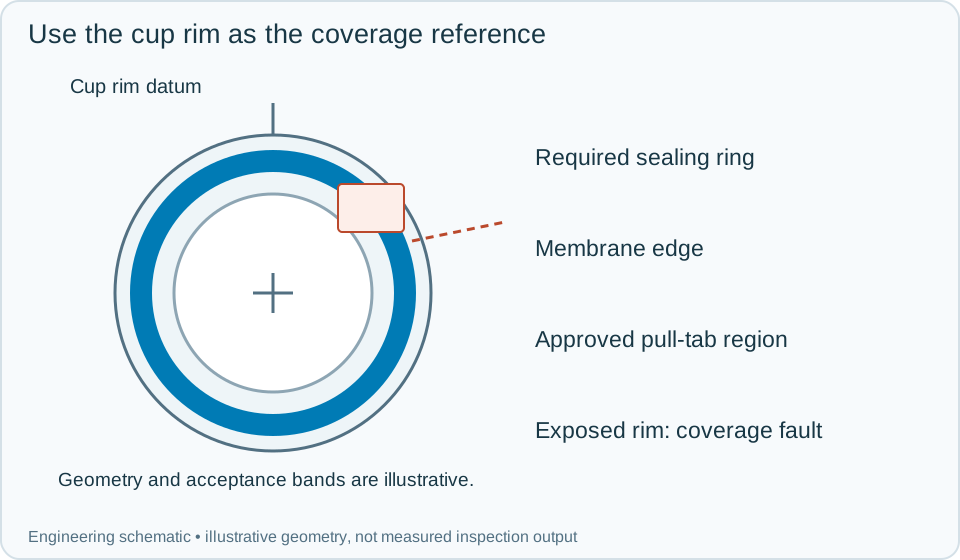
On a small screen, scroll across the diagram to inspect the labels.
Swipe across the table to compare all columns →
| Approach | Useful when | What to validate |
|---|---|---|
| Top view | Lid coverage and lateral position are visible. | Check foil glare and pull tabs. |
| Oblique edge view | Lifted edges need another angle. | Confirm neighbouring cups do not obstruct it. |
| Lane-specific views | A common view loses detail or visibility. | Maintain lane-to-reject correspondence. |
Worked example: a wrinkle looks like an exposed rim
In an illustrative cup, the lid edge is correctly located but a reflective wrinkle crosses the sealing-ring image. Compare the local evidence with the independent cup and membrane contours. If the membrane still covers the required area and the wrinkle is permitted, it is not a displacement failure. If the actual cup rim is exposed beyond the allowed overlap, reject the cup for coverage.
If condensation prevents a reliable edge decision, hold or recheck the cup instead of returning a favourable offset. In a multi-lane machine, retain lane and cup-event identifiers through each image and reject command. A failure in one lane must not trigger the adjacent cup. After an authorised rework, inspect the identified cup again and preserve the first failed attempt.
Swipe across the table to compare all columns →
| Observed evidence | Inspection decision | Action and retained record |
|---|---|---|
| The approved pull tab protrudes while the required sealing ring remains covered. | Tab geometry alone does not indicate misalignment. | Keep independent cup and membrane contours. Evaluate any wrinkle or lifting requirement separately before issuing the final cup decision. |
| The actual membrane edge leaves part of the required cup-rim band exposed. | Coverage failure relative to the cup datum. | Record the exposed sector, lane and cup event. Confirm rejection in the correct lane and preserve the failed inspection before rework. |
| Condensation prevents a reliable membrane edge although the lid appears present. | Presence may pass; alignment remains unmeasured. | Hold or recheck the cup using the qualified recovery route. Do not substitute a lid-presence result for required coverage evidence. |
How should a misplaced or uncertain lid be handled?
- 01Locate the cupEstablish the cup-based reference.
- 02Check the lidEvaluate presence and alignment.
- 03Inspect the marginRecord visible edge faults or incomplete coverage.
- 04Reject before packingKeep the decision with its cup and lane.
Associate each cup with its result before multipacking hides the rim. Where several lanes share a camera, preserve lane and cup identity. A partially hidden rim needs a coverage response; passing the visible half does not establish that the complete required seal margin was checked.
Challenge tabs, wrinkles and lane offsets separately
Include approved tab orientations, displaced membranes, acceptable wrinkles, condensation and cups shifted within their lane. Record both contours, coverage decision, image-validity status and actual reject confirmation.
Check that recipe changes update cup geometry and lid design together. A larger lid from a different product may hide the entire rim while still being the wrong component, so identity requirements need their own check where that mix-up is possible.
Swipe across the table to compare all columns →
| Challenge | What the trial should establish |
|---|---|
| Good wet and glossy lids | Challenge reflections and condensation. |
| Small shifts in different directions | Test position against the cup, not the artwork. |
| Missing lid and folded edge | Verify independent failure reasons. |
| Cup moved between lanes or stopped | Confirm the correct item is rejected. |
Why lid alignment does not prove seal integrity
Use the available image to assess visible coverage and edge condition. Seal strength, microleaks, temperature history and microbiological suitability are separate process or test requirements. Product on a rim may look like a highlight, so validate with actual contamination and normal condensation rather than drawings alone.
Use Visual seal inspection vs leak testing to develop the related acceptance and integration questions for your trial.
Cup and lid variations for an alignment trial
The dairy, juice and bakery guide connects cup and lid variations with the checks needed around filling, sealing and packing.
Supply cup and lid families, accepted positioning variation, deliberately missing or shifted lids, visible folds, wet good packs and the lane/reject arrangement.
Use the optical and recovery challenges above when applying the architecture choices in HIKROBOT and other vision solutions comparison.
Scope and budget
Use the yoghurt cup inspection scope and cost factors to scope rim localisation, lid offset checks and the required reject interface.
Testing and handover
The testing and handover process should test lid glare and acceptable placement variation separately from any seal-integrity test.