Application guide by addaScanCompare the inspection task, imaging conditions and validation steps with your own production line.
- Task
- Counting rebar ends in a bundle
- Decision focus
- Rebar counting machine
- Workflow
- Load the expected quantity and product family.
- Validation
- Known-count bundles across diameters
Touching rebar ends, surface texture and partial views
Original explanatory diagrams show the product states and inspection questions. They are schematics, not captured inspection results.

Individual visible bars can be enumerated.
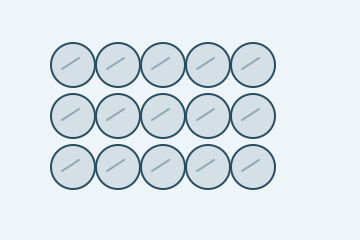
Neighbouring ends must remain separate objects.

Surface appearance can create false features.

A hidden end requires an exception, not a guessed count.
Select an image to view it at full size.
Define one visible rebar end before counting the bundle
Explore Rebar counting system and Presence and counting inspection to connect this inspection task with the wider station requirements.
Swipe across the table to compare all columns →
| Decision | Evidence to use | Rule to agree |
|---|---|---|
| Bundle identity | Associate the image with the correct dispatch record. | Avoid reusing a previous count. |
| End separation | Detect individual visible end faces. | Check merge and split errors. |
| Count accepted | Compare the valid count with the required quantity. | Escalate hidden or ambiguous regions. |
Inspect boundaries and recessed ends explicitly
Choose a view that exposes the end faces across the bundle. Check whether recessed or angled bars are hidden behind their neighbours. Lighting should preserve boundaries without turning every rust patch into an apparent edge. A model needs acceptable rust and end-shape variation as well as clean examples.
Segmentation can help show the operator where each count came from. It also reveals uncertain merged regions. Where physical occlusion prevents a reliable count, reposition the bundle or use the approved alternative verification method. A hidden bar cannot be established merely by extrapolating a regular packing pattern.
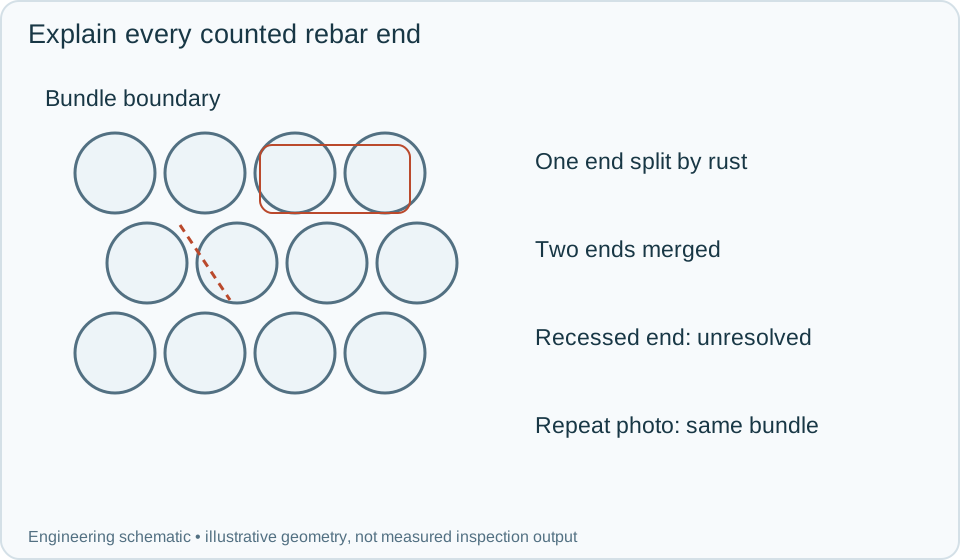
On a small screen, scroll across the diagram to inspect the labels.
Swipe across the table to compare all columns →
| Approach | Useful when | What to validate |
|---|---|---|
| Single end-face view | All required ends are exposed. | Challenge edge bars and uneven cutting. |
| Additional controlled view | A second angle resolves specific occlusions. | Deduplicate corresponding bars. |
| Presentation adjustment | Recessed or hidden ends remain unresolved. | Define the safe handling and review process. |
Worked example: one rusty end is counted twice
In an illustrative image, the detector splits a single end at a strong rust boundary. Review the local segmentation against the continuous outer contour and merge only through the qualified rule or recorded manual correction. A different region contains two adjacent ends merged into one; that needs separation or another view, not the same correction.
Bind each acquisition to the bundle identifier. Rephotographing the same bundle should update its inspection attempt, not create an additional shipment quantity. If a recessed end remains invisible, return an unresolved count and hold the bundle for the agreed confirmation. Preserve the original detections, corrected count, correction reason and final dispatch disposition so a later quantity query can be reconciled.
Swipe across the table to compare all columns →
| Observed evidence | Inspection decision | Action and retained record |
|---|---|---|
| Rust divides one continuous visible end into two detection regions. | Potential overcount from one end being split. | Retain segmentation and full bundle context, apply the qualified correction or recorded operator review and preserve the original detections. |
| Adjacent ends merge into one region or a recessed end remains hidden. | Potential undercount or unavailable evidence. | Reposition or use the approved alternative confirmation, keep the bundle on hold and record the unresolved locations with the final quantity. |
| The same bundle is photographed again after repositioning. | New inspection attempt, not another shipment quantity. | Associate the image with the existing bundle identity, preserve earlier uncertainty and record the accepted final count and dispatch disposition. |
When should an uncertain bundle count be rechecked?
- 01Identify the bundleLoad the expected quantity and product family.
- 02Expose the endsCapture a usable view of the bundle face.
- 03Count distinct objectsFlag merges, splits and obscured regions.
- 04Confirm dispatch quantityLink the accepted count to the bundle record.
Assign a count to a specific bundle event. If several images are combined, prevent the same bar end from being counted twice across views. Compare the completed count with the bundle record and retain the marked image for exception review. A low-confidence or obscured region should be visible to the operator rather than hidden behind a plausible total.
Validate both overcounts and undercounts
Include rusty ends, touching boundaries, recessed bars, irregular bundle outlines and repeated images of one bundle. Compare results with an independently established quantity and inspect the locations of every disagreement.
An operator-confirmed total should remain distinguishable from a fully automatic result. Choose the camera arrangement and review workflow together, since a fast initial count is not sufficient when unresolved regions regularly require physical repositioning.
Swipe across the table to compare all columns →
| Challenge | What the trial should establish |
|---|---|
| Known-count bundles across diameters | Measure both undercount and overcount. |
| Rusty and unevenly cut ends | Check false split and merge events. |
| Straps, shadows and recessed bars | Document unobservable conditions. |
| Bundle replacement at the station | Verify identity and fresh capture. |
What an end-face count cannot tell you about the bars
A visible-end count does not establish bar length, grade, weight or structural quality. It also does not prove that a recessed bar whose end is hidden was counted. Agree the permitted presentation and the conditions requiring manual verification or another handling step.
Use PLC and reject integration to develop the related acceptance and integration questions for your trial.
Bundle layouts and bar-end samples to provide
The building materials guide places bundle counting alongside material handling and dispatch checks, separate from bar grade or dimensional testing.
Provide bundles across diameters and packing patterns, independently counted references, rusty and uneven ends, recessed bars, straps and the dispatch identification method.
Use the optical and recovery challenges above when applying the architecture choices in HIKROBOT and other vision solutions comparison.
Scope and budget
Use the rebar counting system scope and cost factors to compare end-face coverage, presentation and additional views needed for overlapping bars.
Testing and handover
Agree the reference count and the threshold for a manual recheck during the testing and handover process.