Application guide by addaScanCompare the inspection task, imaging conditions and validation steps with your own production line.
- Task
- Food-tray seal-area contamination inspection
- Decision focus
- Seal inspection systems
- Workflow
- Map the agreed sealing band.
- Validation
- Good filled trays across recipes
Product contamination across the visible seal band
Original explanatory diagrams show the product states and inspection questions. They are schematics, not captured inspection results.

The defined visible margin is clear.
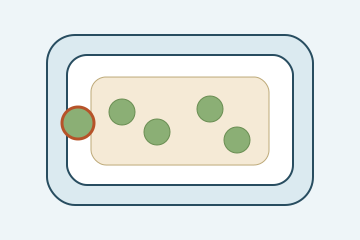
Product crosses the sealing region.
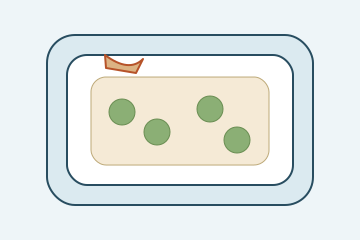
Low contrast challenges lighting and classification.
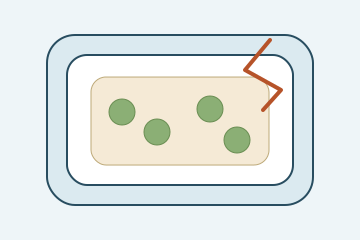
A fold needs its own visible-edge decision.
Select an image to view it at full size.
Inspect contamination where the sealing band is visible
Explore Fill level, cap and seal inspection and Food tray seal inspection to connect this inspection task with the wider station requirements.
Swipe across the table to compare all columns →
| Decision | Evidence to use | Rule to agree |
|---|---|---|
| Correct region | Locate the tray and its seal band. | Exclude intended cavity content. |
| Visible contamination | Compare suspicious regions with real product samples. | Check corners and low-contrast smears. |
| Inspectability | Confirm that film and tooling expose the target. | Hold or separately scope hidden regions. |
Divide responsibility between pre-seal and post-seal views
A pre-seal view can reveal the open tray rim and contamination before the film hides it. It cannot observe material introduced afterwards. A post-seal view may preserve evidence through clear film, while printed film or dark structures can conceal it. Evaluate actual tray and film combinations rather than assuming all transparent-looking packaging provides a usable view.
Locate the tray and construct the seal-region map from its geometry. Compare directional and diffuse lighting on representative food residues, moisture and normal rim features. If a required region is opaque after sealing, move that check earlier and control the later contamination risk, or use another suitable inspection method.
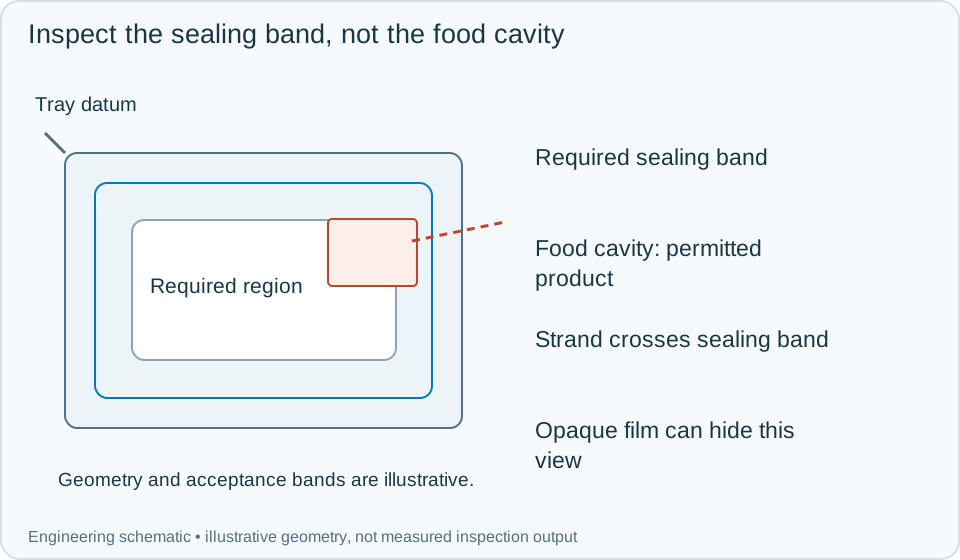
On a small screen, scroll across the diagram to inspect the labels.
Swipe across the table to compare all columns →
| Approach | Useful when | What to validate |
|---|---|---|
| Reflected-light inspection | Surface deposits contrast with the band. | Challenge gloss and product-colour changes. |
| Transmitted-light inspection | Packaging transmits useful contrast. | Confirm the tray and product do not mask the band. |
| Earlier process view | The completed package hides the surface. | Account separately for defects introduced afterwards. |
Worked example: food in the cavity crosses onto the rim
In an illustrative tray image, a food strand starts inside the permitted cavity and continues across the sealing band. The cavity portion is acceptable, but the intersection with the required band fails the contamination rule. Retain the band overlay and local evidence, then divert the tray before sealing if that is the assigned station action.
After authorised cleaning or repacking, reinspect the full required band under the same tray identity with a new attempt. If printed film later covers the band, a clear post-seal image of the artwork cannot confirm that the underlying rim stayed clean. Record which checks were completed before and after sealing. An obscured required region remains unavailable evidence, and release must follow the agreed process responsibility rather than an assumed visual pass.
Swipe across the table to compare all columns →
| Observed evidence | Inspection decision | Action and retained record |
|---|---|---|
| Food stays inside the cavity and outside the correctly located sealing band. | Cavity content alone is not seal contamination. | Retain the region map and evaluate the complete band. Other food or fill requirements remain assigned to their separate rules. |
| A strand intersects the required band before sealing. | Visible seal-area contamination. | Divert the tray before the next operation, retain the crossing region and reinspect the full band after any authorised correction. |
| Printed film hides the band at the final camera station. | Post-seal visual evidence unavailable for that region. | Record the coverage limit and assign pre-seal inspection plus later process controls or another suitable test in the acceptance plan. |
When should a tray be held for a seal check?
- 01Locate the trayMap the agreed sealing band.
- 02Expose the regionChoose illumination for the package and food.
- 03Classify visible faultsSeparate contamination, folds and obscured regions.
- 04Track the trayApply the agreed hold or reject action.
Preserve tray identity through the sealer and reject station. If inspection takes place before sealing, a pass describes that earlier condition; it cannot automatically stand for the finished seal. If it takes place after sealing, test which parts of the band remain visible through the lid. Store the defect location so quality staff can distinguish recurring rim contamination from normal cavity content.
Validate residues at difficult seal locations
Place representative contamination at corners, narrow band sections and beside normal moulded features. Include wet but acceptable rims and product that approaches the band without crossing it. Test tray mislocation and film variation as separate challenges.
Store tray recipe, seal-region placement, contamination evidence and disposition. Visible band inspection supports contamination control; seal integrity and strength may still require dedicated tests.
Swipe across the table to compare all columns →
| Challenge | What the trial should establish |
|---|---|
| Good filled trays across recipes | Separate normal contents from seal-band material. |
| Food at corners and straight edges | Verify coverage and location reporting. |
| Thin residue and clear film folds | Challenge weak contrast. |
| Late contamination or displaced tray | Check process scope and tracking. |
What a seal-area image cannot prove
A clean-looking seal band can still leak, and a visible deposit does not quantify seal strength. Detection depends on contrast, coverage and the minimum defect agreed with the customer. Avoid a single threshold developed on one food colour and then applied to all recipes.
Use Visual seal inspection vs leak testing to develop the related acceptance and integration questions for your trial.
Tray formats and seal contamination to provide
Use the meat, staples and dry goods guide to consider product residue, tray changes and the inspection point before a seal defect becomes inaccessible.
Provide empty and filled trays, lid films, permitted rim appearance, actual product contamination at edges and corners, and the timing of filling, sealing and inspection.
Use the optical and recovery challenges above when applying the architecture choices in HIKROBOT and other vision solutions comparison.
Scope and budget
Compare tray presentation, residue contrast and line handling with the food tray seal inspection scope and cost factors.
Testing and handover
Use the testing and handover process to agree visible contamination criteria and the separate tests required for seal integrity.