Application guide by addaScanCompare the inspection task, imaging conditions and validation steps with your own production line.
- Task
- PET preform black-speck and neck inspection
- Decision focus
- Preform inspection
- Workflow
- Load neck and wall inspection requirements.
- Validation
- Specks at different depths and sides
Separate wall specks from neck-edge damage
Original explanatory diagrams show the product states and inspection questions. They are schematics, not captured inspection results.

Assess the defined wall and neck regions.

A local dark feature needs classification against samples.

Missing edge material requires a dedicated neck view.
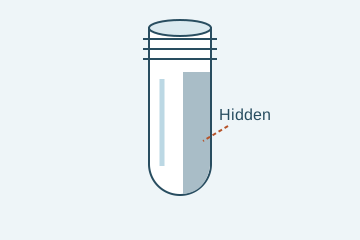
One side view leaves part of the circumference unobserved.
Select an image to view it at full size.
Assign preform defects to the view that can reveal them
The plastics and packaging guide explains where preform appearance checks fit alongside moulding, handling and downstream packaging operations.
Define the inspection scope before choosing the station layout.
Swipe across the table to compare all columns →
| Decision | Evidence to use | Rule to agree |
|---|---|---|
| Wall feature | Find dark regions under controlled transmitted light. | Separate normal optical structure from defects. |
| Neck completeness | Evaluate the visible rim and finish geometry. | Use coverage appropriate to the circumference. |
| Inspection coverage | Confirm all required views were acquired. | Hold a preform with incomplete inspection. |
Use rotation to resolve projection ambiguity
In a transparent wall, near and far surfaces project into the same image. Compare views through a controlled rotation and retain their angular relationship. A feature that stays fixed in the image while the preform moves may belong to the background or optics. A feature that moves with the preform can support a product-related defect decision, but its depth may still be unresolved.
The neck needs views that expose its required contour and sealing features. A sidewall camera cannot automatically prove neck completeness. If one view remains obscured or saturated, treat that coverage as missing; do not average it into the acceptable views.
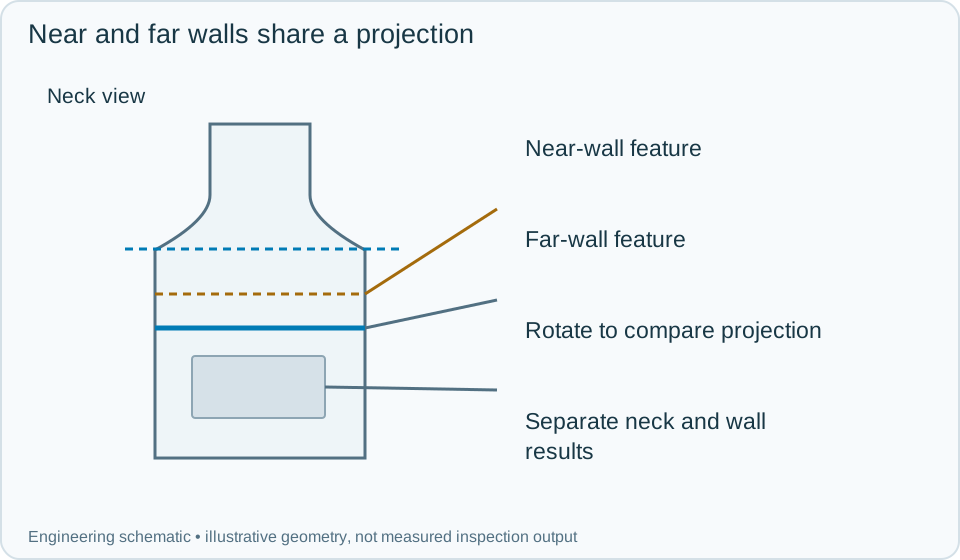
On a small screen, scroll across the diagram to inspect the labels.
Swipe across the table to compare all columns →
| Approach | Useful when | What to validate |
|---|---|---|
| Single transmitted view | The required feature is visible without wall ambiguity. | Challenge both near- and far-side samples. |
| Rotation or multiple views | Circumferential features need wider coverage. | Track view completeness per preform. |
| Dedicated neck view | Rim and neck defects have different geometry. | Prevent support tooling from masking the edge. |
Worked example: a dark speck appears in one side image
In an illustrative sequence, a suspected speck is visible through the wall. Reimage at a known rotation while preserving the same preform event. If it follows the product and meets the accepted contamination criterion, hold the preform and retain the view sequence.
If the spot stays at the same sensor location on different preforms, inspect the window and background. That diagnosis does not justify releasing parts whose required areas were obscured; recheck them under a restored setup. A separate neck-edge defect fails its own rule even if the sidewall is clear. Aggregate results only when the required angles and neck view are present, then confirm that the identified preform receives the correct reject or review action.
Swipe across the table to compare all columns →
| Observed evidence | Inspection decision | Action and retained record |
|---|---|---|
| A suspected speck moves with the preform through registered rotational views. | Product-related feature requires the agreed defect classification. | Retain angular views and the feature region, apply the contamination rule and keep the neck result separate in the part record. |
| The same dark spot stays fixed across different preforms at the sensor location. | Station contamination or background interference is suspected. | Inspect the optical path, restore visibility and recheck affected preforms. Preserve which required regions had been obscured. |
| Sidewall views pass but a required neck view is absent or saturated. | Whole-preform inspection incomplete. | Hold the identified preform, recover the missing qualified view and aggregate only after every required region has a valid result. |
What should happen when a preform view is incomplete?
- 01Identify the familyLoad neck and wall inspection requirements.
- 02Acquire the viewsExpose required regions with suitable light.
- 03Evaluate separatelyKeep wall and neck decisions distinct.
- 04Combine by preformRelease only after all required checks complete.
Locate the neck or support feature consistently, then assign the wall and neck results to the same preform. A missing view, overlap or tilted part should have an explicit response. Use a defect map to identify the inspected regions rather than reporting an overall pass that silently ignores an unobserved surface.
Verify coverage with transparent-material variation
Challenge wall thickness and tint variation, near and far wall defects, neck faults and missing rotation frames. Record the required view map, observed defect region and incomplete-view reasons.
Additional cameras or rotation are justified by blind areas, not simply by a desire for more images. Define what surface evidence the chosen arrangement provides and avoid extending a visible inspection result into an unsupported guarantee of internal material quality.
Swipe across the table to compare all columns →
| Challenge | What the trial should establish |
|---|---|
| Specks at different depths and sides | Confirm the defined visibility limits. |
| Chipped rims around the neck | Find sectors masked by tooling or reflections. |
| Good scuffed or damp samples | Evaluate false rejects against accepted variation. |
| Missing frame or incorrect presentation | Verify a coverage failure cannot become a pass. |
Which preform features remain outside the view
Black appearance alone does not identify the contaminant material. Scuffs, moisture and mould features may resemble a speck under some lighting. Vision also does not establish polymer chemistry, barrier performance or every internal defect. Classify only the visible features that have been agreed and challenged with real samples.
Use Visual seal inspection vs leak testing to develop the related acceptance and integration questions for your trial.
Preform necks, colours and inclusions to test
Provide preforms across neck finishes, resin shades and normal optical variation, plus confirmed wall inclusions, neck chips and examples of acceptable surface marks.
Use the optical and recovery challenges above when applying the architecture choices in HIKROBOT and other vision solutions comparison.
Scope and budget
Use the vision system cost guide to assess how neck views, inclusion detail and preform handling affect the station scope.
Testing and handover
The testing and handover process should include obscured features, normal colour changes and a preform that cannot be inspected completely.