Application guide by addaScanCompare the inspection task, imaging conditions and validation steps with your own production line.
- Task
- Date-code inspection on wrinkled sachets
- Decision focus
- Date code inspection
- Workflow
- Expose the full code without harming the seal.
- Validation
- Normal folds on good packs
Wrinkles, missing strokes and wrong date content
Original explanatory diagrams show the product states and inspection questions. They are schematics, not captured inspection results.
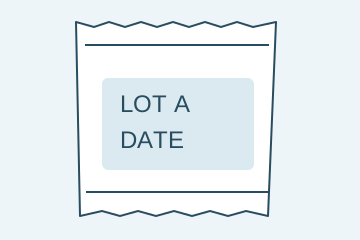
The complete date and batch are visible.
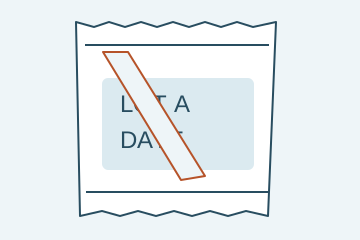
Part of the code is hidden; visibility must be resolved.
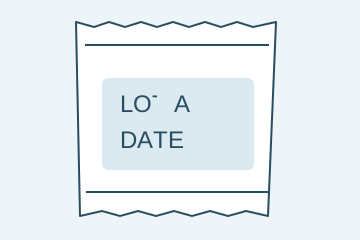
A visible code has incomplete printed characters.
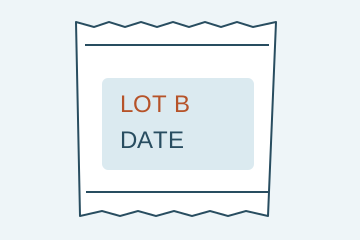
Clean text disagrees with the current job.
Select an image to view it at full size.
Choose a visible print window on the filled sachet
Explore OCR / OCV code inspection and Pouch inspection to connect this inspection task with the wider station requirements.
Swipe across the table to compare all columns →
| Decision | Evidence to use | Rule to agree |
|---|---|---|
| Code present | Locate the full intended print region. | Hold a missing or obscured region. |
| Print acceptable | Evaluate required strokes against accepted print variation. | Separate film folds from ink defects. |
| Content correct | Compare OCR output with the current date and batch rules. | Reject readable but wrong content. |
Support the film without creating a new blind area
A guide or backing surface can stabilise the printed region, but must not cover characters, distort the seal or create a bright reflection. Compare the supported and unsupported package under production motion. Verify that the complete code remains inside the field across normal fill and sealing variation.
If the print is consistently hidden after filling, an earlier inspection point may provide better evidence, with a separate check for later damage where required. Trained OCR can help with visible variable characters; it cannot establish content behind a physical fold. Keep optical improvement and recognition-tool selection as distinct decisions.
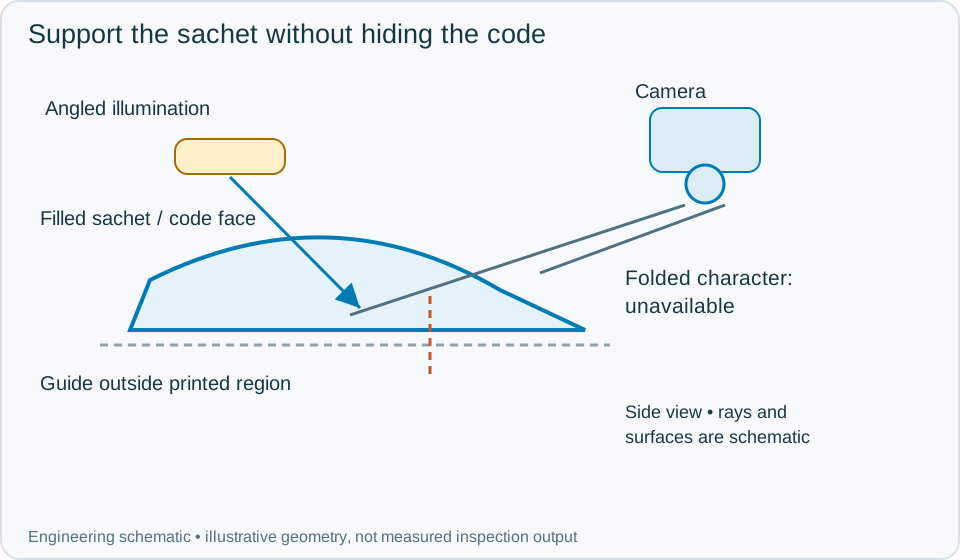
On a small screen, scroll across the diagram to inspect the labels.
Swipe across the table to compare all columns →
| Approach | Useful when | What to validate |
|---|---|---|
| Fixed view | Presentation keeps the code region visible. | Challenge pouch tilt and movement. |
| Presentation control | A support or guide reduces folds at the imaging point. | Check that it does not damage the package. |
| Additional view or repositioned station | The code is intermittently hidden from one angle. | Maintain the identity of the same sachet. |
Worked example: the expected date is partly behind a fold
In an illustrative filled sachet, the first date characters are sharp but the last character is hidden. Do not substitute the expected value. Return unavailable content and retain the full package image showing the fold.
If the line can re-present that same sachet safely, acquire another view within a controlled retry event. A complete sharp code can then be verified against the recipe and its print-quality rule. If the fold remains, divert the package rather than retry indefinitely. A missing stroke in an otherwise fully visible character is a different fault and should remain rejected even if OCR guesses correctly. Record the original image, re-presentation, observed string and final physical action under one sachet identity.
Swipe across the table to compare all columns →
| Observed evidence | Inspection decision | Action and retained record |
|---|---|---|
| The guide exposes the whole date without altering the seal or moving it outside the validated view. | Presentation improvement is usable subject to moving trials. | Record filled-package samples across normal variation and repeat content and print checks before accepting the revised station setup. |
| A character is physically hidden under a fold, although nearby digits are sharp. | Incomplete visibility; OCR confidence cannot resolve the hidden digit. | Keep the full sachet image, hold its event and perform only the agreed re-presentation or exception route. |
| A visible character is damaged but OCR still returns the expected date. | Print condition fails separately from content. | Preserve the defect crop and decoded string, confirm package rejection and investigate the printer rather than the package guide alone. |
When should an unreadable sachet be held?
- 01Present the pouchExpose the full code without harming the seal.
- 02Locate and readCapture the print region under controlled light.
- 03Compare the jobKeep content, print quality and visibility separate.
- 04Track dispositionHold or reject the correct sachet.
Locate the printed area relative to visible package features before reading it. Check the expected string separately from print completeness, and retain an explicit obscured/no-read state. Associate the result with the sachet through sealing, cutting or conveyor transfer. A change in pitch or a stop-start event must not move a reject decision onto the next good pack.
Validate support and sealing changes together
Test empty and filled samples, normal fill variation, seal-induced wrinkles and the allowed lateral drift. Include folds over different characters so success on one convenient date does not hide a coverage gap. Confirm that a support adjustment does not introduce seal or handling problems.
Preserve unavailable-view results separately from wrong dates and damaged printing. That separation tells the operator whether to investigate package presentation, recipe control or the printer.
Swipe across the table to compare all columns →
| Challenge | What the trial should establish |
|---|---|
| Normal folds on good packs | Determine which variations remain inspectable. |
| Faint ink and missing strokes | Record false acceptance separately from no-read. |
| Previous-job date or batch | Verify recipe changeover against the expected data. |
| Line stop and pitch change | Confirm physical rejection of the intended pack. |
What date-code inspection cannot verify
Date-code inspection does not establish seal integrity. If the code crosses the heat-seal band, separate embossing or crimp texture from missing ink. A pack can have correct text and a contaminated seal, so those requirements need separate regions and acceptance rules.
Use Sachet date code and seal checks to develop the related acceptance and integration questions for your trial.
Sachets and crease variations to test
Use the meat, staples and dry goods guide to place sachet date checks alongside pack formation and seal inspection.
Provide filled sachets from each film and product family, complete job strings, normally wrinkled good samples, deliberate print faults and photographs of the printer-to-reject path.
Use the optical and recovery challenges above when applying the architecture choices in HIKROBOT and other vision solutions comparison.
Scope and budget
The pouch inspection scope and cost factors helps define film presentation, lighting and the response to a date field hidden by a crease.
Testing and handover
Use the testing and handover process to test wrong content separately from a code that cannot be read confidently.