Application guide by addaScanCompare the inspection task, imaging conditions and validation steps with your own production line.
- Task
- Returnable glass bottle inspection
- Decision focus
- Empty bottle inspection
- Workflow
- Separate bottles before the filler.
- Validation
- Good worn and damp returns
Accepted scuffing, mouth chips and internal objects
Original explanatory diagrams show the product states and inspection questions. They are schematics, not captured inspection results.
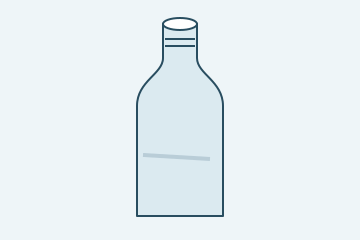
Normal scuffing must be represented in the good set.
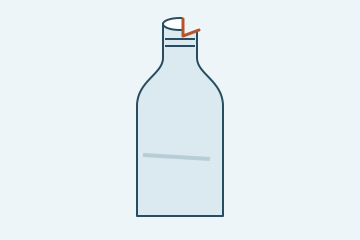
A finish view checks the visible rim.
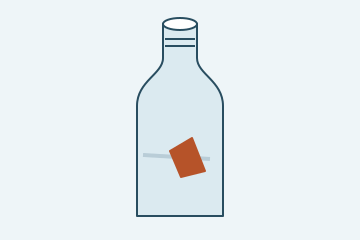
A separate optical path is needed inside the bottle.
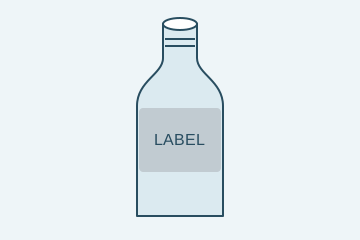
A label or heavy scuffing can hide the target area.
Select an image to view it at full size.
Match bottle-mouth, base and wall faults to their views
Explore Empty container and preform inspection and Returnable glass bottle inspection to connect this inspection task with the wider station requirements.
Swipe across the table to compare all columns →
| Decision | Evidence to use | Rule to agree |
|---|---|---|
| Finish acceptable | Inspect the visible mouth circumference. | Account for chips at difficult angles. |
| Interior visibly clear | Check the defined internal regions. | State which objects and locations are covered. |
| Container inspectable | Recognise the family and confirm required views. | Hold unknown or heavily obscured bottles. |
Locate the bottle family before applying region rules
Confirm the bottle recipe and locate the mouth, base and wall regions using the expected geometry. A different bottle family can shift the regions and change normal refraction. Use approved wet and dry samples to understand residual-water appearance rather than teaching every dark feature as contamination.
Choose the inspection point after washing according to stability, visibility and drainage. Sidewall coverage may require several views or rotation. A label or handling component can block a wall region even when the other views are clear. Record coverage explicitly and keep mouth defects separate from wall or base contamination.
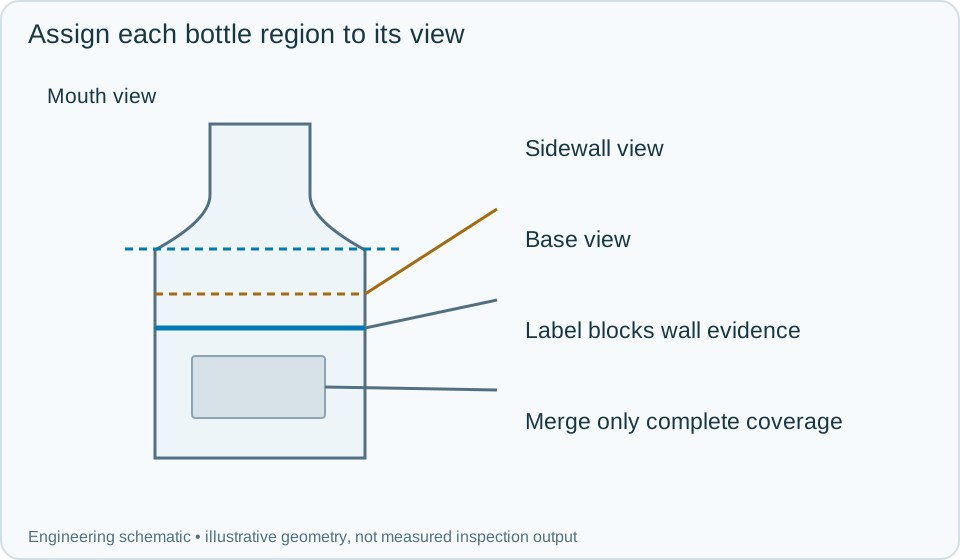
On a small screen, scroll across the diagram to inspect the labels.
Swipe across the table to compare all columns →
| Approach | Useful when | What to validate |
|---|---|---|
| Mouth view | Rim damage is a priority. | Match the view to finish geometry. |
| Base/interior view | Visible objects inside the container are the target. | Test base patterns and water droplets. |
| Combined sidewall views | Additional circumferential coverage is required. | Manage embossing, wear and view association. |
Worked example: a clear sidewall does not clear the bottle
In an illustrative inspection, the side views appear acceptable but the mouth view shows a missing edge segment. The bottle fails the mouth rule regardless of the clean sidewall. Another bottle has a dark base feature whose appearance is ambiguous with residual water. Hold it for the qualified recheck route, retaining both the base and full bottle context.
If drainage and a repeated view resolve the feature as acceptable water behaviour, record that attempt under the same bottle event. If contamination remains, reject it. A third bottle has an opaque remnant label covering a required wall area; its wall result is incomplete, not clear. Release requires all mandatory regional decisions and confirmation of the correct bottle handling.
Swipe across the table to compare all columns →
| Observed evidence | Inspection decision | Action and retained record |
|---|---|---|
| A mouth-edge segment is absent in a correctly located top view while sidewalls appear clear. | Mouth defect fails independently of sidewall acceptance. | Store the mouth evidence and bottle recipe, reject the bottle and verify that the correct event reaches the removal point. |
| A base feature changes after the qualified drainage and recheck step. | Resolve against approved residual-water behaviour. | Keep both base images under the same bottle event and record why the final condition meets or fails the contamination criterion. |
| An opaque label remnant blocks a required wall region. | Wall coverage incomplete, not a clean-wall result. | Hold or route for the defined recovery, then repeat the relevant full coverage check and retain the missing-region record. |
What happens to a rejected bottle after the washer?
- 01Present after washingSeparate bottles before the filler.
- 02Capture each regionUse mouth, interior and side views as required.
- 03Combine decisionsRequire complete inspection of the same bottle.
- 04Confirm rejectionPrevent the rejected bottle entering the filler.
Confirm bottle spacing and identity through the multi-view station. Combine all required checks before the filler decision, and define what happens to an unfamiliar bottle or an obscured view. Reject confirmation matters because an image alarm alone does not remove the container from the filling stream.
Challenge the combinations found after washing
Include chipped mouths, base contamination, residual water, label remnants and the permitted bottle-family variation. Test a missing camera view and a bottle entering skewed. Verify that a good result from one region cannot overwrite another region's failure.
Keep each view and defect location with the bottle event. This supports a useful process investigation while respecting the boundary between visible inspection and any additional cleanliness or strength requirements.
Swipe across the table to compare all columns →
| Challenge | What the trial should establish |
|---|---|
| Good worn and damp returns | Establish acceptable appearance variation. |
| Mouth damage around the finish | Verify angular coverage. |
| Internal objects at difficult positions | Document what remains hidden. |
| Wrong bottle family or missing view | Confirm the hold and reject behaviour. |
What visible bottle inspection cannot confirm
Visible inspection does not prove sterility or the absence of transparent chemical residue. An apparently clear bottle can still fail a separate washing or hygiene requirement. Do not infer that a bottom image covers the mouth, or that a good mouth image establishes the integrity of the whole bottle.
Use Visual seal inspection vs leak testing to develop the related acceptance and integration questions for your trial.
Returnable bottles and damage samples to test
Use the bottling and canning guide to consider where an empty-bottle check sits between washing and filling.
Provide returned bottles with representative wear, water and embossing, known mouth chips, visible internal objects, bottle dimensions and the washer-to-filler layout.
Use the optical and recovery challenges above when applying the architecture choices in HIKROBOT and other vision solutions comparison.
Scope and budget
Review base, sidewall and neck coverage with the returnable glass bottle inspection scope and cost factors before deciding how many views are needed.
Testing and handover
Use the testing and handover process to agree the washer-exit presentation and a confirmed route for damaged or incompletely inspected bottles.