Application guide by addaScanCompare the inspection task, imaging conditions and validation steps with your own production line.
- Task
- Pallet identity and dispatch-order checks
- Decision focus
- Pallet identification system
- Workflow
- Identify the carrier in the dispatch zone.
- Validation
- Correct pallet under reflective wrapping
A readable pallet ID can still fail the dispatch check
Original explanatory diagrams show the product states and inspection questions. They are schematics, not captured inspection results.
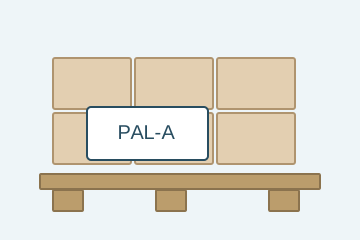
The pallet identity is authorised for this dispatch.
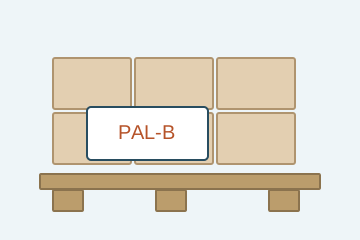
A readable identity belongs to another order.

The pallet event remains unresolved.
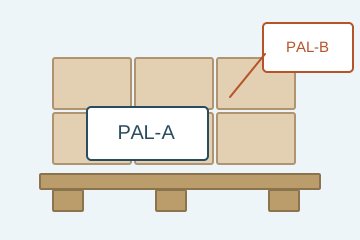
A neighbouring pallet must not satisfy this event.
Select an image to view it at full size.
Validate a pallet identity against the dispatch event
Explore Pallet identification system and Carton and pallet verification to connect this inspection task with the wider station requirements.
Swipe across the table to compare all columns →
| Decision | Evidence to use | Rule to agree |
|---|---|---|
| Pallet identified | Read the designated pallet identifier. | Distinguish carton and transport labels. |
| Order matched | Compare with the current dispatch expectation. | Treat unknown and mismatched IDs explicitly. |
| Release confirmed | Bind the response to the correct physical event. | Hold on timeout or stale data. |
Constrain the read zone and the expected identifier
Define the pallet-label format and physical reading region. Exclude neighbouring pallets and individual case labels using the qualified spatial and content rules. Associate the read with a dispatch event that includes the current order, station and pallet movement state.
A reader can handle the optical task while a warehouse interface manages validation and acknowledgements. Decide how duplicate scans, pending requests and operator corrections are recorded. A rescan after a timeout must query or retry the same business event according to the interface contract; it should not create an unexplained second dispatch.
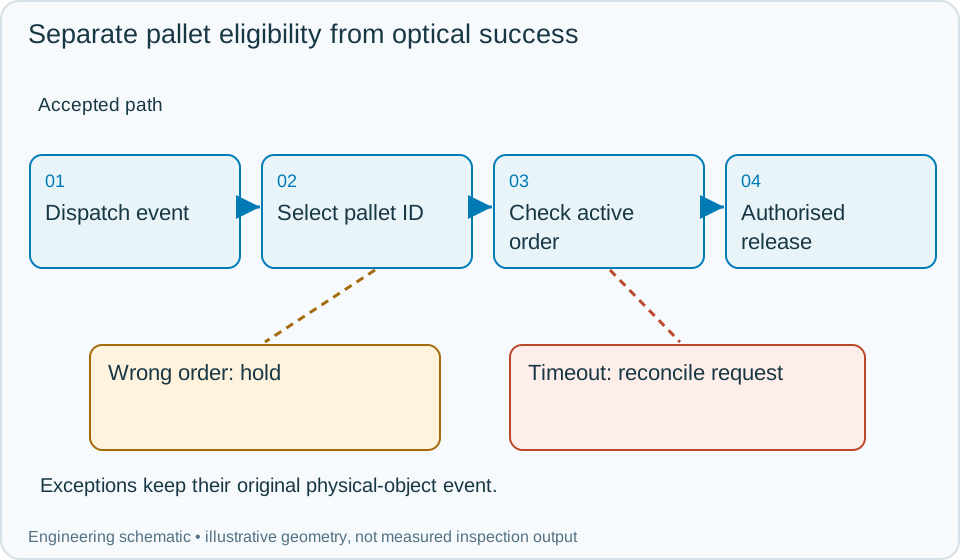
On a small screen, scroll across the diagram to inspect the labels.
Swipe across the table to compare all columns →
| Approach | Useful when | What to validate |
|---|---|---|
| Fixed single-face reader | Pallet labels arrive in a controlled position. | Challenge wrapping and forklift variation. |
| Multiple reading faces | Orientation varies within a defined gate. | Prevent adjacent-lane cross-reading. |
| Reader plus business-system validation | Dispatch authorisation depends on order data. | Define timeouts, retries and audit events. |
Worked example: a known pallet belongs to another order
In an illustrative loading event, the reader returns a valid pallet ID, but the order check rejects it. Hold the pallet and show the mismatch reason. Repeated scanning does not make the assignment correct; an authorised order or pallet correction is needed.
For a timeout, distinguish unknown response from confirmed rejection. Reconcile the pending request before sending a new independent release. If the pallet leaves and another enters, a delayed acknowledgement for the first must not release the second. Record any manual correction with the original order, pallet ID, reason and operator identity. Advance the physical pallet only after the required eligibility and release acknowledgement are established.
Swipe across the table to compare all columns →
| Observed evidence | Inspection decision | Action and retained record |
|---|---|---|
| A valid pallet ID belongs to another active order or is not eligible for dispatch. | Business rejection independent of decode success. | Hold the physical pallet, show the returned reason and record any authorised order correction without replacing the original rejected event. |
| The dispatch request times out and the operator scans the same pallet again. | Pending transaction needs reconciliation, not an unexplained second release. | Query or retry under the agreed event identifier, retain scan attempts and confirm the warehouse record before advancing the pallet. |
| A neighbouring pallet or individual case label is readable within the image. | Candidate is not automatically the current pallet ID. | Apply the qualified spatial and identifier rules, retain the selected region and hold if physical ownership remains ambiguous. |
When should a pallet be held at the dispatch gate?
- 01Create a pallet eventIdentify the carrier in the dispatch zone.
- 02Read the designated labelSelect the correct identity field.
- 03Validate the orderObtain a response for this exact event.
- 04Release or holdKeep decision and physical movement aligned.
Send the pallet identity and event to the order-validation system, then distinguish accepted, mismatched, unknown and timeout outcomes. A network failure should not inherit the last accepted response. After a re-read or operator correction, retain the history and ensure only the authorised physical pallet is released.
Challenge neighbouring labels and repeated business events
Test visible case codes, an adjacent pallet, a known but ineligible pallet, network loss and a repeated successful scan. Check both the warehouse record and the gate or conveyor action.
Retain the read image, selected identifier, dispatch-event ID, order response and movement confirmation. This separates an optical no-read from a business hold and provides a clear recovery path without treating every readable pallet as ready to ship.
Swipe across the table to compare all columns →
| Challenge | What the trial should establish |
|---|---|
| Correct pallet under reflective wrapping | Validate optical reliability. |
| Readable ID for another order | Verify mismatch handling. |
| Neighbouring pallet and duplicate labels | Check event association. |
| Timeout, re-read and operator recovery | Prevent stale approval and duplicate release. |
Why a valid barcode does not authorise dispatch
Matching a pallet ID to an order does not independently inspect every carton or prove the actual contents. If content verification is required, scope the carton-to-pallet aggregation and exception process. A fixed reader is one component of this workflow, not a replacement for warehouse business rules.
Use Barcode verification and grading to develop the related acceptance and integration questions for your trial.
Pallet labels and dispatch-order rules to provide
Use the logistics and distribution guide to relate pallet identity to order selection, loading controls and the receiving or dispatch system.
Provide pallet label formats and positions, wrapping variants, order-validation rules, examples of mixed or duplicate labels, lane movement and the WMS/ERP interface requirements.
Use the optical and recovery challenges above when applying the architecture choices in HIKROBOT and other vision solutions comparison.
Scope and budget
Compare label coverage, order matching and gate controls with the pallet identification system scope and cost factors.
Testing and handover
The testing and handover process should test a valid label against the wrong order, duplicate arrivals and a changed dispatch instruction.
The envelope verification project provides an example of identity matching and mismatch handling tested at FAT. Use that control lesson when defining dispatch interlocks for a pallet.