Application guide by addaScanCompare the inspection task, imaging conditions and validation steps with your own production line.
- Inspection task
- Instant-noodle fork presence inspection
- Decision focus
- instant-noodle fork presence inspection
- Station planning
- Decide which evidence exists before and after sealing
- Illustrative scenario
- a sachet edge looks like a fork handle
Packing-lane presentation for a fork-presence check
The application images show the physical product and imaging conditions. The engineering diagram below explains the inspection logic and recovery decisions.
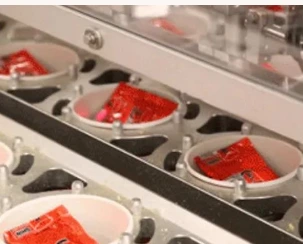
Selected line view from the fork-count application.
Select an image to view it at full size.
Inspect the fork while its distinguishing shape is visible
Swipe across the table to compare all columns →
| Condition | Approach to evaluate | Selection check |
|---|---|---|
| Fork is fully exposed | Evaluate shape and position checks. | Include the range of acceptable utensil poses. |
| Partial sachet occlusion | Evaluate visibility and alternative camera timing. | Do not accept a fully hidden utensil by assumption. |
| Several lanes | Track results per lane and product event. | Verify independent reject handling. |
Decide which evidence exists before and after sealing
Before sealing, the accessory may be exposed but can still move or be lost later. After sealing, transparent film may retain visibility, whereas printed film or food can hide it. Assign responsibility to the chosen station and address any later transfer risk through process control or an additional check.
Locate each lane and package region independently. A wide camera can cover several lanes only if the required fork detail remains visible in each one. Maintain per-lane event identifiers and trigger positions; a successful fork detection in one lane cannot satisfy a neighbouring package's requirement. When overlap hides the defining features, return uncertain rather than inferring presence from a partial edge.
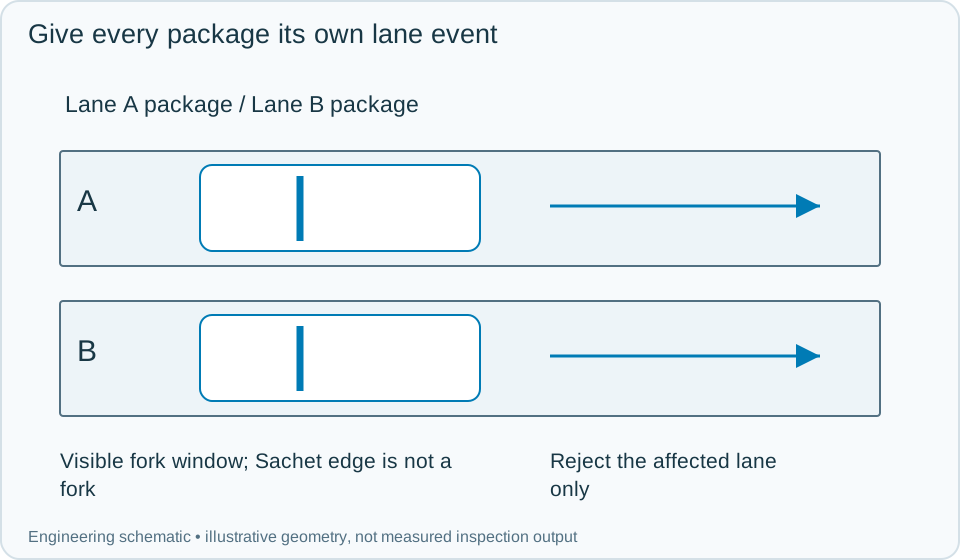
On a small screen, scroll across the diagram to inspect the labels.
Worked example: a sachet edge looks like a fork handle
In an illustrative lane, the expected handle-like feature appears but the required fork geometry is absent. Compare the candidate with the defined accessory features and package region. If the evidence belongs to a seasoning sachet, the package fails fork presence even though a general object detector found something elongated.
On the next trigger, two lanes advance at different times. Bind each image region to its own package event so a previous lane result cannot fill the other's empty slot. An observed extra fork should receive its own state where extra accessories matter; an occluded fork receives uncertain inspection. Hold or divert the affected package, then confirm the physical action in the correct lane. If reinspection follows repacking, record it as another attempt for that package.
Swipe across the table to compare all columns →
| Observed evidence | Inspection decision | Action and retained record |
|---|---|---|
| A seasoning-sachet edge supplies a handle-like line but lacks the required fork features. | Fork presence is not established. | Keep the candidate region, apply the missing or uncertain accessory rule and confirm handling of the affected package in its own lane. |
| Lane A advances while lane B pauses, with valid accessory detections in both image regions. | Results must remain tied to independent package events. | Record lane triggers and package identifiers, avoid carrying a prior result forward and verify the physical lane-specific reject output. |
| Printed film hides the fork after sealing although a pre-seal check passed. | Post-seal evidence is unavailable; later handling responsibility matters. | Retain the pre-seal event and specify how later loss is controlled or checked. Do not claim the hidden final accessory was visually observed. |
Validate lookalikes and cross-lane timing
Include seasoning packets, film wrinkles, partially covered forks, overlapping accessories and an empty package. Test one lane stopping while another continues, and verify reject outputs against the physical packages.
A smart camera may cover stable presence rules and lane geometry. A trained feature detector can help with appearance variation, but only if validation includes the lookalikes that caused false acceptance. Preserve the observed region, lane, package event and reason for hold so operators can separate visibility failures from actual missing accessories.
Swipe across the table to compare all columns →
| Challenge | What to verify |
|---|---|
| Missing fork | Confirm the expected pack is rejected. |
| Two overlapping forks | Test whether an extra utensil is detected. |
| Seasoning packet over the fork | Define visibility requirements and uncertain results. |
| Adjacent lanes with different states | Check result and reject association. |
Pack formats and fork positions for a trial
Use the meat, staples and dry goods guide to choose an inspection point before the fork is hidden by other pack contents or final closure.
Provide the full packing sequence, utensils, sachets, lane layout and reject timing.
Use the plc reject integration guide to develop the next step.
Define the wider inspection responsibility in presence counting.
Develop the related acceptance requirements with assembly verification.
Use the optical and recovery challenges above when applying the architecture choices in vision-system comparison guide.
Scope and budget
Compare utensil presentation, pack timing and reject tracking with the assembly verification scope and cost factors.
Testing and handover
Use the testing and handover process to test a fork obscured by a sachet and confirm that the result remains linked to the correct pack.