Application guide by addaScanCompare the inspection task, imaging conditions and validation steps with your own production line.
- Task
- Roll-label print and registration inspection
- Decision focus
- Print inspection systems
- Workflow
- Separate fixed and variable regions.
- Validation
- Good substrate and varnish variation
Missing artwork, colour offset and print registration
Original explanatory diagrams show the product states and inspection questions. They are schematics, not captured inspection results.
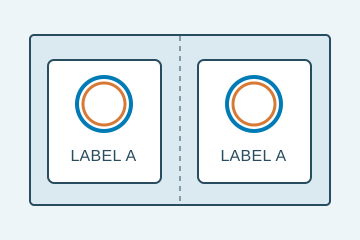
Artwork and layer positions match the reference.
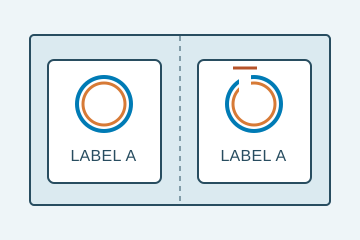
A required part of the artwork is absent.
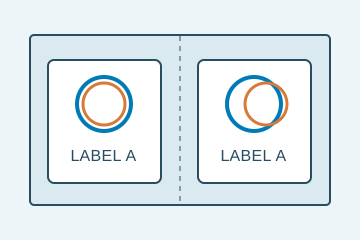
Colour layers shift relative to the same datum.
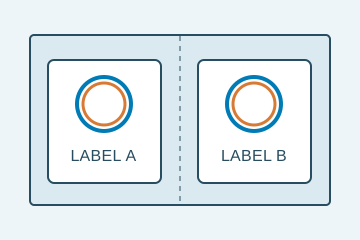
A complete repeat belongs to another product version.
Select an image to view it at full size.
Inspect one print repeat with a shared registration reference
Explore Label and print inspection and Web and line-scan inspection to connect this inspection task with the wider station requirements.
Swipe across the table to compare all columns →
| Decision | Evidence to use | Rule to agree |
|---|---|---|
| Artwork present | Compare required fixed regions with the approved master. | Mask only intentionally variable content. |
| Registration correct | Measure relative positions using a common reference. | Do not realign each colour independently. |
| Repeat identity | Check the expected version and material position. | Retain a traceable location for rework. |
Separate repeat phase, artwork version and variable fields
Establish the repeat position using a stable feature, registration mark or validated motion reference. Compare colour-layer positions within that shared coordinate system. Evaluate missing ink against the intended artwork and verify variable fields against the active production recipe.
A fixed artwork template can detect a wrong version or missing feature, while OCR or code tools handle changing fields. Neither replaces colour-to-colour registration measurement. For a moving web, preserve longitudinal position and repeat identity so a defect can be found after rewinding or cutting. A splice or break requires explicit coordinate recovery rather than continuing an old phase assumption.
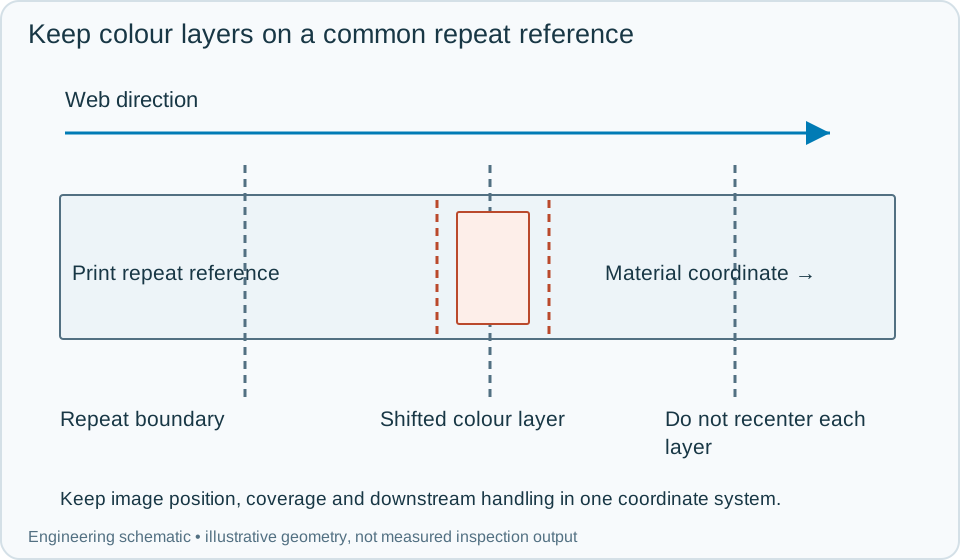
On a small screen, scroll across the diagram to inspect the labels.
Swipe across the table to compare all columns →
| Approach | Useful when | What to validate |
|---|---|---|
| Triggered area view | One repeat fits the required field and motion conditions. | Challenge changes in repeat length. |
| Encoder-synchronised line scan | Continuous width and length need inspection. | Validate image geometry during speed changes. |
| Separate variable-data check | Codes or text change between repeats. | Use job data rather than a fixed artwork image. |
Worked example: the artwork is complete but one colour is shifted
In an illustrative repeat, all required graphic elements are present and the variable code is correct. One colour layer is displaced relative to the common reference, so the registration decision fails. Do not independently recenter that layer and report a good template match as acceptable registration.
A later repeat uses an old artwork version with correct variable data. It fails version identity separately. Record each failed repeat's position, image and reason for downstream marking or review. After a splice, confirm repeat phase and roll-coordinate continuity before accepting subsequent positions. If the reference is lost, mark the interval as uninspected or unlocated and reconcile it during the agreed recovery process.
Swipe across the table to compare all columns →
| Observed evidence | Inspection decision | Action and retained record |
|---|---|---|
| All colour layers match their shapes but one is offset in the shared repeat coordinate. | Registration fails despite complete artwork. | Keep the common reference and layer displacement, identify the affected repeat and confirm downstream marking or containment. |
| The variable field is correct but the fixed artwork belongs to an old version. | Artwork identity failure independent of variable data. | Store observed and expected versions with the repeat position. Clear old stock or job data and verify first-off repeats. |
| A splice interrupts the established repeat phase or length reference. | Defect location cannot be assumed continuous. | Mark the uncertain interval, recover the roll and phase reference and verify that earlier defects remain findable after rewinding or cutting. |
How should a registration fault be tracked along the web?
- 01Load the artwork revisionSeparate fixed and variable regions.
- 02Synchronise to the webCapture complete repeats with stable geometry.
- 03Inspect independent conditionsEvaluate print, registration and identity.
- 04Mark the material positionPreserve the fault location for converting.
Record defect position against the repeat and material-length reference. The converting or rewinding stage must be able to find the flagged section even after a stop or splice. If a whole repeat is missing, compare the motion and trigger history rather than depending on a print region that never appeared.
Validate both appearance and material-location recovery
Challenge shifted layers, missing ink, approved print variation, old versions and variable-field mismatches. Test rewinding, splicing and an interrupted encoder reference; verify that the physical defective repeat can still be identified.
Keep the common registration transform, roll identity, repeat location and final disposition. Comparing HIKROBOT and other systems should include these location and recipe requirements, not only a demonstration that both detect an obvious print defect.
Swipe across the table to compare all columns →
| Challenge | What the trial should establish |
|---|---|
| Good substrate and varnish variation | Establish false-reject behaviour. |
| Small missing features and registration shifts | Check the required detail and common datum. |
| Previous artwork revision | Verify recipe/version control. |
| Splice, restart and rewind | Locate the correct flagged material. |
Which print properties need separate measurement
Artwork comparison does not automatically verify every variable date or serial. Scope those data checks separately. Colour appearance in a camera image also differs from an agreed colour measurement; illumination, calibration and the acceptance method must match the intended claim.
Use Web and line-scan inspection to develop the related acceptance and integration questions for your trial.
Label rolls and registration limits for a trial
The plastics and packaging guide connects roll-label inspection with printing, converting and material tracking.
Provide approved artwork and revisions, accepted print variation, registration faults, missing ink, variable-data regions, web speed behaviour and the defect marking or rewind process.
Use the optical and recovery challenges above when applying the architecture choices in HIKROBOT and other vision solutions comparison.
Scope and budget
Use the food packaging artwork verification scope and cost factors to scope print comparison and recipe management alongside the web-position interface.
Testing and handover
The testing and handover process should test registration drift and verify that the recorded defect follows the correct roll position.