Application guide by addaScanCompare the inspection task, imaging conditions and validation steps with your own production line.
- Inspection task
- Bottle orientation before labelling
- Decision focus
- bottle orientation before labelling
- Station planning
- Keep the angle reference and the handling sequence explicit
- Illustrative scenario
- a correct angle produces a misplaced label
Camera access to the bottle’s printed reference
The application images show the physical product and imaging conditions. The engineering diagram below explains the inspection logic and recovery decisions.
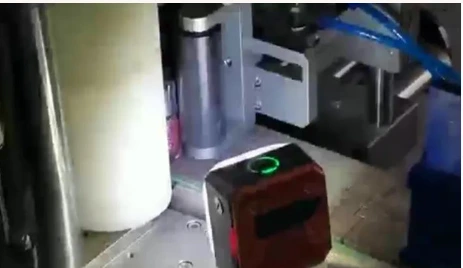
The installation detail shows the camera and rotating bottle presentation.
Select an image to view it at full size.
Orient the bottle, then verify where the label lands
Swipe across the table to compare all columns →
| Condition | Approach to evaluate | Selection check |
|---|---|---|
| Distinct printed face | Evaluate pattern or feature localisation. | Challenge similar graphics and permitted print variation. |
| Glossy curved bottle | Evaluate controlled lighting and rotational sampling. | Check that a highlight cannot imitate the reference. |
| Final label acceptance | Add an appropriate downstream view. | Verify position and product identity after physical application. |
Keep the angle reference and the handling sequence explicit
Choose a repeatable seam, embossed feature or asymmetric geometry that is visible before labelling. Define the angular zero and rotation direction used by the vision system and the actuator. A symmetric bottle outline cannot establish a unique orientation on its own. If the reference is hidden or ambiguous, return no location instead of supplying a default angle.
The rotation command should complete before the bottle leaves the controlled holder. Check whether the conveyor, gripper or labeller can slip the bottle afterwards. Where that movement is possible, a second orientation observation or a post-label check is more useful than tightening the first camera's matching score. The post-label reference must still be the bottle feature, not simply the label itself.
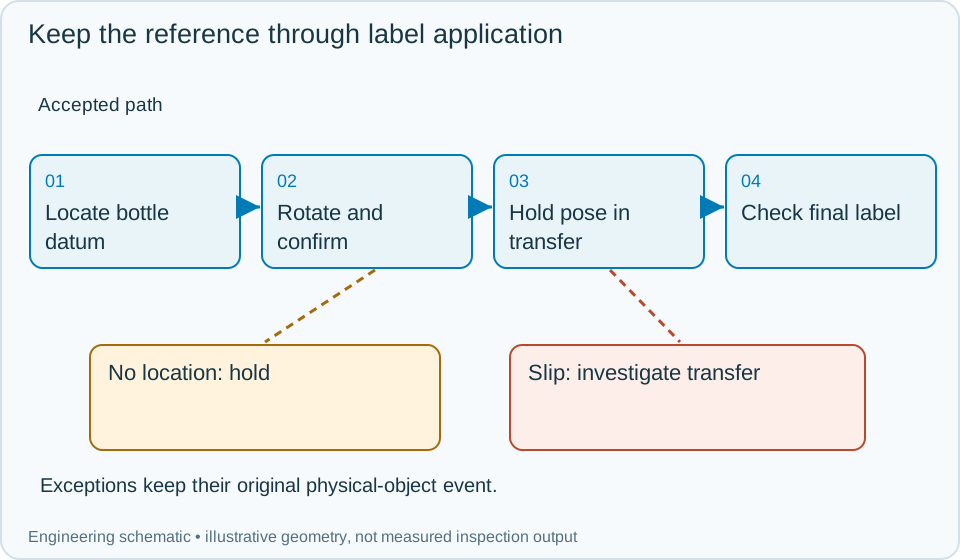
On a small screen, scroll across the diagram to inspect the labels.
Worked example: a correct angle produces a misplaced label
In an illustrative cycle, the camera locates the reference, outputs the required rotation and receives a motion-complete signal. A downstream image shows the reference has moved before label application. The fault lies in pose retention or transfer, even though the original angle was correct. Hold the affected bottle and examine the handling interval rather than retraining the locator.
Compare this with two other states. If no reliable reference is found, the bottle should enter the agreed no-location route before rotation. If an incorrect feature is selected, the actuator may execute perfectly but orient the wrong datum; retain the matched region to diagnose that error. Once handling is corrected, inspect the final label relative to the bottle reference and record the achieved placement. Confirm rejection of a mislabelled bottle instead of counting a successful rotation as finished inspection.
Swipe across the table to compare all columns →
| Observed evidence | Inspection decision | Action and retained record |
|---|---|---|
| The reference locator has two plausible matches on different bottle faces. | Orientation unresolved; an angle value alone is insufficient. | Keep the candidate regions and hold before rotation. Improve the distinguishing feature or presentation, then repeat the identified bottle's location check. |
| The correct rotation completes but the bottle reference moves during transfer. | Pose retention failure after a valid visual command. | Record commanded angle, motion completion and downstream pose. Correct handling and validate final label placement before restoring automatic acceptance. |
| The reference remains stable but the label is offset relative to it. | Label application position failure. | Keep the bottle-reference and label regions together, reject or rework the bottle and verify placement on the controlled reinspection attempt. |
Validate the complete orientation-to-label chain
Challenge mould variations, wet bottles, partly hidden references and deliberate transfer slip. Record located angle, commanded movement, motion completion, downstream pose and final label result under one bottle event. These observations separate perception, actuation and application errors.
A smart camera may be sufficient for one stable visible reference; additional views or a controlled rotating presentation are justified when the feature is otherwise hidden. Select the arrangement from coverage and repeatability of the final label position, not only the speed of the initial angle output.
Swipe across the table to compare all columns →
| Challenge | What to verify |
|---|---|
| Different initial angles | Find the reference without assuming a fixed arrival pose. |
| Faint or partly hidden print | Define a no-reference result instead of using the last angle. |
| Bottle slip after capture | Measure the final label position, not only the detected pose. |
| Product changeover | Confirm that the active reference matches the bottle variant. |
Bottle faces and orientation data to provide
The bottling and canning guide helps distinguish bottle orientation before labelling from the finished-label checks after application.
Provide the bottle variants, reference artwork, label position drawing, rotation mechanism and the distance between localisation and label application.
Use the label verification sop guide to develop the next step.
Define the wider inspection responsibility in label print inspection.
Translate these view and interface requirements into equipment choices with smart camera selection.
Use the optical and recovery challenges above when applying the architecture choices in vision-system comparison guide.
Scope and budget
Use the vision system cost guide to separate image localisation costs from the bottle rotation and applicator interface.
Testing and handover
The testing and handover process should verify that the measured face position reaches the applicator with the correct bottle identity.