Application guide by addaScanCompare the inspection task, imaging conditions and validation steps with your own production line.
- Inspection focus
- Fruit-carton fields checked against the packing job
- Primary theme
- Batch code verification
- Decision evidence
- Readable old lot
- Trial priority
- Readable previous-job marks
Use the active packing record as the marking reference
The original English schematic explains the observable features and the proposed decision. The tables below set out the conditions to test on your own line.
Swipe across the diagram to see all details →
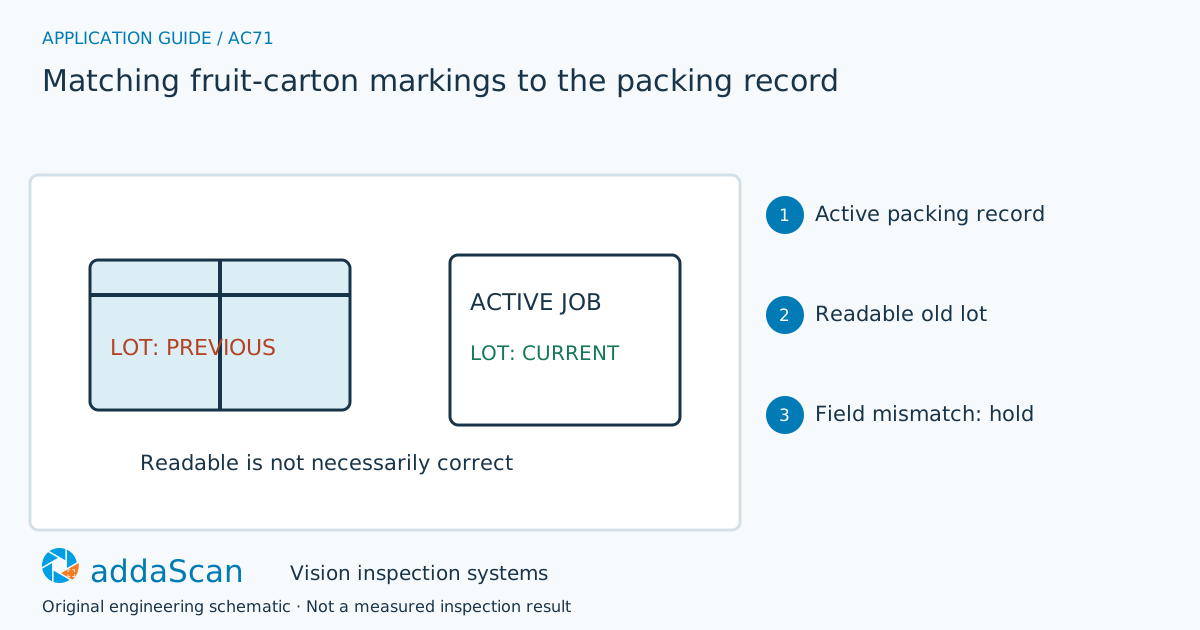
A carton marking is checked against the active packing record. Clear text from the preceding job remains a mismatch, while unreadable fields remain unresolved. Original verification schematic.
Select an image to view it at full size.
Check field meaning after successful recognition
Locate each field relative to stable carton features and allow only the permitted format variations. Corrugated surfaces, ink spread and board colour can change contrast. Recognition confidence is evidence about reading, not agreement with the packing job. Use controlled master data for each field and explicitly handle unavailable or conflicting job records. Requirements can vary by commodity and market; the camera recipe must follow the approved marking specification.
Agree which system or approved document supplies each required field. Product, lot, packhouse and destination information may come from different parts of the packing workflow; the camera should compare against a defined active record rather than infer correctness from a plausible printed format. Version that record at a job change and make the change visible to the inspection controller.
Inspect the permitted carton faces under realistic board colour, surface texture and print variation. Locate the marking region before recognising characters. When a field is obscured or only partly readable, preserve the missing segment instead of returning a likely value from a dictionary of common destinations.
Separate field readability from job-record agreement
Swipe across the table to compare all columns →
| Approach | Useful when | Limit or integration responsibility |
|---|---|---|
| OCR/OCV | Human-readable printed fields | Needs font, layout and expected-value rules. |
| Barcode plus readable fields | Encoded identity with visible marking checks | Confirm the two representations agree and use the right job version. |
OCR is useful for human-readable fields; barcode decoding can supply structured data where the packaging format includes it. Neither method establishes the active job without a trusted comparison record. Compare coverage and field handling on the same cartons, including the required response when the upstream packing data are unavailable.
A clear previous-job mark must still fail
Illustrative scenario: every character reads clearly, but a lot field belongs to the previous packing run. Isolate the carton and retain a field-level difference record.
Reconcile remaining printed cartons and update the active job only through the agreed changeover procedure. Verify first-off marks against the corrected record. Release after the required fields match; neither a high OCR score nor operator selection of a familiar template establishes compliance.
At changeover, account for cartons between the printer and inspection point. A valid old-job carton must be diverted or handled under an explicitly identified transition, not automatically accepted because the new recipe loaded. Recheck corrected markings against the intended job record.
Challenge board variation and cartons left at changeover
Swipe across the table to compare all columns →
| Challenge sample or event | Expected behaviour to establish | Evidence to retain |
|---|---|---|
| Readable previous-job marks | Hold on business mismatch, not image confidence. | Active job/version, expected export-packing fields, readable old-job values and the carton’s hold or segregation record. |
| Weak ink and board variation | Record no-read separately from confirmed wrong content. | Board/ink sample, located field images, character-level uncertainty and the qualified reread or manual comparison. |
| Job change with old cartons present | Demonstrate segregation and first-off verification. | Old cartons in transit, printer/inspection recipe sequence, new job acknowledgement and first-off verification. |
Test correct text from the wrong job alongside genuinely weak print. Review field mismatches separately from recognition failures. Applicable export marking requirements should be checked through the agreed quality process; a readable mark is not evidence of regulatory certification.
OCR does not certify export compliance
Image inspection supports an approved export-marking process; it is not PPECB certification or a substitute for current commodity requirements.
Prepare carton formats and authoritative packing fields
Share permitted photos or drawings, plus details of actual carton marks, packing-record fields, changeover rules and the destination-specific approved specification. Agree any physical sample arrangements after the initial assessment.
Fruit carton marking inspection for export defines the marking station and job-data comparison. Agree which fields are authoritative before choosing recognition tools or describing compliance coverage.
Checking missing, blurred and misplaced date codes on medicine cartons explains missing and misplaced date-code checks. Fruit cartons additionally require the readable fields to match the correct packing job.
Review the indicative station budget and exclusions. Match the quoted views, product range and reject arrangement to the trial; changes to the production machinery and other exclusions remain separately agreed.
For line conditions around fruit-carton fields checked against the packing job, see agro-processing inspection.
Compare lighting, processing, interfaces and support in the HIKROBOT and other vision solutions guide. Agree sample testing, acceptance responsibilities and handover through the delivery process.