Application guide by addaScanCompare the inspection task, imaging conditions and validation steps with your own production line.
- Inspection focus
- Complete moulded tyre specification fields
- Primary theme
- OCR inspection
- Decision evidence
- Raised specification text
- Trial priority
- Correct date with wrong specification
Locate the complete specification around the sidewall
Reference imagery and an original English schematic explain the observable features and the proposed decision. The tables below set out the conditions to test on your own line.
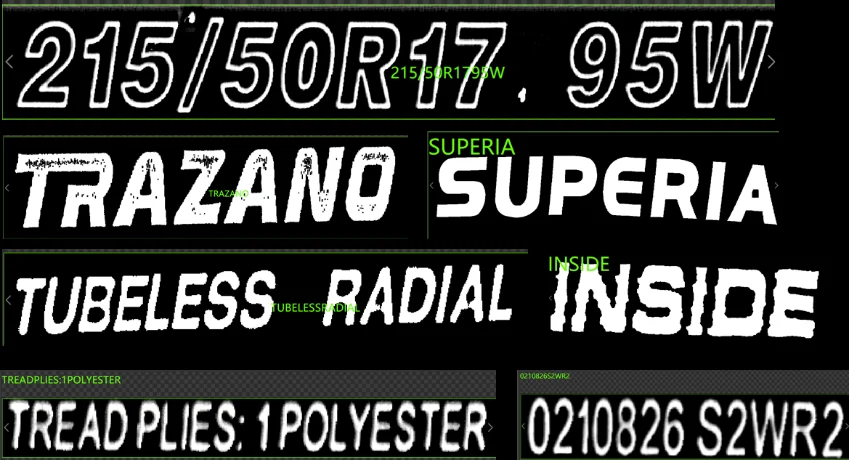
The view contains moulded specification fields. Date recognition alone does not verify the complete tyre specification.
Swipe across the diagram to see all details →
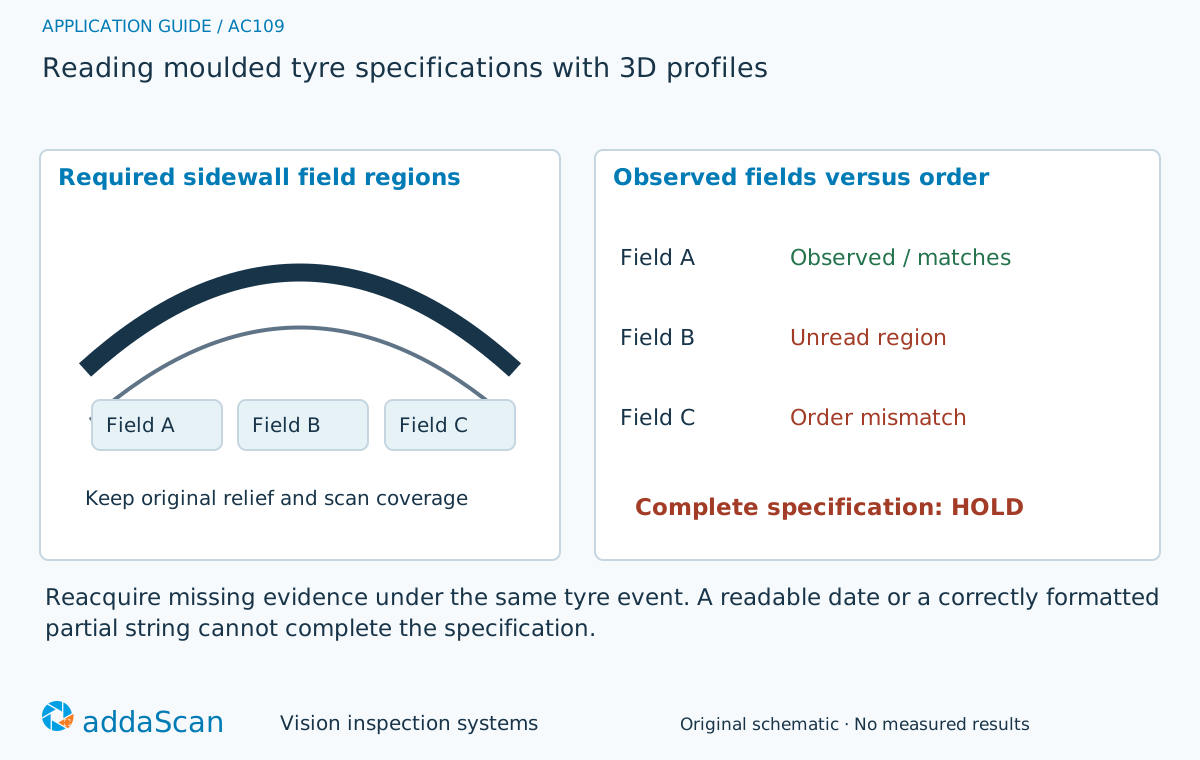
The moulded specification must be read as the required field set and compared with the order. A readable date or a partial specification does not confirm the tyre variant. Original schematic; the reference view illustrates lettering, not this station’s measured performance.
Select an image to view it at full size.
Unwrap the curved marking without losing character relief
Profile acquisition needs controlled relative motion and sufficient coverage of the moulded text. Remove the broad sidewall curvature while preserving raised or recessed characters. Similar characters, mould wear and lettering near other ribs require challenge samples. Keep the original height data with the recognised fields so a wrong read can be investigated rather than hidden behind a final string.
Agree the required field set with the order or production record. A recognisable brand, size prefix or manufacturing date is not a substitute for the full specification required for that transaction. Locate each field from the correct sidewall region and retain the distinction between a character that was read, one that conflicts with the expected value and one that was not observed.
For profile-based reading, separate broad tyre curvature from the local raised or recessed lettering. The transformation should preserve character strokes and gaps instead of smoothing them into the surrounding ribs. Keep the raw profile and the character regions so that an apparent recognition improvement can be checked against the physical relief. A correctly formatted string is not sufficient evidence that those characters were measured.
Define the scan coverage and motion reference. Overlapping scan sections need to be aligned to the same tyre, with gaps in the required field regions explicitly marked. When a tyre rotates or is repositioned for a second attempt, establish which field was reacquired. Appending characters from an untracked second tyre would create a convincing but invalid identity record.
Compare intensity images with usable height relief
Swipe across the table to compare all columns →
| Approach | Useful when | Limit or integration responsibility |
|---|---|---|
| 2D illuminated OCR | Good contrast under controlled tyre presentation | Curvature and black-on-black marks can limit visibility. |
| Height-map character reading | Moulded relief provides a stronger signal | Needs curvature handling, complete scans and character-level validation. |
Use illuminated 2D OCR if the required characters retain adequate contrast across the allowed tyre presentation. Consider height-map reading when the relief provides more usable evidence, after testing curvature, mould wear and adjacent ribs. The trial should compare both methods on the same required fields and difficult samples. A 3D sensor does not remove the need for character validation or order matching.
A correct date can accompany the wrong tyre variant
Illustrative scenario: the date field reads correctly, but the specification string differs from the active order. Hold the tyre and retain the field-level comparison.
Rescan unread areas without replacing confirmed fields with guessed characters. Reconcile the complete required field set under the same tyre event. Release only after the specification and order agree, with unknown or invalid profile regions resolved.
A confirmed mismatch remains a mismatch until the tyre or order discrepancy is resolved. Reacquisition is appropriate for missing or invalid field evidence; it must not search repeatedly until a desired string appears. Retain the original read, corrected interpretation where justified, active order version and the authorisation for release or diversion.
Challenge missing characters and interrupted scans
Swipe across the table to compare all columns →
| Challenge sample or event | Expected behaviour to establish | Evidence to retain |
|---|---|---|
| Correct date with wrong specification | Fail order matching independently of date readability. | Complete expected field set, recognised specification, readable date, order version and the exact mismatching segment. |
| Worn mould marks and similar characters | Retain height evidence and avoid guessed substitutions. | Raw profile/intensity image, character regions, mould-wear or rib interference, unresolved characters and independent transcription. |
| Partial scan or tyre movement | Reacquire the missing region under the same event. | Tyre event, scan-section coverage, alignment of a repeated section, invalid regions and complete final field comparison. |
Include tyres sharing a prefix but differing in a required suffix, worn characters, similar character shapes and scans interrupted across a field boundary. Review character substitution separately from no-read and order mismatch. A partial identification may support an operator investigation, but must not be presented as a complete automatic release decision. Specify the handling and traceability of tyres entering a manual exception route.
Identification does not establish tyre condition
Identification does not establish tyre condition, structural quality or regulatory conformity.
Define sidewall coverage and order fields
Share permitted photos or drawings, plus details of moulded specification variants, order fields, worn sample examples, tyre sizes and scan presentation. Agree any physical sample arrangements after the initial assessment.
OCR and code inspection defines expected fields and no-read or mismatch handling. The related tyre barcode solution reads labels and explicitly excludes a 3D moulded-text station from its published budget.
Reading tyre barcodes when position and orientation vary addresses tyre-label barcodes under changing presentation. That identification route is distinct from reading moulded relief; a successful label decode cannot replace missing specification characters.
Use the cost and scope guide to understand the station boundary. The tyre barcode solution explicitly excludes a 3D moulded-text station from its figures; profile-based specification reading must be scoped separately.
Compare lighting, processing, interfaces and support in the HIKROBOT and other vision solutions guide. Agree sample testing, acceptance responsibilities and handover through the delivery process.