Application guide by addaScanCompare the inspection task, imaging conditions and validation steps with your own production line.
- Inspection task
- Tyre barcode reading with variable pose
- Decision focus
- tyre barcode reading with variable pose
- Station planning
- Lay out views around position and focus constraints
- Illustrative scenario
- two cameras read the same tyre
Variable tyre-code positions need defined view coverage
The application images show the physical product and imaging conditions. The engineering diagram below explains the inspection logic and recovery decisions.
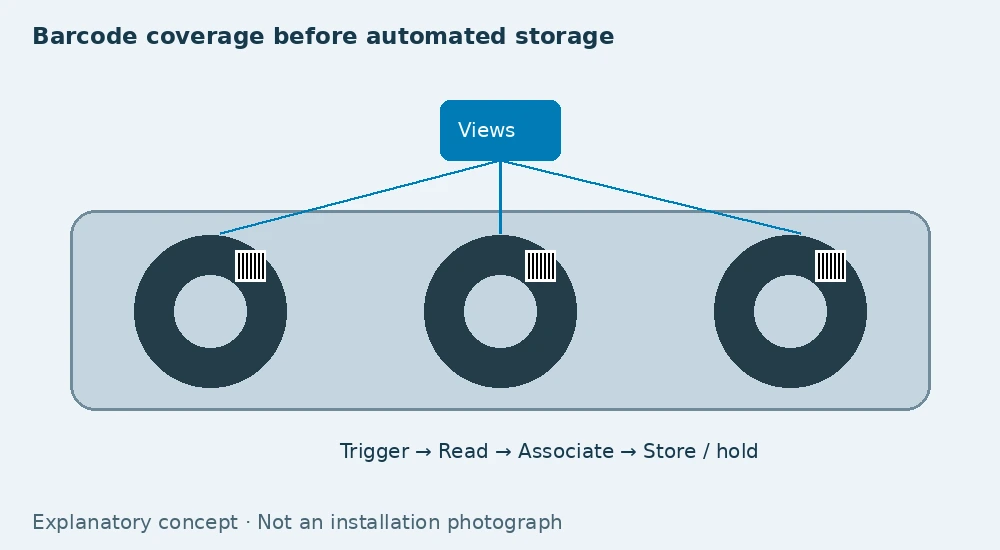
Original explanatory diagram for assessing variable tyre-barcode positions. The geometry is explanatory, not an installation drawing.
Select an image to view it at full size.
Cover the tyre's barcode envelope without losing narrow bars
Swipe across the table to compare all columns →
| Condition | Approach to evaluate | Selection check |
|---|---|---|
| Restricted, repeatable label pose | Compare a fixed reader with controlled presentation. | Validate the smallest barcode at every permitted depth. |
| Broad position or orientation variation | Evaluate panoramic or multiple-view coverage. | Demonstrate coverage without gaps between views. |
| HIKROBOT versus a packaged alternative | Compare complete optical coverage and event handling on identical samples. | A product-family name or advertised read rate is not a matched test. |
Lay out views around position and focus constraints
Map the label envelope for each tyre family. Evaluate the field of view, working distance, depth of field and bar sampling at its extremes. Curved placement can shorten the apparent bar width or hide part of the label. Multiple cameras may improve coverage, but their overlap needs a rule for merging repeated observations of the same tyre.
If handling can standardise label orientation, that mechanical change may simplify the optical station. Where orientation remains variable, compare fixed views, controlled rotation or another supported reading arrangement. Evaluate the same difficult tyres on HIKROBOT and alternative readers; a nominal long reading distance says little about detail on the farthest curved label.
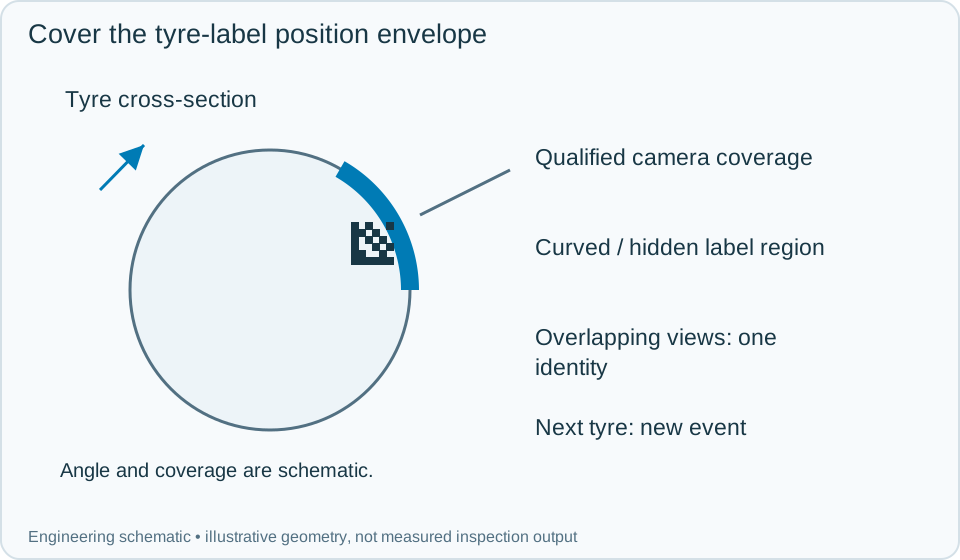
On a small screen, scroll across the diagram to inspect the labels.
Worked example: two cameras read the same tyre
In an illustrative conveyor event, both overlapping cameras decode one tyre label. Associate their observations with the same tracked tyre and deduplicate the matching identity. Do not increment production quantity twice or submit two independent tyre records.
A following tyre produces no read because the label is turned outside the validated views. Route it to an identified recovery position and retain the no-coverage reason. If an operator turns it for rereading, keep that retry linked to the held tyre rather than the next conveyor event. If different cameras return conflicting identities for one event, hold it and inspect whether two tyres overlapped in the reading zone. Release only after the identity and downstream handling response satisfy the agreed rule.
Swipe across the table to compare all columns →
| Observed evidence | Inspection decision | Action and retained record |
|---|---|---|
| Two overlapping cameras return the same accepted code for one tracked tyre. | Repeated observations, one tyre event. | Deduplicate identity, keep both view references and submit a single required production binding before confirming storage or conveyor handling. |
| The label turns outside all qualified camera views. | Unobserved barcode, not an accepted tyre identity. | Route the identified tyre to recovery and preserve its event during reorientation; do not attach a delayed read to the following tyre. |
| Different views return different codes while two tyres overlap in the reading zone. | Object association or identity conflict. | Hold the affected flow, retain full images and tyre tracking, restore physical separation and resolve the individual identities before routing. |
Test mixed sizes and closely spaced arrivals
Challenge near and far label positions, size transitions, damaged labels and small gaps between tyres. Check the image evidence and object association together. The largest tyre can obscure a following smaller one even when both are individually readable.
Store the tyre event, view identifier, code position, read attempts and recovery outcome. If physical separation is insufficient to distinguish simultaneous tyres, improve spacing rather than assigning codes by arrival time alone. Barcode identity does not establish tyre manufacturing date unless the relevant data is actually encoded or separately read.
Swipe across the table to compare all columns →
| Challenge | What to verify |
|---|---|
| Smallest and largest tyres | Test the extremes of the code-position envelope. |
| Rotated or tilted label | Check resolution, focus and complete barcode visibility. |
| Adjacent tyres and repeated reads | Keep one verified identity per tyre event. |
| No-read before storage entry | Confirm a defined hold, reroute or recovery procedure. |
Tyre positions and barcode labels for a trial
The logistics and distribution guide connects tyre identification with receipt, storage and movement between handling points.
Provide tyre sizes, barcode samples, all permitted label locations, conveyor spacing, storage-entry signals and no-read handling rules.
Use the read tyre manufacturing date dot code guide to develop the next step.
Develop the related acceptance requirements with tyre barcode reading.
Translate these view and interface requirements into equipment choices with code reader selection.
Use the optical and recovery challenges above when applying the architecture choices in vision-system comparison guide.
Scope and budget
Review permitted tyre positions, reader coverage and no-read routing in the tyre barcode reading scope and cost factors.
Testing and handover
Use the testing and handover process to challenge every allowed label location and verify the storage-entry identity handover.
If the task also includes a moulded production date, use the tyre manufacturing date guide to define it separately from barcode identification.