Application guide by addaScanCompare the inspection task, imaging conditions and validation steps with your own production line.
- Inspection focus
- Clip engagement with the gathered bag neck
- Primary theme
- Seal inspection
- Decision evidence
- Clip captures film
- Trial priority
- Clip beside the neck
Where the clip must sit on the gathered neck
The original English schematic explains the observable features and the proposed decision. The tables below set out the conditions to test on your own line.
Swipe across the diagram to see all details →
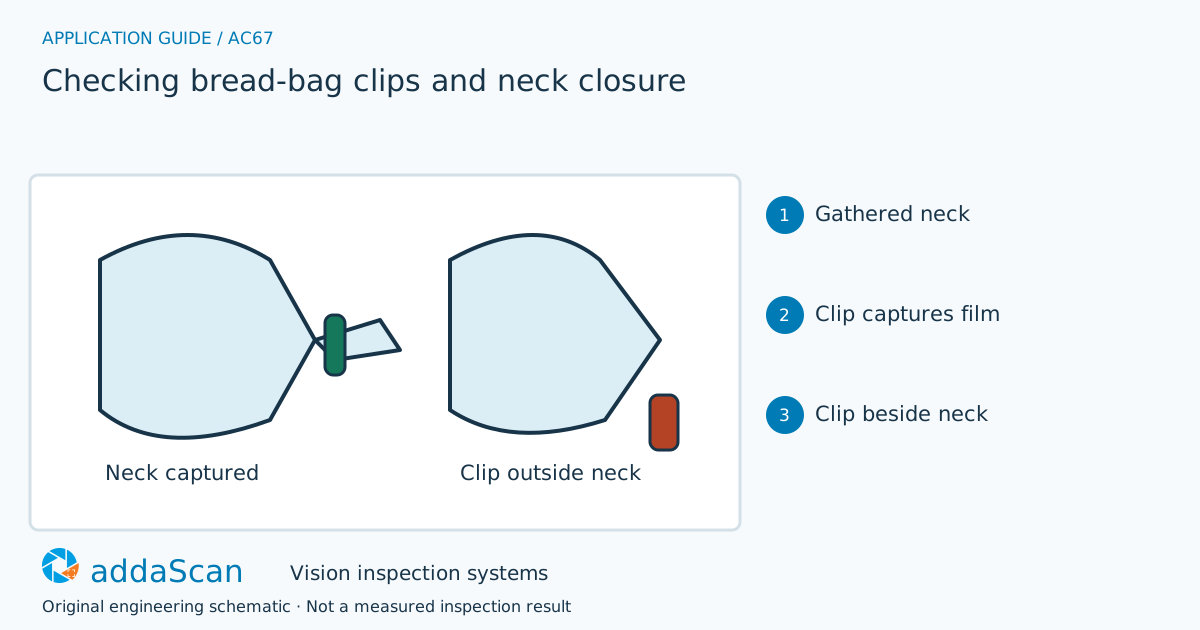
The clip must capture the gathered film. Finding a clip beside the bag confirms component presence but leaves closure engagement failed. Original schematic; retention force and airtightness are not measured.
Select an image to view it at full size.
Locate the neck before judging the clip
The crumpled film changes shape between packs, so a fixed rectangle around the conveyor is a weak reference. Locate the gathered neck and compare the clip opening with that region. Reflections from clear film can conceal folds; test diffuse light and contrasting backgrounds with the actual bag print. The acceptable relationship must come from closure samples, including loose, partial and off-neck clips.
Define the acceptance feature with the packaging team before choosing a classifier. The visible clip opening and gathered film must have the approved spatial relationship; clip colour or a recognisable silhouette alone answers a different question. Include loose film tails and the permitted neck shape so that normal folds do not become an accidental defect rule.
Arrange the inspection after the closing tool releases the bag. Tooling, a guide or the loaf itself may hide the engagement region even when the clip is easy to see. Use a view or controlled presentation that exposes that region without pulling the bag into a shape it does not have in normal production. If the relation is not observable, return unresolved and contain the loaf through the agreed recheck route.
Clip presence or neck engagement: which view is needed?
Swipe across the table to compare all columns →
| Approach | Useful when | Limit or integration responsibility |
|---|---|---|
| Clip-presence check | Missing closure components | Cannot establish that film is captured. |
| Neck-relative inspection | Clip position and engagement | Needs stable presentation and an unobstructed engagement view. |
Use a presence check where the requirement really is missing-clip detection. For engagement, compare neck-relative imaging with a mechanical presentation change that makes the captured film visible. Test both on partially captured and off-neck clips. A more complex model cannot recover a relationship hidden behind the closing mechanism or printed film.
A clip beside the bag must not release the pack
Illustrative scenario: the clip is visible but its opening sits outside the gathered film. Hold the loaf as an engagement failure.
Reclose it, then take another image after the mechanism clears the view. Preserve the first result and the rework result against the same pack. Release requires visible neck capture under the approved rule; an operator confirming that a clip exists does not resolve the original fault.
Associate the reclosed loaf with its original failure before reinspection. If that association cannot be maintained, use a controlled rework entry with a fresh complete inspection. Require the mechanism-clear condition again; an image taken while the operator is still holding the neck is not equivalent to the production view.
Include folds and hidden engagement in the trial
Swipe across the table to compare all columns →
| Challenge sample or event | Expected behaviour to establish | Evidence to retain |
|---|---|---|
| Clip beside the neck | Reject despite correct clip colour. | Pack identity, common view of clip and neck, off-neck decision, and confirmation that the loaf entered the hold route. |
| Loose film and partial capture | Save the engagement image and agreed classification. | Approved fold examples, engagement-region visibility, light/background setting and the disposition of partially captured film. |
| Mechanism still in view | Wait for a valid capture or route the pack to reinspection. | Original and reclosed pack records, mechanism-clear trigger, new engagement image and authorised rework release. |
The trial set should separate absent clips, wrong visible clip identity, partial neck capture and hidden engagement. Include changes in print and film reflectivity that occur in the approved bag range. Keep functional retention testing separate so that a visually accepted relationship is not reported as a measured closing force.
A closure image cannot prove leak-tightness
Visible engagement does not prove airtightness or retention force. Those requirements need separate tests.
Plan the check after the closing mechanism clears
Share permitted photos or drawings, plus details of closure styles, printed bags, known loose closures, closing-cycle timing and available views. Agree any physical sample arrangements after the initial assessment.
Bread bag closure and date code inspection covers the station around this bag-neck check, including the view and removal of failed packs. The closure machine and its adjustment responsibilities must be agreed separately.
Food-tray seal-area contamination inspection addresses visible contamination in a sealed tray. It illustrates a separate closure problem: neither a clean seal-area image nor a correctly engaged bread clip proves leak-tightness.
Review the indicative station budget and exclusions. Match the quoted views, product range and reject arrangement to the trial; changes to the production machinery and other exclusions remain separately agreed.
For line conditions around clip engagement with the gathered bag neck, see dairy, juice and bakery lines.
Compare lighting, processing, interfaces and support in the HIKROBOT and other vision solutions guide. Agree sample testing, acceptance responsibilities and handover through the delivery process.