Application guide by addaScanCompare the inspection task, imaging conditions and validation steps with your own production line.
- Inspection focus
- Flaps and bulges outside the expected carton envelope
- Primary theme
- Seal inspection
- Decision evidence
- Open top flap
- Trial priority
- Open flap on a correctly labelled carton
Verify the carton envelope as well as its label
The original English schematic explains the observable features and the proposed decision. The tables below set out the conditions to test on your own line.
Swipe across the diagram to see all details →
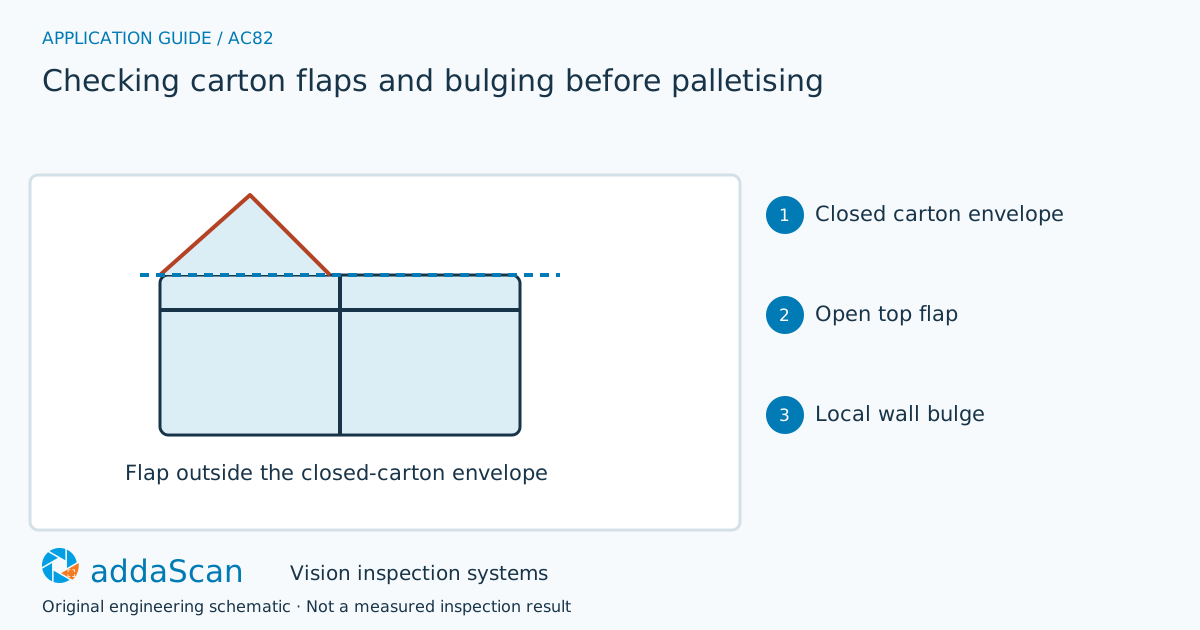
A readable carton label does not confirm that flaps are closed or the walls fit the pallet envelope. Compare the observed shape with the active format. Original schematic.
Select an image to view it at full size.
Compare local geometry with the right carton format
Use the active carton specification and locate its main body before examining protrusions. Overall dimensioning can flag a larger envelope, but the reason may be an open flap, a bowed wall or a different carton format. Profile coverage and belt presentation determine which faces can be assessed. Do not infer side-wall integrity from a top-only height result.
Define the allowed external envelope for the active carton format and the local features that must be closed. A larger approved format should not be classified as a bulge using the previous recipe. Locate stable carton faces and distinguish overall size, open flap and local wall deformation, because they may require different corrective actions.
Check what the camera or depth sensor can actually see before the carton enters the palletiser. A decoded label establishes identity only under its matching rules; it does not expose the far wall or top flap. If a crushed reference face prevents localisation, preserve an invalid-shape result rather than comparing an incorrectly aligned carton with the nominal outline.
Separate nominal size from local flap or wall faults
Swipe across the table to compare all columns →
| Approach | Useful when | Limit or integration responsibility |
|---|---|---|
| Envelope dimensioning | Gross out-of-size packs | May not distinguish flap, bulge and wrong format. |
| Local profile and format checks | Locate protrusions before palletising | Requires surface coverage and format-linked limits. |
A dimensioning view can establish the observed envelope where coverage is sufficient. Local flap or wall checks may need additional directions or presentation changes. Compare those options using the full permitted size range and the regions the pallet pattern or handling equipment depends on.
A correctly labelled carton can be unfit for the pallet pattern
Illustrative scenario: the barcode is correct but one top flap extends above the closed-carton envelope. Hold the carton before palletising and retain its ID with the protrusion location.
Reseal it and measure again using the same format. If crushed edges prevent a valid body reference, send it to the agreed manual assessment route. Release requires acceptable observed geometry and a resolved identity, not merely a successful scan.
After reclosing a flap, recheck the carton in its normal conveyed state and associate that result with the carton event. At a format change, confirm the new envelope and in-transit cartons before permitting the palletiser to use the next pattern.
Challenge format changes and damaged reference faces
Swipe across the table to compare all columns →
| Challenge sample or event | Expected behaviour to establish | Evidence to retain |
|---|---|---|
| Open flap on a correctly labelled carton | Hold despite successful decoding. | Carton identity, active format, open-flap region, observed envelope and the palletiser hold signal. |
| Normal format change | Use the right envelope without carrying old limits. | Old/new format records, nominal envelopes, permitted size variation and first-off results under the new pattern. |
| Crushed or poorly located carton | Return an invalid datum and confirm the manual route. | Damaged locating face, invalid pose, affected views and the controlled re-presentation or rejection result. |
Include correctly labelled cartons with shape faults and acceptable cartons from other formats. Test the worst observable side and damage that removes the locating datum. Evaluate the interlock that prevents an unresolved carton reaching the pallet pattern.
External shape cannot prove internal pack integrity
Visible shape does not prove compression strength or internal packing condition.
Define the carton envelope accepted by the palletiser
Share permitted photos or drawings, plus details of carton formats, flap and bulge examples, pallet clearances and the resealing route. Agree any physical sample arrangements after the initial assessment.
Carton and pallet verification helps associate carton identity, observed state and palletising permission. Define the shape envelope separately from the label match.
Counting milk cartons after case packing checks contents in packed cases. Correct contents and a correct count do not resolve an open flap or bulging wall.
Use the cost and scope guide to understand the station boundary. An estimate depends on the required views, product presentation, exception handling and connection to the existing line. A similar camera does not establish the price of this application.
For line conditions around flaps and bulges outside the expected carton envelope, see logistics and distribution inspection.
Compare lighting, processing, interfaces and support in the HIKROBOT and other vision solutions guide. Agree sample testing, acceptance responsibilities and handover through the delivery process.