Application guide by addaScanCompare the inspection task, imaging conditions and validation steps with your own production line.
- Inspection focus
- Cap height relative to the bottle finish
- Primary theme
- Bottle cap inspection
- Decision evidence
- Side: skirt tilted
- Trial priority
- Correct cap on a leaning bottle
Locate the skirt against the bottle finish
The original English schematic explains the observable features and the proposed decision. The tables below set out the conditions to test on your own line.
Swipe across the diagram to see all details →
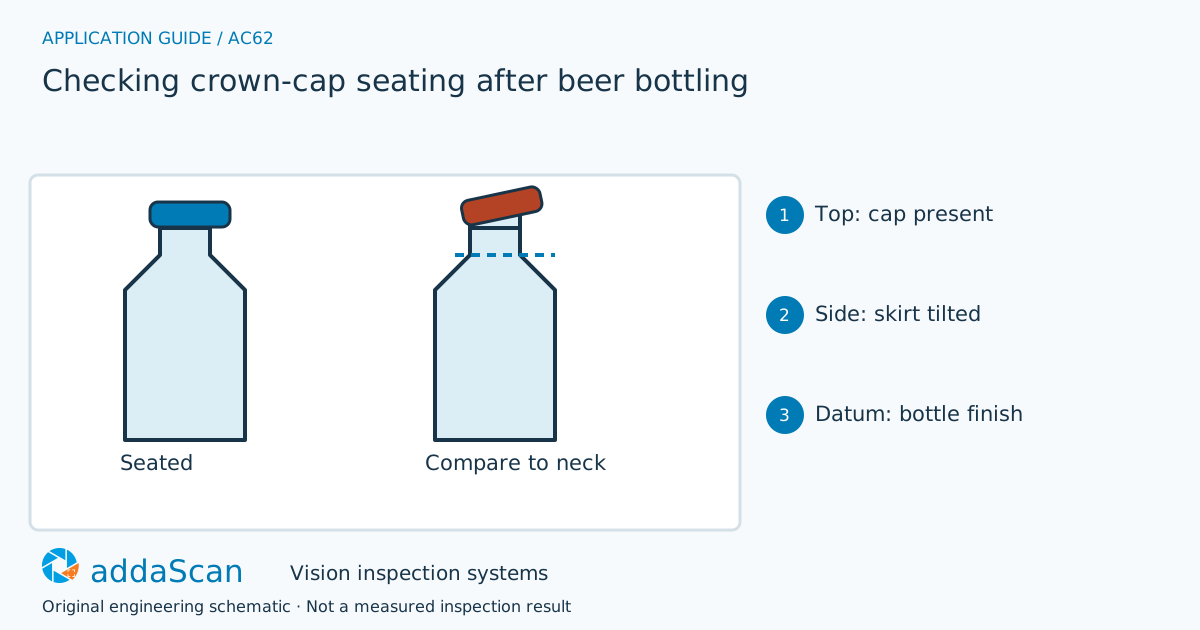
The cap skirt is compared with the bottle finish, rather than with an absolute image height. A top-view presence result cannot resolve a side-view seating fault. Original schematic; no measured clearance or seal result is shown.
Select an image to view it at full size.
Use the bottle finish as the seating datum
Conveyor lean changes absolute cap height in the image. Locate a repeatable feature on the bottle neck, normalise pose and compare the cap skirt on both sides to that local datum. Backlighting can clarify a silhouette, while reflected lighting can reveal folds or damaged edges. Bottle rotation and guide rails may hide the skirt, so test the full permitted presentation rather than one carefully positioned sample.
Start with the seating feature the capper specification actually controls. Identify the bottle-finish reference and the parts of the skirt used for the comparison; the conveyor rail or image border is not a substitute. A damaged neck reference should produce an unresolved seating measurement, because the system has lost the datum needed to distinguish a tilted cap from a tilted bottle.
Present the same acceptable bottle at the permitted lean and lateral positions, then repeat with confirmed seating faults. If the apparent fault follows conveyor position rather than the cap, improve presentation or pose correction before setting a rejection limit. Test after the closing head has cleared the view and while the bottle can still be tracked to the reject. The capper and reject signals must refer to that bottle, including during gaps and a line restart.
What top and side views each establish
Swipe across the table to compare all columns →
| Approach | Useful when | Limit or integration responsibility |
|---|---|---|
| Top camera | Cap presence and visible type | Cannot establish skirt seating all around the neck. |
| Side profiles | Relative height and tilt | Requires a bottle datum, sufficient angular coverage and protection from guide-rail occlusion. |
A top image can identify missing or wrong caps, but it is not evidence about an unseen skirt edge. Add side coverage only where it reveals the agreed seating feature; adding cameras without removing rail occlusion may leave the same gap. Where a full seating check cannot be observed, agree a limited visible check and a separate route for unresolved bottles instead of labelling the station as complete circumferential inspection.
A correct cap can still sit crooked
Illustrative scenario: the top view recognises the correct cap, but the left and right skirt clearances differ after bottle-pose correction. Mark a seating fault and divert that bottle, retaining the side view and the capping event where available.
After a capper adjustment, inspect identified first-off bottles again with the validated recipe. Do not release an unobserved side simply because the top view passed; unresolved coverage needs another view or a controlled manual route.
A second image is useful only if its bottle identity and newly visible region are known. Preserve the first fault when a bottle is reworked; the replacement observation closes that fault only after all required views are valid. A capper reset or recipe reload must not clear outstanding bottles from the reject queue.
Challenge leaning bottles and hidden skirt edges
Swipe across the table to compare all columns →
| Challenge sample or event | Expected behaviour to establish | Evidence to retain |
|---|---|---|
| Correct cap on a leaning bottle | Pose correction should prevent a false seating failure. | Bottle event, neck datum, left/right skirt regions, pose correction and the accepted leaning-bottle reference. |
| Tilted cap and deformed skirt | Record relative geometry and confirm the physical diversion. | Fault sample identity, observed skirt displacement, view coverage, reject command and physical reject acknowledgement. |
| Hidden skirt segment | Return incomplete coverage and test recovery after repositioning. | Obscured region, affected camera, reinspection or manual disposition, and the result used to resolve the same bottle. |
Use independently identified good and faulty closures across the allowed bottle-finish variants. Repeat accepted samples at the presentation limits, not only at the centre of the image. Review false rejects separately from missed seating faults and from incomplete observations; each requires a different corrective action.
Visual seating does not establish seal integrity
External seating geometry does not prove pressure retention or seal integrity. Keep leak or pressure tests as separately specified checks.
Define the views around your capper
Share permitted photos or drawings, plus details of normal and crooked caps, bottle-finish variants, rail positions and the approved seating criteria. Agree any physical sample arrangements after the initial assessment.
Fill, cap and seal inspection helps define the visible cap check and its reject handling on a bottling line. Crown-cap seating needs its own view and sample assessment; a moulded plastic-cap defect station is a different scope.
Checking labels, caps and product mix before beverage packing explains cap presence alongside beverage label and product checks. Share a bottle event where useful, while retaining a separate seating result.
Use the cost and scope guide to understand the station boundary. Crown-cap seating is not the moulded-plastic-cap defect station; its view coverage and handling must be assessed separately.
For line conditions around cap height relative to the bottle finish, see bottling and canning inspection.
Compare lighting, processing, interfaces and support in the HIKROBOT and other vision solutions guide. Agree sample testing, acceptance responsibilities and handover through the delivery process.