Application guide by addaScanCompare the inspection task, imaging conditions and validation steps with your own production line.
- Inspection focus
- Dip-tube connection and exposed length
- Primary theme
- Assembly verification
- Decision evidence
- Tube beside socket
- Trial priority
- Loose tube beside housing
Inspect the tube-to-pump connection as well as the tube
The original English schematic explains the observable features and the proposed decision. The tables below set out the conditions to test on your own line.
Swipe across the diagram to see all details →
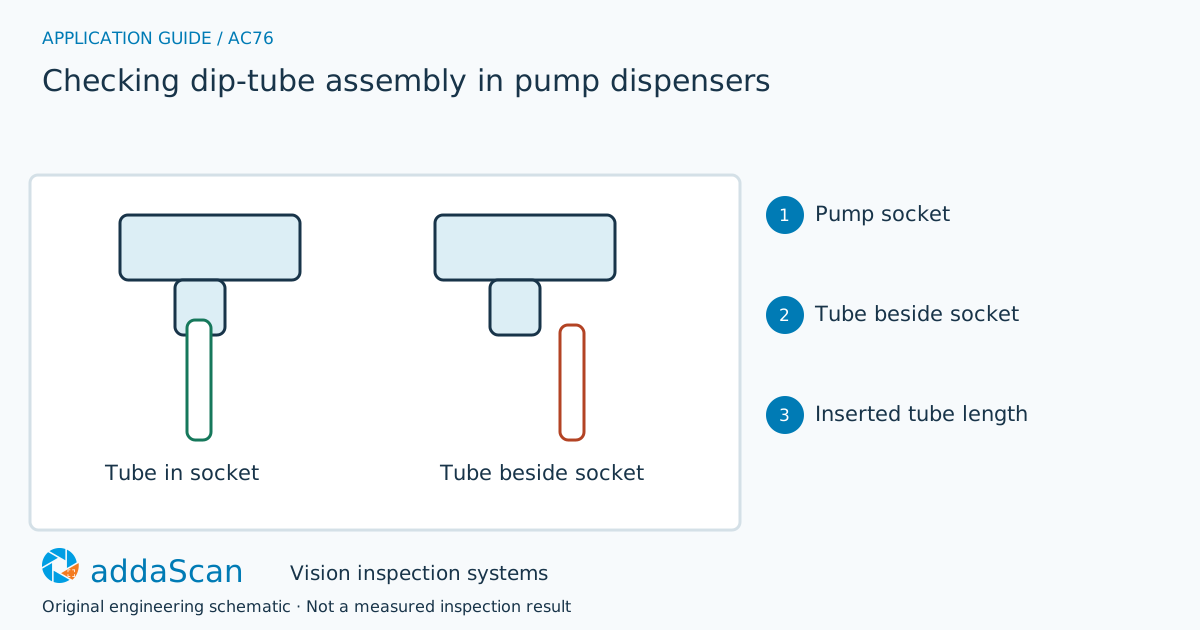
A tube can be present without being inserted into the pump socket. Check connection and visible length independently, keeping hidden joint evidence unresolved. Original schematic; pump function is not tested.
Select an image to view it at full size.
Anchor the tube measurement to the pump socket
Locate the pump housing and its connection feature before searching for the tube. Transparent tubes may need a contrasting background or transmitted light; reflections can create false edges along the housing. Define whether the inspection occurs before the assembly enters the bottle, because the bottle can conceal both tube end and joint. A nearby loose tube should never satisfy an assembly-presence condition.
Define the connection feature relative to the pump socket, then evaluate the visible tube length separately. A tube next to the housing can have the expected colour and length without being inserted. Conversely, an inserted tube can be too short or bent. Preserve these different results so rework addresses the actual failure.
Choose an inspection point before later assembly hides the joint, where practical. If the socket conceals the insertion depth, a side image may only prove visible engagement, not the full internal connection. Name that limit and agree whether another observation or independent functional check is required. Do not turn an invisible dimension into a pass based on tube presence.
Choose views from the joint and required length
Swipe across the table to compare all columns →
| Approach | Useful when | Limit or integration responsibility |
|---|---|---|
| Tube presence | Gross missing-part detection | Can accept a loose tube beside the pump. |
| Joint and length inspection | Visible seating and correct tube extension | Needs an observable connection and a calibrated length reference. |
A single view may cover exposed connection and length features in a controlled fixture. Complementary views can resolve an occluded joint, provided they belong to the same pump and share the locating reference. Reorientation must be included in the cycle and exception handling rather than assumed to be free.
A loose tube beside the pump must not pass
Illustrative scenario: a tube runs alongside the pump but stops outside the socket. Hold the assembly even though a tube detector returns present.
After insertion, reacquire the joint and the required length region, keeping the rework tied to the assembly event. If a fixture hides the joint, rotate or re-present the assembly. Release only after the socket relationship and length checks are both valid.
After reseating or replacing a tube, recheck both engagement and the relevant length or bend condition. A repaired joint that remains hidden needs the agreed independent route. Keep the original failure linked to the final assembly result.
Challenge partial insertion and hidden reworked joints
Swipe across the table to compare all columns →
| Challenge sample or event | Expected behaviour to establish | Evidence to retain |
|---|---|---|
| Loose tube beside housing | Fail assembly despite tube presence. | Pump event, socket datum, loose-tube position, visible connection evidence and the hold decision. |
| Short, bent and partly inserted tubes | Record which geometry requirement failed. | Known short/bent/partly inserted sample, independent feature labels, joint and length images and separate decisions. |
| Hidden joint after rework | Require another view before closing the result. | Original assembly fault, rework action, joint visibility after rework and the complete reinspection or independent disposition. |
Include tubes positioned beside the pump and partially inserted tubes, not only missing ones. Repeated fixture loading should not change the interpreted engagement. Where function or sealing is required, identify that separate acceptance method before claiming the assembly is complete.
Visible assembly does not prove pump function
Visible insertion does not prove pull-out strength, pump flow or leak tightness.
Define accessible views of the dip-tube assembly
Share permitted photos or drawings, plus details of pump variants, transparent and opaque tubes, insertion faults and fixture drawings. Agree any physical sample arrangements after the initial assessment.
Assembly verification and error proofing covers visible assembly presence, position and variant checks. For pump tubes, the socket view and the required insertion evidence decide whether that scope is sufficient.
Distinguishing missing, reversed and correctly fitted cap liners distinguishes cap-liner states. The shared lesson is that component presence does not establish correct seating or orientation.
Review the indicative station budget and exclusions. The assembly budget is a reference for visible component checks; hidden insertion geometry, 3D and fixture modifications must be added explicitly.
For line conditions around dip-tube connection and exposed length, see plastics and packaging inspection.
Compare lighting, processing, interfaces and support in the HIKROBOT and other vision solutions guide. Agree sample testing, acceptance responsibilities and handover through the delivery process.