Application guide by addaScanCompare the inspection task, imaging conditions and validation steps with your own production line.
- Inspection focus
- Occupancy at every egg-tray pocket
- Primary theme
- Vision counting system
- Decision evidence
- Empty pocket
- Trial priority
- Empty pocket with neighbouring overlap
A tray needs a resolved result at each required pocket
The original English schematic explains the observable features and the proposed decision. The tables below set out the conditions to test on your own line.
Swipe across the diagram to see all details →
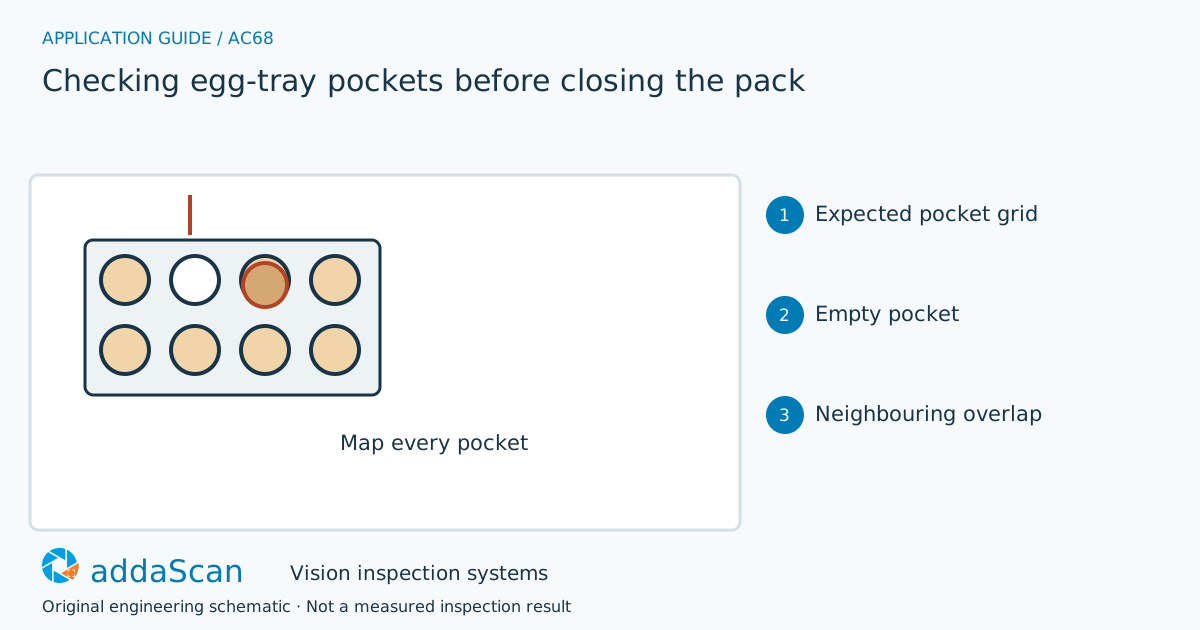
An overall count can conceal an empty pocket beside an overlap. Assign observations to the correct tray positions and keep hidden pockets unresolved. Original schematic; egg quality is not inferred from occupancy.
Select an image to view it at full size.
Register the tray grid before counting eggs
Tray rotation changes pocket coordinates. Locate repeatable tray features and map each expected pocket into the image; reject an unknown tray format rather than resizing a familiar template blindly. Lighting should separate egg surfaces from the tray without erasing pale edges. A height view may help with overlaps, but moulded pulp texture and shadow require trials with actual trays.
Identify the tray variant and locate its pocket pattern before assigning egg observations. An egg spanning the boundary between two pockets can increase apparent occupancy in both unless the association rule identifies one physical object. Conversely, a high rim or overlapping egg can hide a correctly occupied pocket. Preserve empty, occupied, misplaced and unobservable states where those distinctions drive different actions.
The check should occur while the relevant pockets remain visible and while the tray can be held. Define how a rotated tray is located and which layouts are permitted. A familiar outer rectangle does not prove the internal pocket map belongs to the active pack size.
Compare a total count with a located pocket map
Swipe across the table to compare all columns →
| Approach | Useful when | Limit or integration responsibility |
|---|---|---|
| Top-view camera | Clearly separated pockets | Validate tray registration and pale-on-pale contrast. |
| Height-assisted inspection | Overlaps or ambiguous silhouettes | Test coverage near pocket walls and missing depth responses. |
Use a total count only where object separation and the acceptance requirement make it sufficient. A pocket map is needed when position matters or overlaps can disguise a shortage. Add a view or controlled repositioning for obscured pockets rather than filling the map from an expected quantity.
One overlap can hide an empty neighbouring pocket
Illustrative scenario: the apparent total matches the recipe, yet the pocket map shows one empty position and an adjacent overlap. Hold the tray and retain the positional result.
After correcting the load, inspect every pocket again under the same tray event. If a label, gripper or tray wall hides a pocket, keep it unresolved until a clear view is obtained. Release depends on the expected occupancy pattern, not a matching total alone.
After a loader or operator corrects a tray, reacquire the complete required pocket map. Moving one egg can obstruct another position, so closing only the originally empty cell may leave a new fault unresolved. Keep the tray identity through the hold and recheck.
Test tray variants and reloaded positions
Swipe across the table to compare all columns →
| Challenge sample or event | Expected behaviour to establish | Evidence to retain |
|---|---|---|
| Empty pocket with neighbouring overlap | Flag the two positions separately. | Tray event, pocket map, object boundaries, the empty/overlapping positions and the resulting hold decision. |
| Rotated and alternative trays | Select the right pocket map or return unknown format. | Tray variant, rotation reference, expected pocket layout and all required position results after localisation. |
| Reworked load | Retain the original map and a complete reinspection map. | Original incomplete map, reload action, fresh complete map and permission to close the identified tray. |
Challenge matching totals with wrong positions, alternative trays and partial visibility at the closing mechanism. Confirm that rework cannot bypass the full pocket check. Internal defects and egg-shell integrity require their own separately defined evidence.
Occupancy does not establish internal egg quality
This task concerns loading. It does not establish internal egg quality, shell microcracks or hygiene.
Define the tray layouts used before pack closure
Share permitted photos or drawings, plus details of tray formats, egg size ranges, loading faults, permitted rotation and the point at which the lid closes. Agree any physical sample arrangements after the initial assessment.
Egg pack inspection after the grader and packer defines the pack check and its handling before closure. Specify whether the project requires occupancy alone or additional visible shell and pack features.
Counting milk cartons after case packing deals with packed milk cartons. Both tasks need complete-position evidence where an overall object total can hide a loading error.
Review the indicative station budget and exclusions. Match the quoted views, product range and reject arrangement to the trial; changes to the production machinery and other exclusions remain separately agreed.
For line conditions around occupancy at every egg-tray pocket, see food and beverage inspection.
Compare lighting, processing, interfaces and support in the HIKROBOT and other vision solutions guide. Agree sample testing, acceptance responsibilities and handover through the delivery process.