Application guide by addaScanCompare the inspection task, imaging conditions and validation steps with your own production line.
- Inspection focus
- Front, back and unresolved pouch orientation
- Primary theme
- Label verification
- Decision evidence
- Back face
- Trial priority
- Front and back across artwork variants
Front, back and unresolved are different pouch states
The original English schematic explains the observable features and the proposed decision. The tables below set out the conditions to test on your own line.
Swipe across the diagram to see all details →
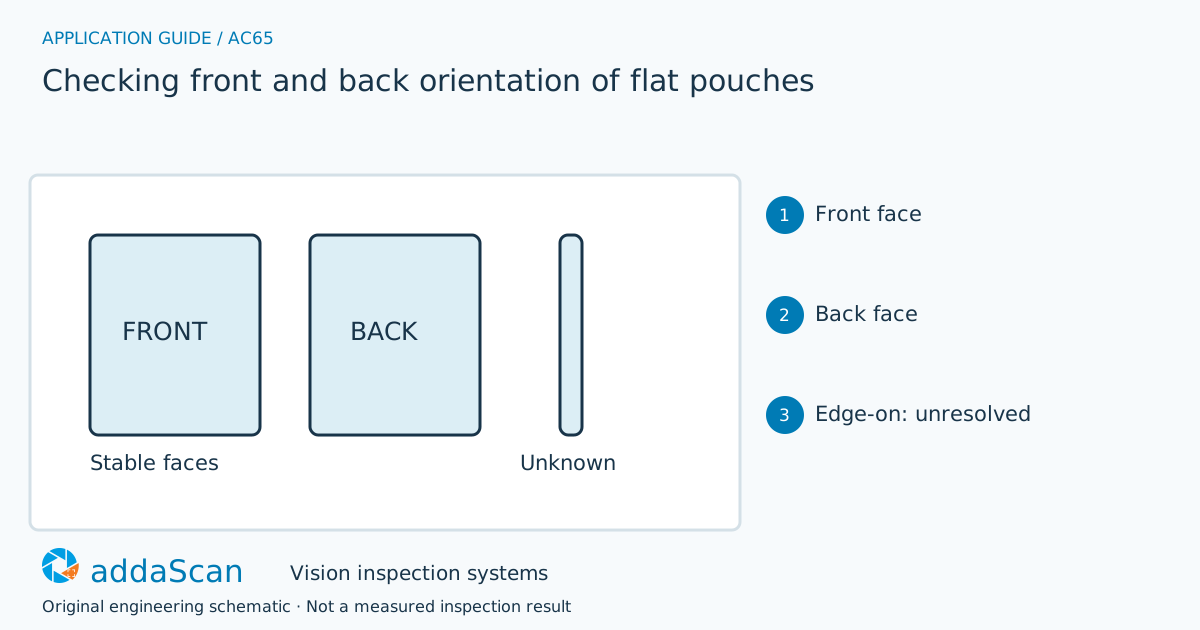
A pouch can show its front, back or too little reliable face evidence. Preserve the unresolved state before a downstream process depends on orientation. Original schematic; artwork classes are illustrative.
Select an image to view it at full size.
Anchor orientation to stable artwork and physical presentation
Find features that remain distinct across the approved artwork family: a seam, an opaque print block or a registered graphic may work better than a changing date code. Locate the pouch before comparing those regions. Wrinkles, translucent film and reflections can reveal or obscure the opposite face. Mechanical guides that flatten the pouch may reduce uncertainty more reliably than expanding a classifier.
Define what distinguishes the two faces for every approved artwork version. Text, a registration feature or a stable graphic region may be more useful than overall colour. Where the film is translucent, a feature printed on the far side can appear through the pouch, so the training or reference set must include the actual material and lighting direction.
Locate the pouch and assess whether enough of the required face is visible before accepting an orientation. A high class score on a small folded corner is not equivalent to a clear front view. Specify the downstream action for front, back and unresolved states: pass, controlled turn or a re-presentation route. Verify the resulting face after a turn when the process depends on that action succeeding.
Compare artwork features with controlled presentation
Swipe across the table to compare all columns →
| Approach | Useful when | Limit or integration responsibility |
|---|---|---|
| Registered feature rules | Distinct and stable artwork | Check mirrored show-through and missing print features. |
| Image classification | Many legitimate appearances | Include edge-on and folded states; validate an explicit unknown outcome. |
A simple feature check can be appropriate when artwork has a stable, unique face marker. Broader classification may handle variation, but still needs an ambiguity boundary and controlled recipe changes. Improving the presentation may resolve a face that no classifier can reliably infer from an edge-on view.
An edge-on pouch must not be forced into a class
Illustrative scenario: front and back features both appear because the pouch is tilted and partially folded. Mark orientation unresolved and send it to the agreed reorientation path.
After flattening, capture a new image and classify again under the same product recipe. When artwork changes, validate both faces and transitional poses before restoring normal feed. Keep the original unresolved image so recurrent presentation faults are visible rather than hidden by retries.
When artwork changes, hold the orientation-dependent operation until the active reference is confirmed. Preserve unresolved packs through turning or refeeding; do not assume the commanded turn exposed the correct face.
Challenge artwork changes and translucent film
Swipe across the table to compare all columns →
| Challenge sample or event | Expected behaviour to establish | Evidence to retain |
|---|---|---|
| Front and back across artwork variants | Save the feature or class evidence and expected face. | Artwork version, located face features, material translucency and confirmed front/back references for each permitted variant. |
| Edge-on, wrinkled and translucent pouches | Unknown should trigger reorientation rather than a forced selection. | Visible-face coverage, fold or edge-on condition, both-side feature evidence and the unresolved/re-presentation result. |
| New artwork under the old recipe | Block or flag the mismatch before accepting its direction. | New artwork identity, previous recipe, blocked processing state and approved reference used before restarting. |
Include near-edge presentation and mixed old/new artwork. Judge wrong-face acceptance separately from unresolved packs. Agree how the operator identifies an authorised artwork update so a new design is not silently treated as an inspection fault or accepted under the wrong recipe.
Face recognition does not establish pouch integrity
Orientation does not establish pouch sealing or contents. A classifier score is not a calibrated probability of a correct downstream operation.
Prepare the permitted pouch artwork and handling range
Share permitted photos or drawings, plus details of both faces of each artwork, difficult poses, line spacing and the physical route for reorienting a pouch. Agree any physical sample arrangements after the initial assessment.
Label and print inspection helps define the visible artwork and reference check. Pouch inspection addresses later packaging checks; upstream face orientation needs its own handling decision.
Locating the printed face of a bottle before label application considers face location on a bottle. Flat pouches introduce folds and translucency, so their presentation and reference features must be tested separately.
Use the cost and scope guide to understand the station boundary. An estimate depends on the required views, product presentation, exception handling and connection to the existing line. A similar camera does not establish the price of this application.
For line conditions around front, back and unresolved pouch orientation, see plastics and packaging inspection.
Compare lighting, processing, interfaces and support in the HIKROBOT and other vision solutions guide. Agree sample testing, acceptance responsibilities and handover through the delivery process.