Application guide by addaScanCompare the inspection task, imaging conditions and validation steps with your own production line.
- Inspection focus
- Visible lubricant coverage on O-rings
- Primary theme
- Surface defect detection
- Decision evidence
- Coated reference
- Trial priority
- Known dry and coated regions
Define the visible signal that represents lubricant coverage
Reference imagery and an original English schematic explain the observable features and the proposed decision. The tables below set out the conditions to test on your own line.
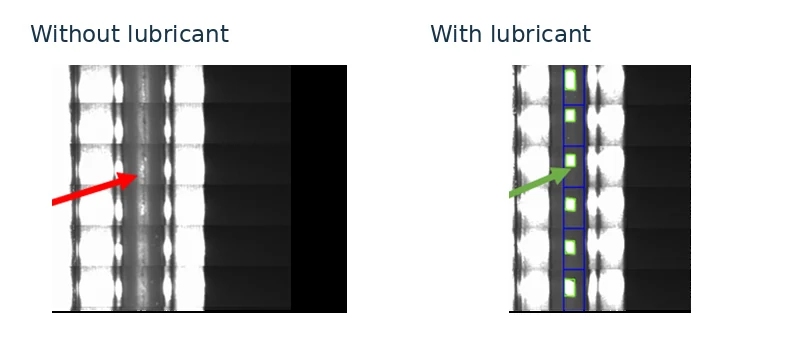
Reference inspection views with the original explanatory labels translated into English. Their contrast illustrates a lubricant-dependent response; it is not a measurement of lubricant quantity.
Swipe across the diagram to see all details →
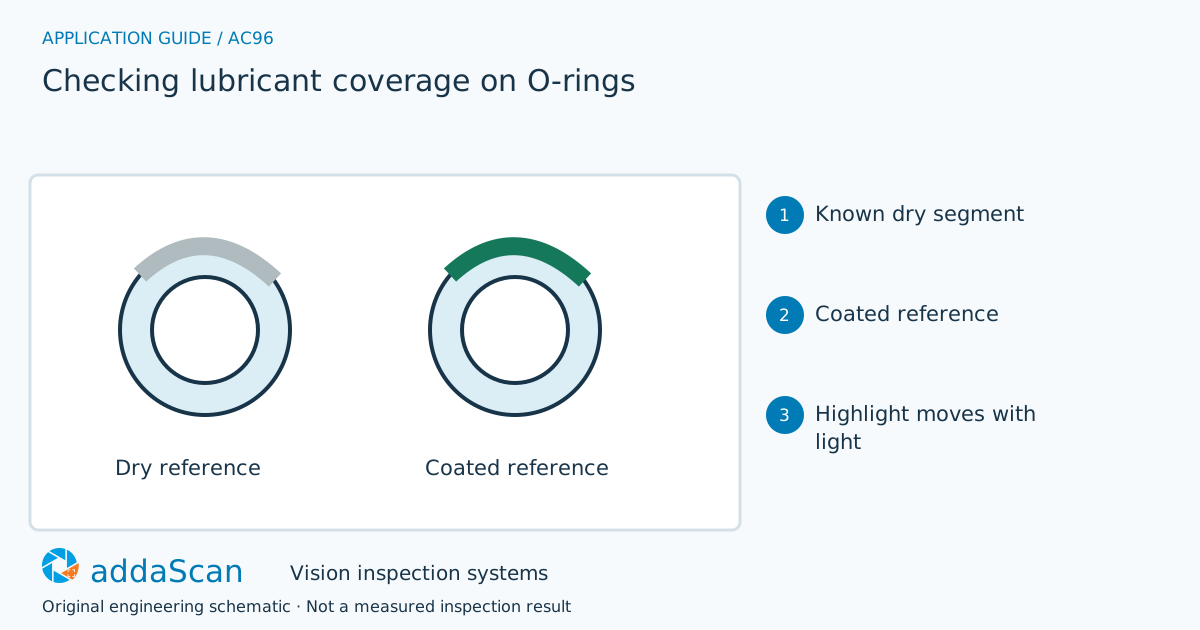
Visible lubricant evidence depends on the qualified contrast method and surface coverage. Reflection changes alone must not be treated as proof of coating. Original schematic; the reference views illustrate regions rather than measured film thickness.
Select an image to view it at full size.
Control reflections before interpreting coverage
Rubber finish, lubricant type and application amount all affect appearance. Compare illumination angles and, where the material permits it, another contrast mechanism suited to the approved lubricant. Do not assume fluorescence without checking the actual formulation. The ring must expose the required surface; a top view alone may miss the inner circumference. Define coverage separately from lubricant quantity.
Establish independently known dry and coated regions before interpreting a brightness difference. Lubricant may change reflection, while an ordinary light-angle change can produce a similar effect. Any contrast or tracer method must be compatible with the actual material and process, and its meaning should be confirmed on representative samples rather than assumed from a clear demonstration image.
Define which ring surfaces require coverage. A top view can leave the inner circumference or support-contact region unseen. Record these areas explicitly and choose a presentation that exposes them where necessary. A smooth overall shine cannot prove that the entire required surface received lubricant.
Compare appearance evidence with a qualified contrast method
Swipe across the table to compare all columns →
| Approach | Useful when | Limit or integration responsibility |
|---|---|---|
| Visible-light contrast | Lubricant visibly changes the qualified surface response | Sensitive to rubber texture and specular highlights. |
| Material-specific optical method | A suitable additional contrast mechanism is demonstrated | Needs formulation validation and complete surface presentation. |
Use direct appearance where coated and dry states remain distinguishable through normal variation. A qualified contrast method may help where direct reflections are ambiguous, but its process suitability and failure modes must be assessed. Compare both on the required ring regions and material batches.
A bright highlight does not prove complete lubrication
Illustrative scenario: a bright segment moves when the light direction changes although the ring remains fixed. Treat it as a reflection question, not confirmed missing lubricant.
Stabilise the illumination and re-present the ring to obtain qualified coverage evidence. Reapply lubricant only through the agreed process and inspect again, retaining the original images. Release requires an interpretable result over the specified surface.
After reapplication, inspect the complete required region because handling may move or redistribute the coating. Keep original dry-region evidence with the new coverage result. If illumination changes, recheck references before carrying the old decision boundary into production.
Challenge light angle and the inner circumference
Swipe across the table to compare all columns →
| Challenge sample or event | Expected behaviour to establish | Evidence to retain |
|---|---|---|
| Known dry and coated regions | Establish distinguishable responses before thresholding. | Independently prepared dry/coated regions, acquisition condition, coverage image and labelled region-level decisions. |
| Light-angle changes | Avoid mistaking moving highlights for coverage defects. | Light-angle sequence, same physical coating state, apparent brightness change and the control preventing a false coverage result. |
| Inner circumference and reapplication | Record coverage and the reinspection result. | Inner-circumference coverage, original dry region, reapplication event and new complete-region observation. |
Change lighting geometry while keeping the coating state fixed, then change coverage while holding acquisition fixed. These paired challenges expose a rule that follows reflection instead of lubricant. Report any hidden region separately from accepted visible coverage.
Coverage images cannot measure friction or film thickness
Visible coverage does not measure lubricant mass, film thickness or long-term sealing behaviour.
Prepare known dry and coated reference regions
Share permitted photos or drawings, plus details of lubricant specification, coated and dry sample examples, rubber finishes and the required coverage region. Agree any physical sample arrangements after the initial assessment.
Surface defect detection helps establish the visible dry/coated distinction. Include the required inner and outer regions and any process-compatible contrast method in the feasibility scope.
Automotive glue-bead inspection evaluates an adhesive bead. Lubricant coverage uses different material evidence and does not inherit a bead-height or bond-strength conclusion.
Use the cost and scope guide to understand the station boundary. An estimate depends on the required views, product presentation, exception handling and connection to the existing line. A similar camera does not establish the price of this application.
Compare lighting, processing, interfaces and support in the HIKROBOT and other vision solutions guide. Agree sample testing, acceptance responsibilities and handover through the delivery process.