Application guide by addaScanCompare the inspection task, imaging conditions and validation steps with your own production line.
- Inspection focus
- Observed pallet state before restart
- Primary theme
- Assembly verification
- Decision evidence
- Observed missing carton
- Trial priority
- Missing carton in a nominally complete layer
Compare the physical layer with the saved placement state
The original English schematic explains the observable features and the proposed decision. The tables below set out the conditions to test on your own line.
Swipe across the diagram to see all details →
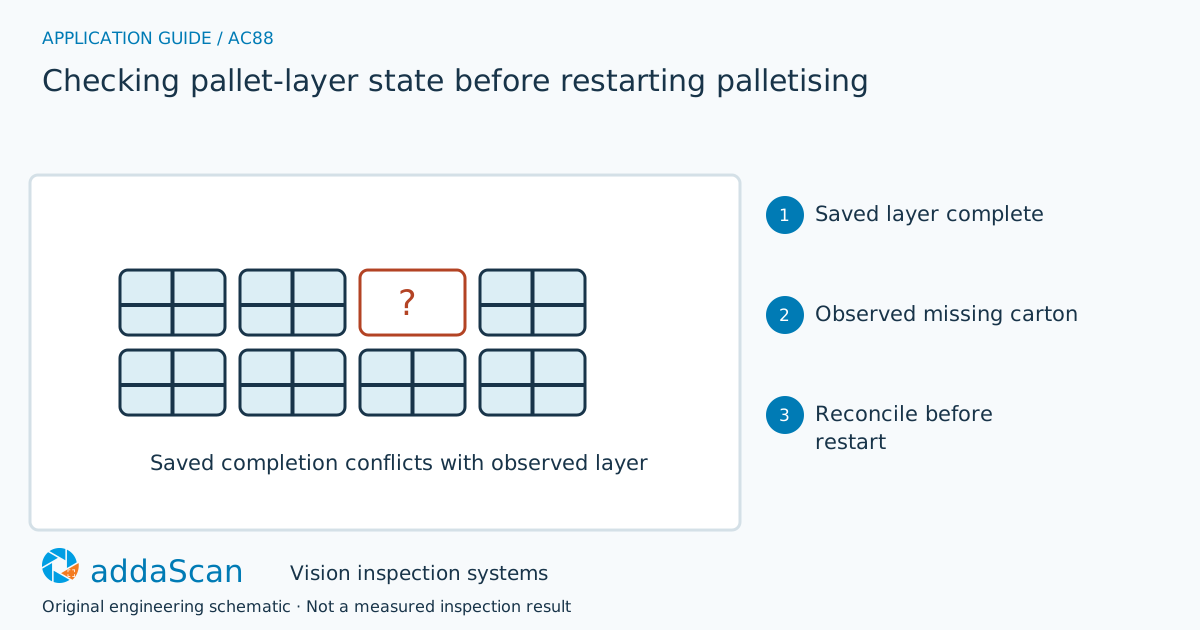
Restart permission requires agreement between the observed layer and the placement record. A stored layer count cannot resolve a missing carton or an unfinished placement. Original process-state schematic.
Select an image to view it at full size.
Rebuild occupancy from the pallet datum
Locate the pallet and inspect the relevant layer positions, allowing for the format and any permitted offsets. Depth can distinguish layers, but wrap, overhang and hidden cartons can obscure occupancy. The robot task history and the observed pattern answer different questions: one records commanded actions, the other describes visible state. Recovery needs both, particularly after power loss during a placement.
Describe the expected layer as named positions for the active pallet pattern. Compare observed occupancy with completed placements, reserved positions and any action interrupted before acknowledgement. A saved layer number is a process memory, not a measurement of the pallet currently in the cell.
Reconcile what the robot or gripper may still hold. A carton physically lifted but not placed can leave the controller and image describing different stages of one task. The restart sequence needs a common pallet identity, pattern and action state. Unknown or obscured positions should block automatic continuation under the agreed process interlock, while machine safety remains with the separately designed safety system.
Use observed positions to qualify a restart
Swipe across the table to compare all columns →
| Approach | Useful when | Limit or integration responsibility |
|---|---|---|
| Stored programme state | Normal uninterrupted sequencing | May not represent an interrupted physical placement. |
| Observed layer reconciliation | Restart after uncertain handling | Needs a pallet datum, visible occupancy and robot-state integration. |
A top view can establish visible layer occupancy where boundaries are clear. Height or additional views may help identify partial placements, but they must be evaluated against the actual stack and occlusion. Compare any vision route with the controlled manual reconciliation required when the complete layer cannot be observed.
A stored complete layer can still contain a missing carton
Illustrative scenario: the controller records a completed layer, but one expected position is empty. Freeze automatic continuation and preserve the saved task state and current image.
Confirm which placements are complete and whether a carton remains in the gripper or transfer area. Repair the layer through the controlled recovery sequence, then reobserve it. Resume only when the physical pattern, task state and safe handling conditions agree.
After correcting a missing or displaced carton, acquire the current layer again and reconcile outstanding robot tasks. Do not increment the layer count until the complete physical pattern and placement sequence agree. A changed pallet or recipe invalidates a saved map from the earlier load.
Challenge gripper-held cartons and hidden positions
Swipe across the table to compare all columns →
| Challenge sample or event | Expected behaviour to establish | Evidence to retain |
|---|---|---|
| Missing carton in a nominally complete layer | Block the next layer. | Pallet and pattern IDs, expected positions, observed missing carton and the blocked restart state. |
| Interrupted placement with carton in gripper | Reconcile both pallet and handling state. | Interrupted task, gripper/placement acknowledgement, reserved position and the reconciliation decision before motion resumes. |
| Unknown pallet format or hidden position | Require controlled recovery rather than inferred occupancy. | Unknown pattern or hidden position, invalid layer map, manual/reacquisition outcome and authorised process restart. |
Interrupt before, during and after placement acknowledgement, including a carton left in the gripper. Verify the physical sequence as well as the controller flags. Record process-release and safety permissions separately.
Pallet vision is not a robot safety function
Vision reconciliation is not a safety-rated robot restart function. Safety interlocks remain separately engineered.
Define restart responsibilities across vision and robot control
Share permitted photos or drawings, plus details of layer patterns, restart logs, camera access and robot/PLC recovery states. Agree any physical sample arrangements after the initial assessment.
Carton and pallet verification associates pallet identity and observed loading state. Scope the restart handshake with the robot/PLC owner; a generic assembly camera is not a complete palletising recovery system.
Pallet identity and dispatch-order checks checks pallet identity against dispatch. An identified pallet still needs its physical layer state resolved before palletising restarts.
Use the cost and scope guide to understand the station boundary. Pallet-state recovery, 3D acquisition where needed and robot/PLC permissions are not priced by a generic assembly-presence station.
For line conditions around observed pallet state before restart, see logistics and distribution inspection.
Compare lighting, processing, interfaces and support in the HIKROBOT and other vision solutions guide. Agree sample testing, acceptance responsibilities and handover through the delivery process.
Once palletising is complete, the pallet identification system for dispatch can address a separate question: whether the SSCC on the wrapped pallet matches the WMS or dispatch order. Resolving the physical layer state permits the agreed restart; it does not by itself authorise loading that pallet. The dispatch station does not replace layer recovery or its robot/PLC handshake.