Application guide by addaScanCompare the inspection task, imaging conditions and validation steps with your own production line.
- Inspection focus
- Stitch position relative to the folded bag mouth
- Primary theme
- Seal inspection
- Decision evidence
- Seam inside fold
- Trial priority
- Continuous seam outside the fold
Locate the stitching relative to the effective bag fold
The original English schematic explains the observable features and the proposed decision. The tables below set out the conditions to test on your own line.
Swipe across the diagram to see all details →
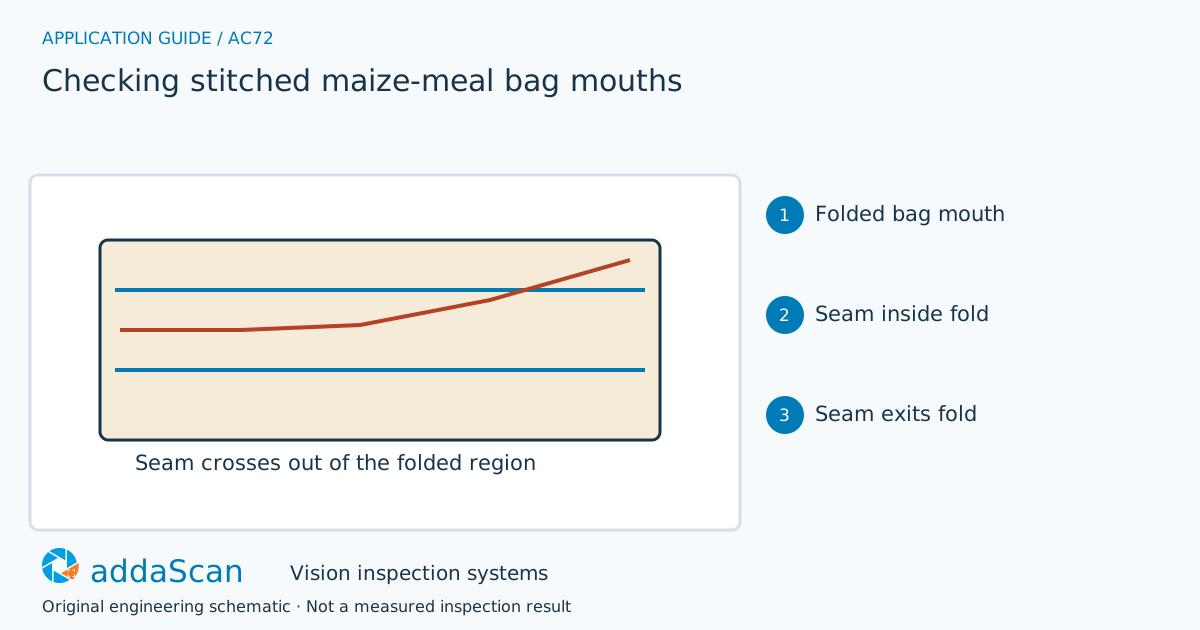
The stitch path must cover the required folded mouth region. A continuous line outside that region does not establish closure. Original schematic; seam strength is not measured.
Select an image to view it at full size.
Find the fold and seam as separate features
Woven texture can resemble stitching, particularly on printed sacks. Test lighting that distinguishes thread or seam relief from the weave and locate the mouth boundary before measuring relative position. A flat support or controlled suspension may be needed to prevent wrinkles from concealing the fold. Absolute seam height on the conveyor is less useful than its position within the bag material that should be captured.
Specify the visible relationship that closes the bag mouth: the folded edge, stitch path and required span across the mouth. A long unbroken line can be present while missing the effective fold. Locate these features relative to the bag rather than comparing thread position with a fixed conveyor height. Bag settling or tilt should not masquerade as a sewing offset.
Printed lines, folds and loose thread can resemble the expected seam. Use representative bags to identify which visual features distinguish them, including dusty or creased material. Define where the view is clear after the sewing head and how the identified bag is contained before stacking if the relationship is wrong or hidden.
Compare thread presence with mouth-closure geometry
Swipe across the table to compare all columns →
| Approach | Useful when | Limit or integration responsibility |
|---|---|---|
| Line-presence check | Gross missing-stitch detection | Can accept stitching that misses the fold. |
| Fold-relative inspection | Seam path and edge relationship | Requires full mouth coverage and tests against woven texture. |
Thread-presence checking fits a missing-stitch requirement. Closure-relationship checking needs the mouth and fold visible together. A second view or controlled presentation may be necessary where the bag lip conceals the path; a stronger line detector cannot prove that the unseen layers were captured.
A continuous seam outside the fold is a failure
Illustrative scenario: stitching is continuous but runs outside the effective fold over part of the mouth. Hold the bag for resewing, retaining the image of the affected segment.
After rework, inspect the entire mouth rather than only the original fault. If the fold cannot be located because the bag is crumpled, return an unknown result and re-present it. Release requires visible closure geometry over the agreed span and confirmed routing.
A re-sewn bag requires a new complete mouth view, including any changed fold. Keep the first defect and rework result linked. After restarting the sewing machine, check the in-transit bags under their actual sew event rather than treating a machine reset as acceptance.
Challenge wrinkles and restarted sewing cycles
Swipe across the table to compare all columns →
| Challenge sample or event | Expected behaviour to establish | Evidence to retain |
|---|---|---|
| Continuous seam outside the fold | Reject on relative geometry. | Bag event, folded-edge and stitch-path locations, missed effective span and containment decision. |
| Wrinkles and printed thread-like lines | Require a valid fold datum before deciding. | Wrinkle/printed-line sample, candidate thread evidence, obscured fold region and the resulting confirmed or unresolved state. |
| Resewn and restarted bags | Retain rework history and recapture the full mouth. | Original seam fault, re-sewing and machine-restart sequence, new complete mouth image and rework release. |
Include uninterrupted stitching in the wrong place, missing spans and acceptable creases. Validate how bag motion affects the relative geometry. Any specified seam force or leak requirement needs a separate test; report the vision scope as the visible closure relationship.
A stitch image does not establish seam strength
Visible stitching does not measure seam strength or establish powder-tightness.
Define the sewing view and failed-bag route
Share permitted photos or drawings, plus details of bag widths, weave and print variants, folded-mouth sample examples, bad seams and the available presentation after sewing. Agree any physical sample arrangements after the initial assessment.
Maize meal bag inspection: print, code, closure defines checks around bag closing and line handling. The sewing mechanism, effective fold and removal of failed bags determine the station scope.
Cement bag counting on a dispatch conveyor concerns bag counting at dispatch. A counted bag can still have a closure fault, so the two results should remain distinct even when linked to one bag event.
Review the indicative station budget and exclusions. Match the quoted views, product range and reject arrangement to the trial; changes to the production machinery and other exclusions remain separately agreed.
For line conditions around stitch position relative to the folded bag mouth, see meat, staples and dry-goods packing.
Compare lighting, processing, interfaces and support in the HIKROBOT and other vision solutions guide. Agree sample testing, acceptance responsibilities and handover through the delivery process.