Application guide by addaScanCompare the inspection task, imaging conditions and validation steps with your own production line.
- Inspection focus
- One top-layer bag and a usable grasp region
- Primary theme
- Assembly verification
- Decision evidence
- Shared seam: no target
- Trial priority
- Two bags inside one region
Select a single visible bag on the current top layer
The original English schematic explains the observable features and the proposed decision. The tables below set out the conditions to test on your own line.
Swipe across the diagram to see all details →
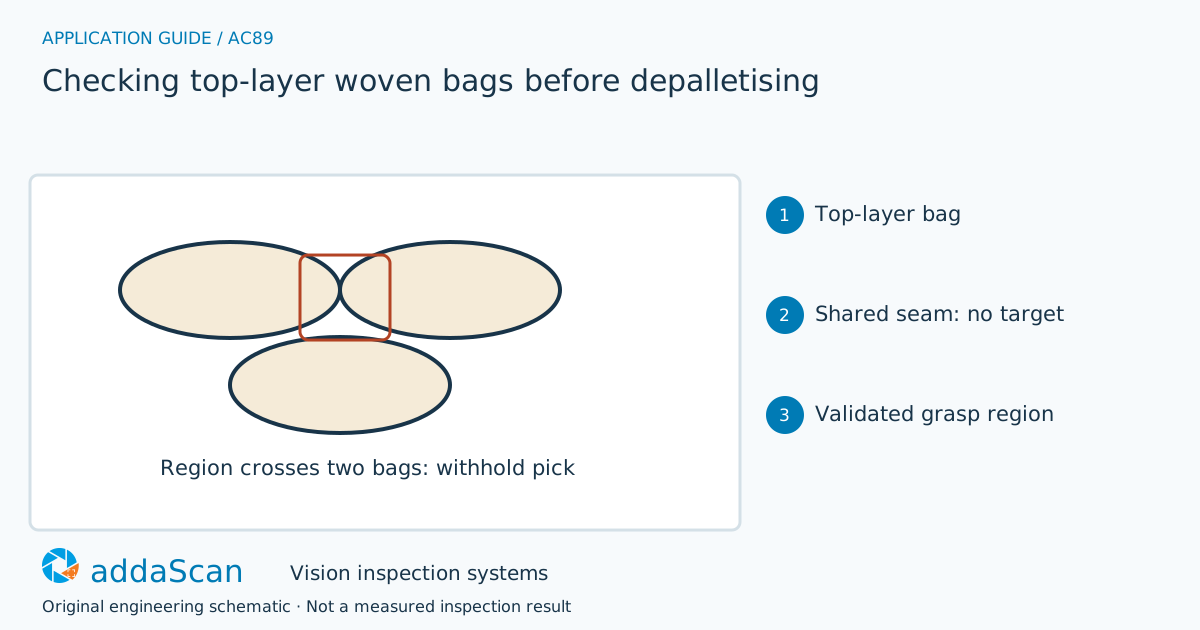
A pick region must belong to one suitable top-layer bag. Spanning boundaries or exposed lower-layer material should invalidate the candidate before it becomes a robot task. Original guidance schematic.
Select an image to view it at full size.
Separate bag boundaries from folds and seams
Bag deformation changes height and contour. Use the top-layer geometry and visible boundaries to distinguish adjacent bags, then evaluate the region needed by the actual gripper. A prominent seam can be a poor grasp location even when it is easy to detect. Depth holes on printed or reflective surfaces must remain missing data, not artificial depressions that split one bag into two targets.
Define the target in terms the gripper can use: one bag, an appropriate accessible surface and a pose within the agreed handling range. A large region may cover two adjacent bags, while a folded top bag can expose material from the layer below. Keep object segmentation, top-layer assignment and grasp suitability as separate conditions.
The bag surface can deform between observation and contact. Agree with the robot/gripper supplier which changes can be tolerated, what confirms a successful pick and when the stack must be reacquired. A predicted target should not remain valid after neighbouring material shifts or a failed grasp disturbs the layer.
Compare localisation with the grasp region actually required
Swipe across the table to compare all columns →
| Approach | Useful when | Limit or integration responsibility |
|---|---|---|
| 2D localisation | Well-separated bags with stable presentation | Cannot always resolve overlapping layers. |
| Depth-assisted target selection | Deformed and overlapping bags | Needs valid surface coverage and gripper-specific region checks. |
Two-dimensional features may help where bag boundaries and layer presentation are controlled. Depth can assist layer separation and surface pose, but does not automatically distinguish overlapping fabric or establish grip performance. Compare the proposed sensing with real bag fill variation and the gripper’s contact requirements.
A region spanning two bags is not a valid pick target
Illustrative scenario: a proposed region covers parts of two overlapping bags and its centre falls on their shared seam. Withhold pick permission and retain the segmentation evidence.
Reobserve from a useful view or use the agreed manual bag-arrangement process. Generate a fresh target only after the layer and grasp region are resolved; do not repeatedly execute the old pose. Confirm pickup before selecting the next exposed bag.
After a failed pick, confirm the gripper state and observe the current stack before choosing another target. Cancel stale targets whose regions have moved. Use a controlled manual route when no single suitable top-layer region can be established.
Challenge folds, lower-layer exposure and failed picks
Swipe across the table to compare all columns →
| Challenge sample or event | Expected behaviour to establish | Evidence to retain |
|---|---|---|
| Two bags inside one region | Reject the ambiguous target. | Observed bag boundaries, top-layer assignment, proposed grasp footprint and rejection of a footprint spanning two bags. |
| Folded top bag over a lower layer | Keep layer identity separate from appearance. | Folded top-bag geometry, exposed lower-layer region, valid depth/appearance evidence and the excluded target areas. |
| Failed pick and shifted stack | Discard old coordinates and reobserve. | Pick task and success feedback, disturbed stack image, cancelled targets and the newly qualified target. |
Include overlapping folds, uneven fill and deliberately unsuccessful picks under an agreed safe test procedure. Evaluate target correctness separately from actual grip success. Vision outputs remain process inputs, not a substitute for robot-cell safety measures.
Vision localisation does not establish robot safety
A visible grasp region does not prove suction retention or safe robot motion.
Define the gripper and stack-recovery interface
Share permitted photos or drawings, plus details of bag materials, filled-shape variation, pallet patterns, gripper requirements and failed-pick handling. Agree any physical sample arrangements after the initial assessment.
Vision station scope and responsibilities helps divide vision localisation, robot handling and recovery responsibilities. The bag, gripper and stack conditions require a specific scope rather than a generic assembly-presence budget.
Cement bag counting on a dispatch conveyor counts bags after dispatch transfer. A count result does not provide the single-bag grasp evidence needed for depalletising.
Use the cost and scope guide to understand the station boundary. Depalletising vision, robot, gripper and stack handling need their own agreed scope; the general guide is not a robot-system price.
Compare lighting, processing, interfaces and support in the HIKROBOT and other vision solutions guide. Agree sample testing, acceptance responsibilities and handover through the delivery process.