Application guide by addaScanCompare the inspection task, imaging conditions and validation steps with your own production line.
- Inspection focus
- Seat-rail feature checks under the correct variant
- Primary theme
- Assembly verification
- Decision evidence
- Complete variant A
- Trial priority
- Old complete assembly on a new order
Use the active seat-rail variant to select required parts
Reference imagery and an original English schematic explain the observable features and the proposed decision. The tables below set out the conditions to test on your own line.
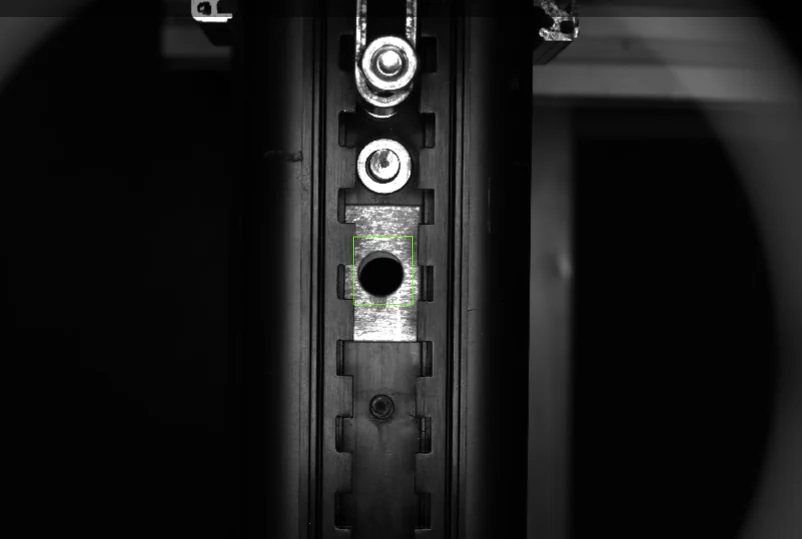
A local view can expose an assembly feature; complete release still depends on the correct variant checklist.
Swipe across the diagram to see all details →
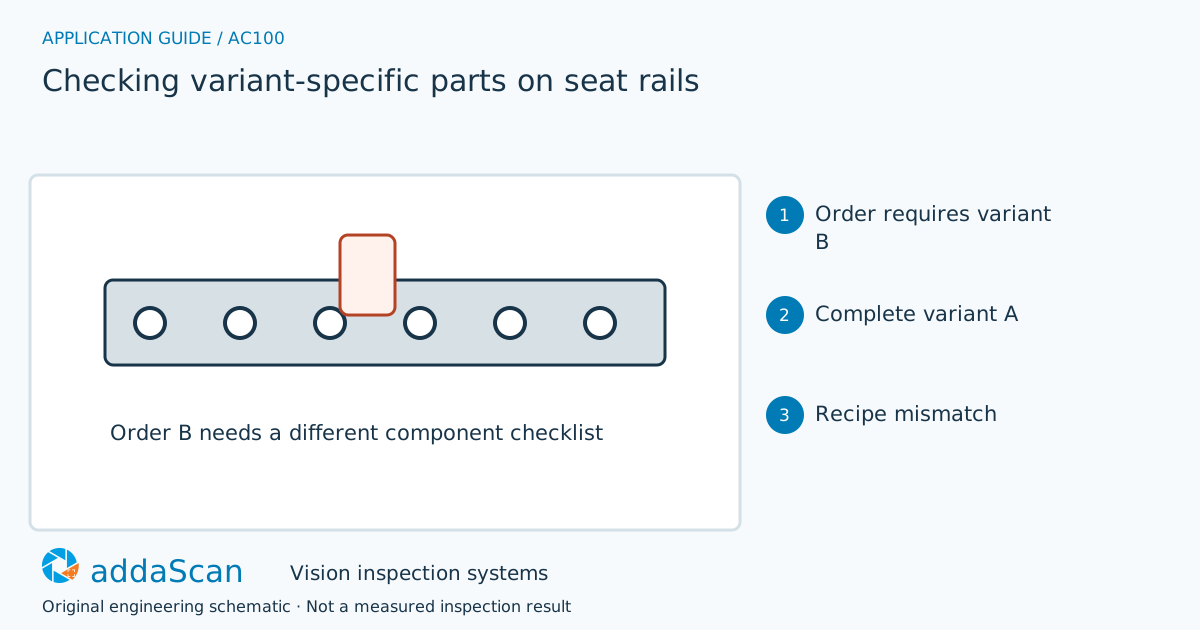
The required component set comes from the active rail variant and order. A complete assembly of another variant is still the wrong assembly. Original schematic.
Select an image to view it at full size.
Bind the feature checklist to the production order
Use a trusted variant selection source and cross-check visible identity features where useful. Similar rail shapes can share many components while differing at one bracket, fastener or mechanism. Define the required views for each checklist item and retain their completion status. A model-selection confidence score cannot override a contradictory order record without an explicit exception process.
Maintain the required component list for each approved rail variant and identify what authorises the active recipe. A completed previous variant can look internally correct while being wrong for the current order. Separate identification of the rail from selection of its required screws, clips, brackets or other visible features; neither should be guessed from whichever parts happen to be present.
Associate each required feature with a locating datum and view. Similar rails may differ in one small component or position, so evaluate the distinguishing features explicitly. An unavailable camera result must not be treated as a component that is not required. Variant-specific exclusions need to come from the approved list.
Compare a general presence check with variant-specific rules
Swipe across the table to compare all columns →
| Approach | Useful when | Limit or integration responsibility |
|---|---|---|
| Manually selected template | Small controlled variant range | Needs changeover verification and mismatch handling. |
| Order-linked checklist | Frequent variants with traceable build requirements | Requires reliable order data and explicit fallback when it is unavailable. |
A general presence check suits an unchanged component set. Mixed variants need identified recipes and feature-level rules, plus a controlled changeover. Compare the methods with a fully assembled wrong variant, not only an assembly with an obvious missing part.
A complete old variant can be wrong for the current order
Illustrative scenario: every observed component matches the old recipe, but the production order requests the new variant. Hold the rail and reconcile the recipe source before changing any inspection result.
Reinspect all required points under the correct variant. A closed rework ticket does not automatically resolve a missing image. Release only after identity, recipe and complete feature evidence agree.
After replacing a component, recheck affected positions and any regions disturbed by the work. Retain the rail/order association through the rework route. If a view is missing, keep the station result open until reacquisition or a recorded independent inspection resolves it.
Challenge similar rails and missing rework views
Swipe across the table to compare all columns →
| Challenge sample or event | Expected behaviour to establish | Evidence to retain |
|---|---|---|
| Old complete assembly on a new order | Block the wrong variant. | Rail identity, active order and recipe, old-variant component map and the detected order mismatch. |
| Similar rails with one differing part | Check the discriminating feature explicitly. | Similar-variant reference lists, distinguishing component/position, acquired view and feature-specific decision. |
| Missing viewpoint after rework | Keep the relevant checklist item open. | Original failed positions, rework record, expected/completed view list and final complete variant checklist. |
Run controlled recipe changes with old parts still present at the station, and challenge the smallest distinguishing feature. Verify the PLC release remains blocked for an unresolved required view, even when all available checks pass.
Visible assembly does not qualify structural performance
Visible component completeness does not establish tightening torque, rail strength or functional performance.
Prepare variant lists and the station release interface
Share permitted photos or drawings, plus details of variant matrices, component checklists, order interfaces and the available fixture viewpoints. Agree any physical sample arrangements after the initial assessment.
Assembly verification and error proofing covers visible component and variant checks. Agree the source of the active recipe and the complete view list before scoping the station.
Kit packing: count, orientation and identity describes kit identity and placement. Seat-rail verification similarly needs variant-specific requirements rather than one universal component count.
Review the indicative station budget and exclusions. Use the assembly budget with the agreed variant list and views; fixture, tooling and mechanical changes remain separately defined.
For line conditions around seat-rail feature checks under the correct variant, see metal-component inspection.
Compare lighting, processing, interfaces and support in the HIKROBOT and other vision solutions guide. Agree sample testing, acceptance responsibilities and handover through the delivery process.