Application guide by addaScanCompare the inspection task, imaging conditions and validation steps with your own production line.
- Inspection focus
- Wire colour at each cavity and visible seating
- Primary theme
- Assembly verification
- Decision evidence
- Correct colour totals
- Trial priority
- Two swapped wires with correct totals
Match each wire position and each connector relationship
The original English schematic explains the observable features and the proposed decision. The tables below set out the conditions to test on your own line.
Swipe across the diagram to see all details →
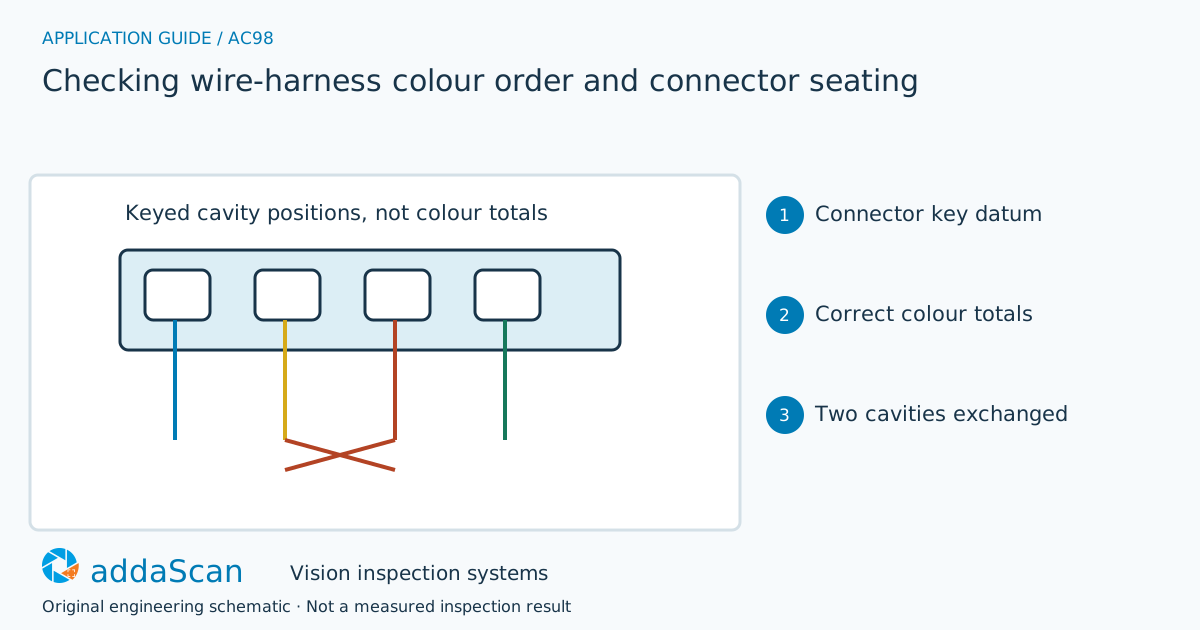
Correct colour totals do not prove the wire order. Locate the connector, compare each position and check seating separately. Original assembly schematic.
Select an image to view it at full size.
Locate the connector key before assigning cavity numbers
The same connector rotated in the image changes apparent left-to-right order. Register its key or other asymmetric feature before mapping cavities. Use controlled colour illumination and reference samples for similar shades, stripes and translucent insulation. Wires may cross before entering the housing, so inspect the region that actually establishes the cavity relationship rather than a convenient distant bundle.
Locate the connector datum before naming wire positions. Left-to-right image order can reverse when a connector is rotated, and two swapped wires can leave the overall colour totals unchanged. Define the expected sequence in part coordinates, including stripe patterns and the permitted appearance of insulation under the chosen illumination.
Evaluate connector seating independently from wire identity. A correct sequence does not show that a latch engaged, while an apparently seated housing can hide a misrouted wire. Name the visible engagement feature and any region that remains inaccessible after assembly. Electrical continuity and retention tests have their own requirements and should not be represented by the optical result.
Compare colour totals with a located harness sequence
Swipe across the table to compare all columns →
| Approach | Useful when | Limit or integration responsibility |
|---|---|---|
| Global colour count | Gross missing-colour checks | Cannot establish cavity order. |
| Registered cavity inspection | Colour-to-position and visible seating | Needs a key datum, controlled colour and clear entry views. |
Colour counting is useful only where quantities are the acceptance requirement. A position-based sequence check needs reliable connector localisation and sufficient visibility of each wire. Additional views may resolve a latch or stripe, but must retain the same harness and reference orientation.
Swapped wires can preserve every colour count
Illustrative scenario: all expected colours are present, but two wires enter exchanged cavities. Hold the harness with the cavity-level mismatch map.
After rework, recheck every required position and the visible seating or latch region. Keep obstructed cavities unresolved until a clear view is obtained. Release only when the correct variant, colour order and specified visible assembly features agree.
After replacing or reseating a wire, recheck the complete affected sequence and the connector state. If the latch is hidden, apply the agreed independent check or controlled re-presentation. A manual rework acknowledgement alone does not supply missing optical evidence.
Challenge rotated connectors and reworked latches
Swipe across the table to compare all columns →
| Challenge sample or event | Expected behaviour to establish | Evidence to retain |
|---|---|---|
| Two swapped wires with correct totals | Flag the actual cavity mismatch. | Harness variant, connector datum, expected/observed colour sequence and exact swapped positions despite matching totals. |
| Rotated connector and striped insulation | Maintain the correct map and colour interpretation. | Connector rotation, stripe reference, located part-coordinate positions and the resulting identity decisions. |
| Reworked harness with hidden latch | Keep seating unresolved until observed. | Original fault, wire/connector rework, latch visibility and complete sequence/seating results used for release. |
Include swapped equal-count sequences, reversed presentation and striped wires at their permitted rotation. Test wrong recipes as well as wrong assembly. Keep sequence failures, seating failures and unresolved views as distinct results.
Visible harness checks do not replace electrical tests
Vision does not replace continuity, insulation-resistance or other electrical tests.
Define connector datums and permitted wire variants
Share permitted photos or drawings, plus details of cavity maps, wire colours and stripes, connector variants, seating examples and fixture views. Agree any physical sample arrangements after the initial assessment.
Assembly verification and error proofing covers visible sequence, variant and seating checks at the assembly station. Electrical tests and connector retention requirements must be listed separately.
Kit packing: count, orientation and identity separates identity, position and orientation in kits. The harness check applies those distinctions to named connector positions.
Review the indicative station budget and exclusions. The assembly budget concerns visible wire order and connector seating. Electrical continuity, pull tests and fixture changes are separate.
Compare lighting, processing, interfaces and support in the HIKROBOT and other vision solutions guide. Agree sample testing, acceptance responsibilities and handover through the delivery process.