Application guide by addaScanCompare the inspection task, imaging conditions and validation steps with your own production line.
- Inspection focus
- Allowed label faces determine scan coverage
- Primary theme
- Barcode scan tunnel
- Decision evidence
- Bottom label hidden
- Trial priority
- One label on each permitted face
List every face on which a valid carton label can arrive
The original English schematic explains the observable features and the proposed decision. The tables below set out the conditions to test on your own line.
Swipe across the diagram to see all details →
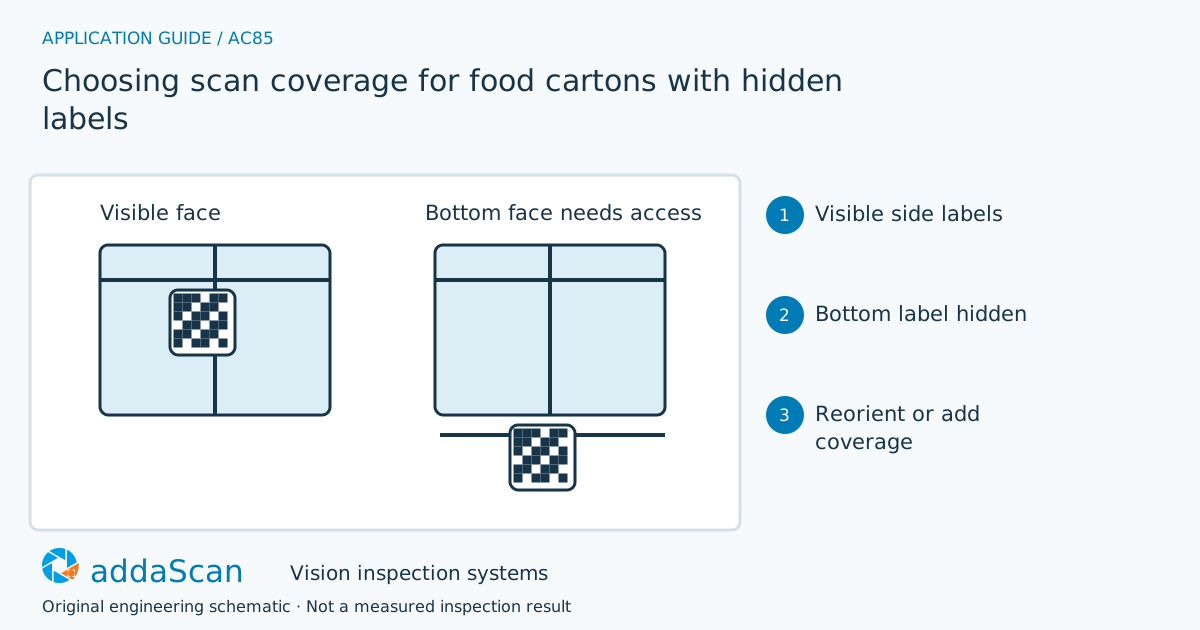
Scanner coverage must follow the permitted label faces. An underside label needs a usable bottom view or an enforced presentation change. Original coverage schematic.
Select an image to view it at full size.
Draw the permitted label zones before comparing readers
List carton sizes, orientations and allowed label positions, including labels near folds and conveyor contact areas. The conveyor itself can obstruct the bottom face; adding a reader does not remove that obstruction. A transfer or gap-based bottom view needs mechanical evaluation alongside optics. Alternatively, a controlled labelling process may keep the required symbol on an observable side and simplify the station.
Make a face-by-face label-placement matrix before selecting the tunnel. Include the smallest and largest carton, labels near folds and any permitted underside label. A five-face arrangement may be entirely correct for a controlled presentation policy but incomplete where the bottom face remains valid. Label policy and scanner coverage must therefore be agreed together.
A bottom view needs an actual optical path through or around the conveyor support. Check the transfer gap, carton stability, small-pack support and protection of the optical window. Specifying another reader without resolving that path does not create bottom coverage. Also define how reads from multiple views become one carton result, particularly near the boundary between consecutive cartons.
Compare presentation control with additional scan faces
Swipe across the table to compare all columns →
| Approach | Useful when | Limit or integration responsibility |
|---|---|---|
| Constrain label presentation | Predictable visible label face | Requires upstream labelling and handling discipline. |
| Multi-face scan including bottom | Variable permitted label faces | Needs mechanical access, synchronisation and format-wide coverage trials. |
Presentation control can simplify the station if production can reliably maintain it and detect violations. Additional views can accommodate more allowed faces but increase mounting, trigger and maintenance requirements. Compare both options against the same challenge matrix and exception route.
A valid bottom label can fall outside a five-face arrangement
Illustrative scenario: all exposed faces produce no-read, but manual turning reveals a readable bottom label. Record a coverage exception rather than assuming decoder failure.
Route the carton for controlled reorientation and link the recovered read to its original event. If bottom labels remain permitted, validate a bottom-reading arrangement across all formats. Release only after identity is recovered; a later unrelated code must not close the earlier no-read.
A no-read carton must retain its own event as the next carton enters the tunnel. Keep the reread lane or manual route separate from later conveyor reads, and record which permitted face remained unresolved for diagnostic use.
Challenge fold-adjacent labels and consecutive cartons
Swipe across the table to compare all columns →
| Challenge sample or event | Expected behaviour to establish | Evidence to retain |
|---|---|---|
| One label on each permitted face | Document whether the full symbol is observable. | Carton size, allowed label face, corresponding reader view and a per-face read/coverage result. |
| Small carton and fold-adjacent label | Challenge gaps, transfer points and view edges. | Small-carton support and fold geometry, visible code modules, acquired view and the reason for a no-read. |
| No-read followed by another carton | Maintain separate identity events through recovery. | Unresolved carton event, following-carton reads, diversion acknowledgement and independently associated reread result. |
Place a real label on each permitted face and repeat at presentation limits. Include two closely spaced cartons where one produces no read. Coverage, decoding and correct object association are separate acceptance questions.
More scan faces do not guarantee every code is readable
Face coverage is distinct from print quality and database validity. More views do not repair an incorrect label.
Prepare the permitted label-face and carton-size matrix
Share permitted photos or drawings, plus details of label-location rules, carton dimensions, orientation sample examples and conveyor-transfer drawings. Agree any physical sample arrangements after the initial assessment.
Scan tunnel and parcel dimensioning system describes dynamic multi-face reading. Define the carton and permitted-label matrix before selecting the number and arrangement of readers.
Associating barcodes with touching parcels addresses touching parcels. Extra views do not resolve a read that cannot be assigned to the correct carton.
Review the indicative station budget and exclusions. Read the tunnel budget with its dynamic coverage assumptions; bottom-view access and conveyor modifications must be confirmed for the line.
For line conditions around allowed label faces determine scan coverage, see logistics and distribution inspection.
Compare lighting, processing, interfaces and support in the HIKROBOT and other vision solutions guide. Agree sample testing, acceptance responsibilities and handover through the delivery process.