Application guide by addaScanCompare the inspection task, imaging conditions and validation steps with your own production line.
- Inspection focus
- Static versus dynamic DWS at factory dispatch
- Primary theme
- Parcel dimensioning
- Decision evidence
- Dynamic: track one carton
- Trial priority
- Previous weight with current barcode
One carton record must contain its own measurements
The original English schematic explains the observable features and the proposed decision. The tables below set out the conditions to test on your own line.
Swipe across the diagram to see all details →
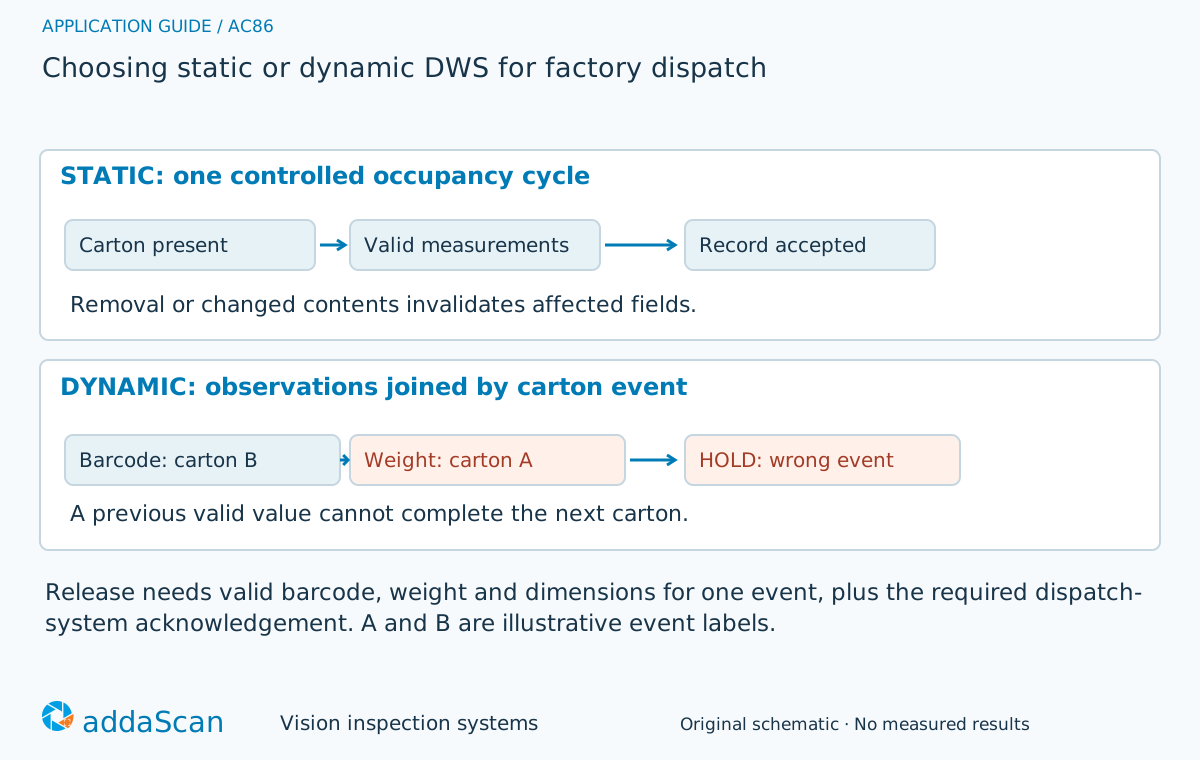
Static DWS waits for a valid occupancy cycle; dynamic DWS associates measurements with a tracked carton. In either path, barcode, weight and dimensions must share the same event before dispatch release. Original workflow schematic.
Select an image to view it at full size.
Compare the complete transaction, not isolated sensor speeds
A static station needs a clear occupancy cycle and confirmation that the carton has settled. Dynamic DWS needs spacing, motion-compatible weighing, dimension coverage and a common object association. Compare exception handling, maintenance access and business-system acknowledgement at equal scope. Legal-for-trade use introduces equipment and approval requirements beyond collecting a numeric weight.
Describe the dispatch sequence before comparing equipment. At a static bench, distinguish empty station, carton present, acquisition in progress, record complete and carton removed. A new barcode should not automatically authorise reuse of the last stable weight. The station needs evidence that the required measurements were obtained for the current occupancy cycle, including when an operator removes and replaces a carton without following the normal sequence.
On a conveyor, assign the observations to a tracked carton event. Barcode read time, scale measurement and dimension capture may occur at different positions. Their association therefore needs the line geometry, object tracking and timing rules, not simply the latest message from each device. Two touching cartons may invalidate both weighing and object association even if a code is readable.
Define a complete record as the required identity, weight and dimensions with valid status for that event. Separate acquisition completion from the response of the warehouse or dispatch system. If the receiving system rejects a record or does not acknowledge it, the physical carton must remain on a defined exception route. A screen displaying three numbers is not evidence that the transaction was accepted.
Choose a bench cycle or a tracked conveyor event
Swipe across the table to compare all columns →
| Approach | Useful when | Limit or integration responsibility |
|---|---|---|
| Static DWS | Packing bench or controlled stop | Validate settling, clear-station detection and operator exceptions. |
| Dynamic DWS | Continuous conveyor flow | Validate spacing, weighing dynamics, field synchronisation and no-read routing. |
Compare both designs with the same barcode faces, package range, exception workload and system interfaces. Static DWS depends on controlled occupancy and operator practice; dynamic DWS depends on spacing, motion-compatible weighing and tracking. The dynamic scan-tunnel budget is relevant only to its stated conveyor configuration. Static equipment, weighing suitability, line modifications and integration must be scoped for the selected workflow rather than inferred from that price.
Reject a current barcode paired with an old weight
Illustrative scenario: the barcode belongs to the current carton, but the weight message still carries the preceding stable reading. Reject the combined transaction.
Clear or reconcile the station, reacquire the current carton and accept only fields within its defined acquisition window. Never populate a timed-out field from the previous result. Release to dispatch after the complete event is confirmed and its business-system response is retained.
A rescan must have an explicit policy for replacing or retaining existing measurements. Reacquire any field invalidated by removal, changed contents or lost object association. Make retries identifiable to the business system so a delayed response to the first attempt does not create two dispatch transactions. Retain the rejected combination as well as the final accepted record.
Test settling, gaps and delayed acknowledgements
Swipe across the table to compare all columns →
| Challenge sample or event | Expected behaviour to establish | Evidence to retain |
|---|---|---|
| Previous weight with current barcode | Reject the mixed transaction. | Current carton event, barcode timestamp, scale value and stability status, stale-field rejection and the reacquired weight. |
| Touching cartons or operator hand in view | Return an occupancy exception. | Carton spacing or occupancy sequence, dimension/weight validity, affected event IDs and the physical exception route. |
| Network timeout after acquisition | Retry the same transaction without duplicate dispatch records. | Transaction ID, sent payload fields, acknowledgement or timeout, retry relationship and final dispatch-release state. |
Exercise a full normal cycle, an early removal, a repeated scan, two cartons too close together, a no-read and a delayed business-system response. Define the permitted action for each before testing. Evaluate field accuracy separately from event association and dispatch control: correct measurements attached to the wrong carton remain a failed system result. The weighing supplier and customer must separately settle any legal-for-trade requirements.
DWS integration does not confer trade approval
Dimension and weight values require their own uncertainty and regulatory evaluation. Vision integration alone does not confer trade approval.
Scope the dispatch workflow before buying DWS
Share permitted photos or drawings, plus details of dispatch volumes, carton range, conveyor spacing, weighing requirements and the destination system message contract. Agree any physical sample arrangements after the initial assessment.
Scan tunnel and parcel dimensioning system describes the dynamic conveyor option and its interfaces. Select the operating cycle first: a static packing bench and a conveyor tunnel have different equipment and exception-handling scopes.
Associating barcodes with touching parcels examines object-to-code association when cartons or parcels touch. Correct association is required before combining the chosen DWS measurements into a dispatch record.
Review the dynamic tunnel budget assumptions. This budget applies to the dynamic tunnel configuration. A static DWS bench, weighing requirements and its business interface need separate assessment.
For line conditions around static versus dynamic dws at factory dispatch, see logistics and distribution inspection.
Compare lighting, processing, interfaces and support in the HIKROBOT and other vision solutions guide. Agree sample testing, acceptance responsibilities and handover through the delivery process.
If carton DWS records are later grouped under a pallet identity, add a separate pallet SSCC and dispatch-order check before loading. The carton measurements must remain linked to the correct handling unit; a valid DWS result does not establish that the pallet is authorised for the dispatch order. Pallet-label reading and the WMS release interface are outside the DWS scope unless explicitly included.