Application guide by addaScanCompare the inspection task, imaging conditions and validation steps with your own production line.
- Inspection focus
- Actual chute evidence after a sort command
- Primary theme
- Barcode scan tunnel
- Decision evidence
- Observed: chute B
- Trial priority
- Wrong-chute arrival
Compare the commanded destination with observed arrival
The original English schematic explains the observable features and the proposed decision. The tables below set out the conditions to test on your own line.
Swipe across the diagram to see all details →
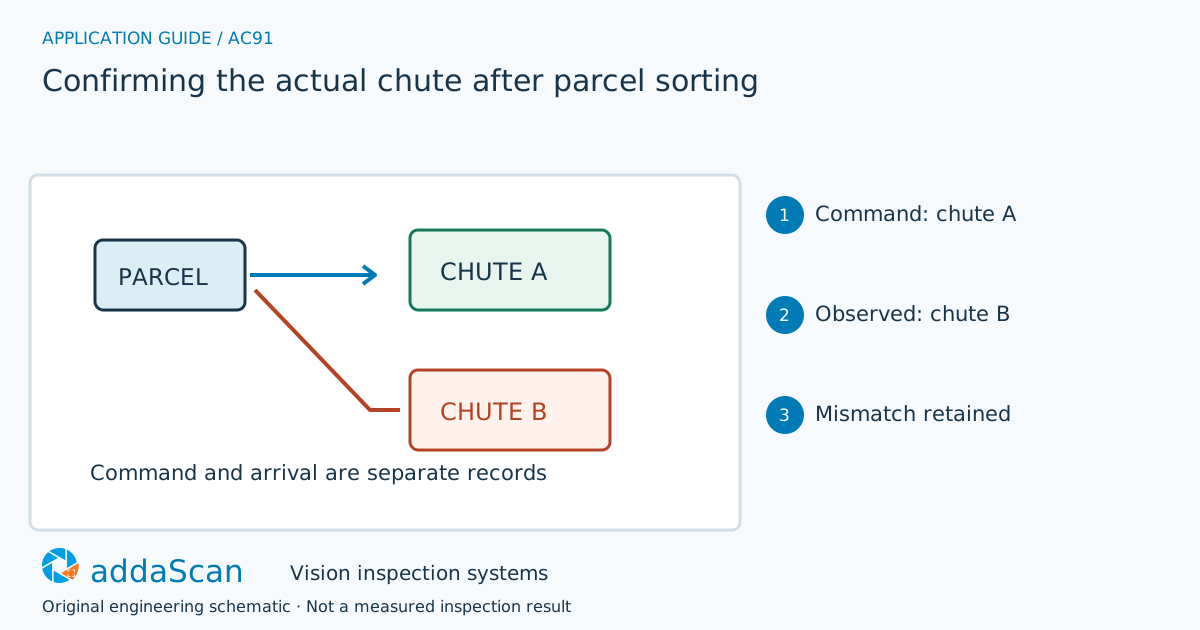
A sorting instruction records intent; a qualified arrival event records the observed destination. Preserve parcel association when events repeat or arrive late. Original confirmation schematic.
Select an image to view it at full size.
Define what counts as confirmed arrival
Choose a sensing region that observes entry into the chute rather than motion nearby. Closely spaced parcels, bounce and partial entry can create several observations for one arrival. Where identification is unavailable at the chute, document the limits of timing-based association. Keep commanded destination, observed destination and reconciliation status as separate fields; overwriting one with another removes the evidence needed to investigate a mis-sort.
Define what observation closes the sort task. A command or diverter acknowledgement describes an intended action; the confirmation must show the parcel reaching the relevant chute or a qualified downstream position. The sensing arrangement needs enough identity and timing evidence to distinguish adjacent parcels, especially where more than one destination can generate a similar signal.
Set the association window from the physical route and validated timing variation. A late event should not automatically satisfy the next parcel’s pending task. Keep unmatched arrivals, missing arrivals and confirmed wrong-chute arrivals as distinct states. The evidence and operational response differ even though all three prevent an uncomplicated confirmation.
Choose arrival evidence that can identify the parcel event
Swipe across the table to compare all columns →
| Approach | Useful when | Limit or integration responsibility |
|---|---|---|
| Command acknowledgement | Confirms that the controller accepted a request | Does not prove parcel arrival. |
| Chute observation with event association | Checks physical outcome | Needs coverage, timing and duplicate-event rules. |
A simple arrival sensor may suffice where mechanical sequencing makes parcel association unambiguous. Where several parcels can occupy the route, additional tracking or identity evidence may be required. Compare the complete event association with the upstream reader and sorter interface; scan-tunnel decoding alone does not establish the arrival.
A sorter command is not proof of the correct chute
Illustrative scenario: the control system commands chute A, while the associated parcel event appears at chute B. Record a mismatch and hold the affected dispatch flow for reconciliation.
Preserve the command, observations and any manual recovery. Before resuming, confirm the recovered parcel destination and resolve neighbouring ambiguous events. Release follows a reconciled physical destination, not a rewritten command that now agrees with the error.
Debounce repeated observations of one arrival without deleting evidence of a possible second parcel. On an unresolved event, reconcile the route or exception area before clearing the task. Preserve the commanded and observed destinations even if an operator later moves the parcel.
Challenge bounces, duplicate observations and close spacing
Swipe across the table to compare all columns →
| Challenge sample or event | Expected behaviour to establish | Evidence to retain |
|---|---|---|
| Wrong-chute arrival | Retain intended and observed destinations. | Parcel event, commanded chute, actual arrival location/time and the recorded wrong-route disposition. |
| Bounce or repeated observation | Create one confirmed arrival or an explicit exception. | Raw arrival sequence, bounce/repeat association, unique confirmation event and any unresolved second-item evidence. |
| Closely spaced parcels | Demonstrate association or hold ambiguous events. | Adjacent parcel IDs, expected windows, observed events, ambiguous associations and the reconciliation used before closure. |
Test correct, missing and wrong arrivals, then bouncing parcels and minimum allowed spacing. Confirm the system does not improve apparent success by assigning unmatched events to whichever task is open.
Chute confirmation depends on observable identity and timing
An arrival sensor may not establish parcel identity by itself. Scope the association uncertainty honestly.
Define the downstream confirmation and exception route
Share permitted photos or drawings, plus details of sorter timing, chute geometry, parcel spacing and control-system event messages. Agree any physical sample arrangements after the initial assessment.
Carton and pallet verification helps define identity and process-state matching. The upstream scan tunnel supplies different evidence from actual chute arrival and should be scoped separately.
Associating barcodes with touching parcels examines ambiguous reads between touching parcels. Correct initial identity is a prerequisite for a defensible downstream arrival association.
Use the cost and scope guide to understand the station boundary. Chute-arrival confirmation is a downstream association and sensing task; the upstream scan-tunnel price does not cover that scope automatically.
For line conditions around actual chute evidence after a sort command, see logistics and distribution inspection.
Compare lighting, processing, interfaces and support in the HIKROBOT and other vision solutions guide. Agree sample testing, acceptance responsibilities and handover through the delivery process.