Application guide by addaScanCompare the inspection task, imaging conditions and validation steps with your own production line.
- Inspection focus
- Carrier occupancy and overhang before sorting
- Primary theme
- Vision counting system
- Decision evidence
- Two parcels one carrier
- Trial priority
- Two same-height parcels with one code
Check single-item loading and the carrier envelope separately
The original English schematic explains the observable features and the proposed decision. The tables below set out the conditions to test on your own line.
Swipe across the diagram to see all details →
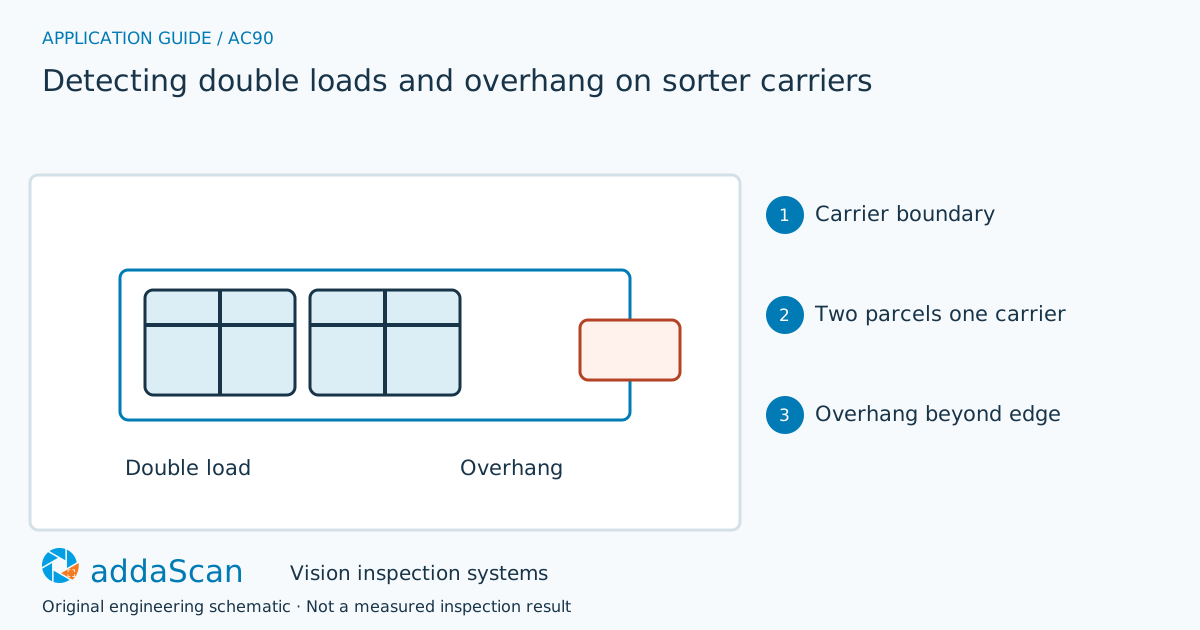
One barcode is compatible with a double load. Check the physical load count and the carrier boundary separately before authorising transport. Original sorter-load schematic.
Select an image to view it at full size.
Locate the carrier before segmenting its load
Use a carrier ID or reliable position event to bind observations to the transport unit. Evaluate the load boundary against the usable carrier area, allowing only approved overhang. Two same-height parcels can merge in a height envelope, so depth alone is not a universal item counter. Test colour, seams, spacing and profiles on real parcel combinations, with an explicit uncertain-occupancy outcome.
Locate the carrier and define its permitted loading region before interpreting parcels. Overall height or one barcode cannot establish that exactly one physical item is present. Two similarly high parcels may share an apparently continuous surface, while one large parcel can overhang despite being a valid single item.
Assign object boundaries and envelope clearance as separate results. Use the carrier identity or position in the sorter cycle to retain those results until the corresponding handling decision is complete. When boundaries are hidden by straps, wrapping or contact, preserve uncertainty rather than using one readable code as the count reference.
Compare object separation with overall load shape
Swipe across the table to compare all columns →
| Approach | Useful when | Limit or integration responsibility |
|---|---|---|
| 2D load boundaries | Separated parcels and visible edges | Touching similar parcels can merge. |
| Combined profile and image evidence | Overhang and variable shapes | Same-height neighbours still require boundary evidence. |
A footprint view can reveal overhang where the carrier edge remains visible. Additional appearance or height evidence may be needed to separate touching objects. Compare the worst double-load geometry and smallest carrier margin, not just isolated parcels centred on the tray.
One readable code can accompany two parcels
Illustrative scenario: two small parcels sit on one carrier, but only one label is read. Divert the carrier as a double load and retain both the occupancy evidence and code result.
Singulate the parcels and create the correct new loading events, preserving the original exception. Release each parcel only after its own occupancy, envelope and identity checks agree.
After an operator unloads or reloads a carrier, invalidate its previous load result. Recheck the new physical load and any code association. An empty-carrier confirmation may be needed to close the previous event before a replacement parcel is accepted.
Challenge equal-height doubles and overhanging singles
Swipe across the table to compare all columns →
| Challenge sample or event | Expected behaviour to establish | Evidence to retain |
|---|---|---|
| Two same-height parcels with one code | Detect occupancy independently of read count. | Carrier event, physical object regions, single decoded code and the double-load decision independent of code count. |
| Single parcel over the carrier edge | Record which permitted boundary is exceeded. | Carrier reference, parcel footprint, exceeded boundary and the action preventing an unsuitable load from continuing. |
| Reloaded parcels | Prevent the original carrier result from passing the new loads. | Previous load result, unload/reload sequence, new object/code association and fresh envelope/count decisions. |
Include two parcels at the same height, an overhanging single and a reload without a normal empty interval. Confirm that each physical load produces the correct carrier result and that stale acceptance cannot survive reloading.
A valid load image does not confirm arrival at the destination
This inspection does not establish contents or transport safety for every load type.
Define the carrier layout and reload process
Share permitted photos or drawings, plus details of carrier dimensions, parcel combinations, allowed overhang and diversion/reloading procedures. Agree any physical sample arrangements after the initial assessment.
Presence and counting inspection helps define physical occupancy and unresolved object boundaries. Add the carrier-envelope and cycle association requirements to the same station scope.
Associating barcodes with touching parcels addresses code-to-object association for touching parcels. That association must remain separate from the number of physical items loaded onto the carrier.
Use the cost and scope guide to understand the station boundary. An estimate depends on the required views, product presentation, exception handling and connection to the existing line. A similar camera does not establish the price of this application.
For line conditions around carrier occupancy and overhang before sorting, see logistics and distribution inspection.
Compare lighting, processing, interfaces and support in the HIKROBOT and other vision solutions guide. Agree sample testing, acceptance responsibilities and handover through the delivery process.