Application guide by addaScanCompare the inspection task, imaging conditions and validation steps with your own production line.
- Inspection focus
- Single-tray confirmation before filling
- Primary theme
- Dimensional measurement
- Decision evidence
- Nested double rim
- Trial priority
- Nested pairs with aligned outlines
Look for the feature that distinguishes one tray from two
The original English schematic explains the observable features and the proposed decision. The tables below set out the conditions to test on your own line.
Swipe across the diagram to see all details →
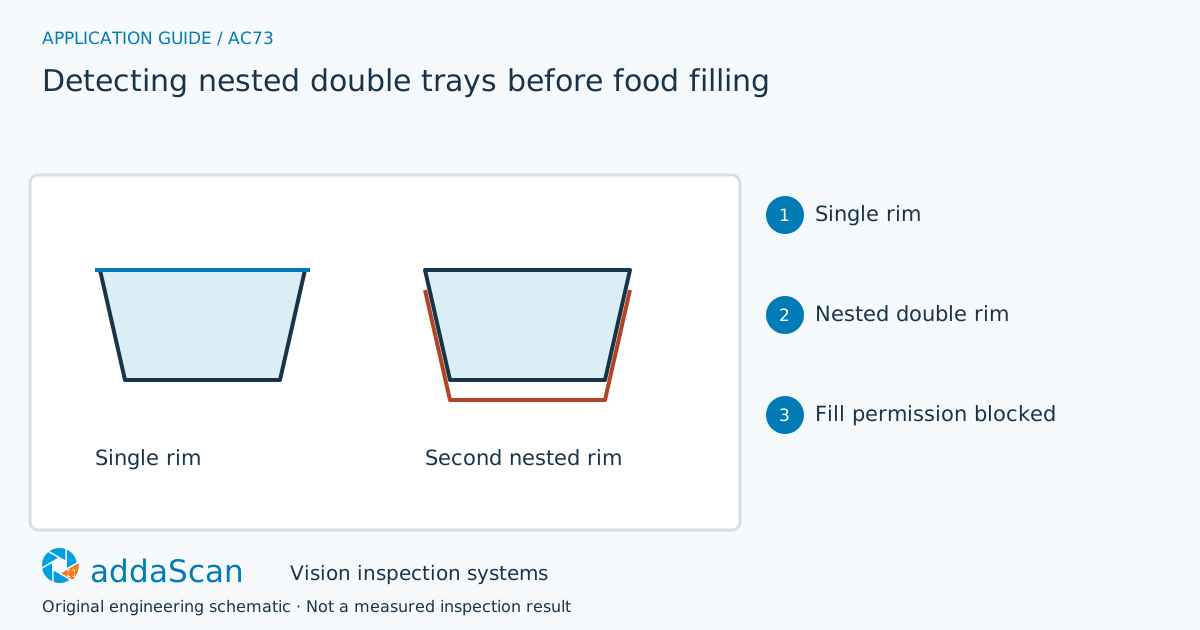
Nested trays can share one top outline. Use valid rim-separation or support-referenced height evidence before allowing filling. Original schematic; tray material feasibility still requires samples.
Select an image to view it at full size.
Measure the rim relationship rather than the outside outline
A side view may reveal a second rim if the conveyor and guides leave it exposed. Height measurement can help when colour and top contours overlap, but tray flex and support variation must be included. Establish the single-tray reference for each mould and material. A fixed threshold above the belt can confuse a lifted single tray with a nested pair unless the tray pose is also known.
Use a physical distinction that survives the permitted nesting and material variation. Two trays may share an almost identical top outline, while their rims or total stack height reveal the double feed. A single tray may also be warped or sitting on debris, so absolute height alone must not become an untested proxy for the number of trays.
Locate the tray relative to the actual support and include all allowed formats. Transparent or reflective rims can produce weak or multiple surface returns. If the chosen feature is not measurable, block the fill permission under the agreed exception rule. Treat a missing measurement separately from confirmed double feed so the operator knows whether to separate trays or restore acquisition.
Compare rim views with a qualified height check
Swipe across the table to compare all columns →
| Approach | Useful when | Limit or integration responsibility |
|---|---|---|
| Side-view silhouette | Exposed, repeatable rim separation | Guide rails must not hide the second edge. |
| Height or profile sensor | Ambiguous overlapping contours | Validate flex, support height and missing profile data. |
A rim view is attractive when the nested separation remains visible across all formats. Height measurement can help where the rims coincide, but needs a stable support reference and valid surface evidence. Compare both on deliberately aligned double trays and the worst acceptable single-tray distortion.
Matching top outlines can conceal a double feed
Illustrative scenario: the top outline looks normal, while the side profile shows a second rim. Inhibit filling for that tray event and remove the nested pair.
After clearing the feed, verify a known single tray and rebuild the association between detection and filler position. On restart, resolve trays already between the inspection station and filler. Release requires a valid single-tray result for the physical tray now at the filling position.
After a feeder stop, identify trays already between inspection and filling. Reinspect uncertain trays before issuing new fill permissions. Clearing the feeder alarm must not release an earlier unresolved tray simply because the current camera view is empty.
Challenge warped trays and stopped feed cycles
Swipe across the table to compare all columns →
| Challenge sample or event | Expected behaviour to establish | Evidence to retain |
|---|---|---|
| Nested pairs with aligned outlines | Detect the additional rim or height evidence. | Physical single/double identity, aligned top outlines, rim or height evidence and the corresponding fill-permission result. |
| Warped single tray | Avoid confusing flex with a second tray. | Independently identified warped single tray, support condition, measured distinguishing feature and false-double review. |
| Stop with trays in transit | Prevent stale single-tray results from enabling filling. | Tray events in transit, stop/restart state, unresolved permission and the reacquisition that authorises filling. |
Repeat both tray count states over material batches and permitted supports. Deliberately remove the usable optical feature to verify the invalid-result path. Downstream lid or seal inspection cannot repair product filled into a double tray, so validate the upstream interlock itself.
An empty-tray check does not verify the later seal
Tray count does not establish cleanliness, cracks or suitability for food contact.
Define the tray-feed interlock before filling
Share permitted photos or drawings, plus details of tray families, nested pairs, warped singles, rim access and distance to the filler. Agree any physical sample arrangements after the initial assessment.
Presence and counting inspection addresses single-versus-double presence at the feeder. A profile check may assist that decision, but filling permission must also handle invalid acquisition.
Yoghurt cup lid presence and alignment deals with lids after filling. That downstream check has a different object and trigger from empty-tray double-feed detection.
Use the cost and scope guide to understand the station boundary. Double-tray feeding is a different station from finished-tray seal inspection. Any profile sensor and feeder changes require their own scope.
For line conditions around single-tray confirmation before filling, see meat, staples and dry-goods packing.
Compare lighting, processing, interfaces and support in the HIKROBOT and other vision solutions guide. Agree sample testing, acceptance responsibilities and handover through the delivery process.