Application guide by addaScanCompare the inspection task, imaging conditions and validation steps with your own production line.
- Inspection focus
- Coating defects versus accepted texture
- Primary theme
- Surface defect detection
- Decision evidence
- Local coating defect
- Trial priority
- Accepted orange peel and actual defects
Define acceptable texture before classifying coating faults
Reference imagery and an original English schematic explain the observable features and the proposed decision. The tables below set out the conditions to test on your own line.

This application rendering illustrates a reflective-surface inspection arrangement. Suitability for a particular coating must be established with samples.
Swipe across the diagram to see all details →
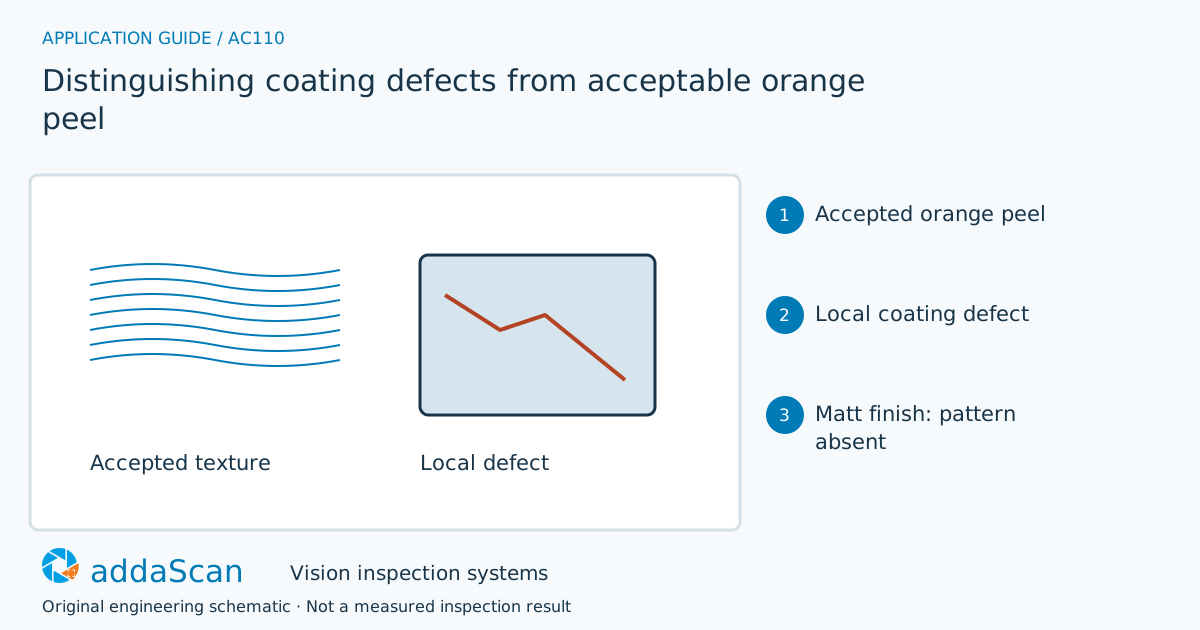
Accepted orange peel and a local defect need labelled references. A matt surface that returns no usable pattern cannot be declared defect-free by that method. Original schematic; the rendering illustrates a reflective-surface arrangement.
Select an image to view it at full size.
Qualify the optical response before grading orange peel
Compare normal orange peel, scratches, dents and other specified defects under the proposed illumination. A diffuse surface may need directional or scattered-light imaging instead of a reflected-pattern method. Recipe, pigment and gloss changes alter the signal; a baseline from a smooth glossy sample cannot automatically grade powder-coated production. Define which texture is acceptable using physical reference samples.
Use physical references to define acceptable orange peel and the local defects that require action. A texture model trained on smooth glossy panels may reject an acceptable powder-coated finish, while a broad texture average may conceal a local dent or scratch. Preserve region-level evidence and the coating recipe or finish class used for the comparison.
A reflected-pattern method needs the surface to return a usable pattern under the proposed geometry. On a matt or highly scattering finish, absent stripes are a failed acquisition condition, not a clean surface. Directional or scattered-light images may be more informative there, but require their own comparison with accepted texture and known defects.
Choose the method from the surface reflection behaviour
Swipe across the table to compare all columns →
| Approach | Useful when | Limit or integration responsibility |
|---|---|---|
| Reflected-pattern deflectometry | Suitable reflective surfaces and slope defects | Requires a usable pattern response and controlled geometry. |
| Directional or scattered-light imaging | Surfaces better described by intensity and texture | Needs tests against accepted orange peel and finish variation. |
Compare the candidate methods on the same finish and fault set. A method effective on automotive gloss cannot automatically be transferred to every pigment or coating. Record pattern validity, surface coverage and defect evidence separately before selecting the acquisition technique.
An absent reflected pattern is an invalid observation
Illustrative scenario: projected stripes are not distinguishable on a matt finish. Mark that acquisition method invalid for the sample rather than interpreting the empty result as a clean surface.
Select and qualify another lighting approach with both accepted texture and known defects. Release under the revised recipe only after it separates the required conditions. Reconfirm the baseline when gloss or coating formulation changes.
After a pigment, gloss or formulation change, qualify the existing acquisition and reference set before grading the new finish. An updated recipe must retain the known defect challenges, not just learn the new acceptable texture.
Challenge pigment and gloss changes against the references
Swipe across the table to compare all columns →
| Challenge sample or event | Expected behaviour to establish | Evidence to retain |
|---|---|---|
| Accepted orange peel and actual defects | Record decisions against labelled physical references. | Approved orange-peel reference, confirmed local defect, coating recipe and region-level distinction under the selected method. |
| Matt sample without reflected pattern | Return invalid acquisition. | Matt-surface response, missing reflected pattern, acquisition-invalid flag and evidence supporting an alternative lighting trial. |
| New pigment or gloss | Requalify the baseline before routine release. | Old/new pigment or gloss reference, recipe/model version, retained defect challenges and controlled restart decision. |
Evaluate normal texture and real defects across the intended finish range, including an intentionally unsuitable sample for the optical method. Verify that acquisition failure cannot appear as zero detected defects. Thickness, adhesion and corrosion protection remain separately tested properties.
Appearance does not measure coating adhesion or thickness
Visible texture does not establish coating thickness, adhesion or corrosion resistance.
Prepare approved texture and actual defect samples
Share permitted photos or drawings, plus details of finish families, gloss range, accepted texture panels, defects and production viewing constraints. Agree any physical sample arrangements after the initial assessment.
Surface defect detection defines the visible coating decision and its acquisition limits. Confirm optical suitability for the actual finish before specifying a station.
Scratch detection on aluminium extrusions separates scratches from normal texture on extrusions. Coated parts likewise need their own accepted texture and reflection conditions.
Use the cost and scope guide to understand the station boundary. Reflected-pattern acquisition or alternative lighting must be qualified for the actual finish before equipment and engineering can be priced.
For this check on coated metal parts, metal-component inspection places the surface decision in the surrounding manufacturing process.
Compare lighting, processing, interfaces and support in the HIKROBOT and other vision solutions guide. Agree sample testing, acceptance responsibilities and handover through the delivery process.