Application guide by addaScanCompare the inspection task, imaging conditions and validation steps with your own production line.
- Inspection focus
- Particles, bubbles and product opacity
- Primary theme
- Surface defect detection
- Decision evidence
- Particle needs evidence
- Trial priority
- Clear and naturally cloudy recipes
Bubbles, particles and obscured liquid need separate decisions
The original English schematic explains the observable features and the proposed decision. The tables below set out the conditions to test on your own line.
Swipe across the diagram to see all details →
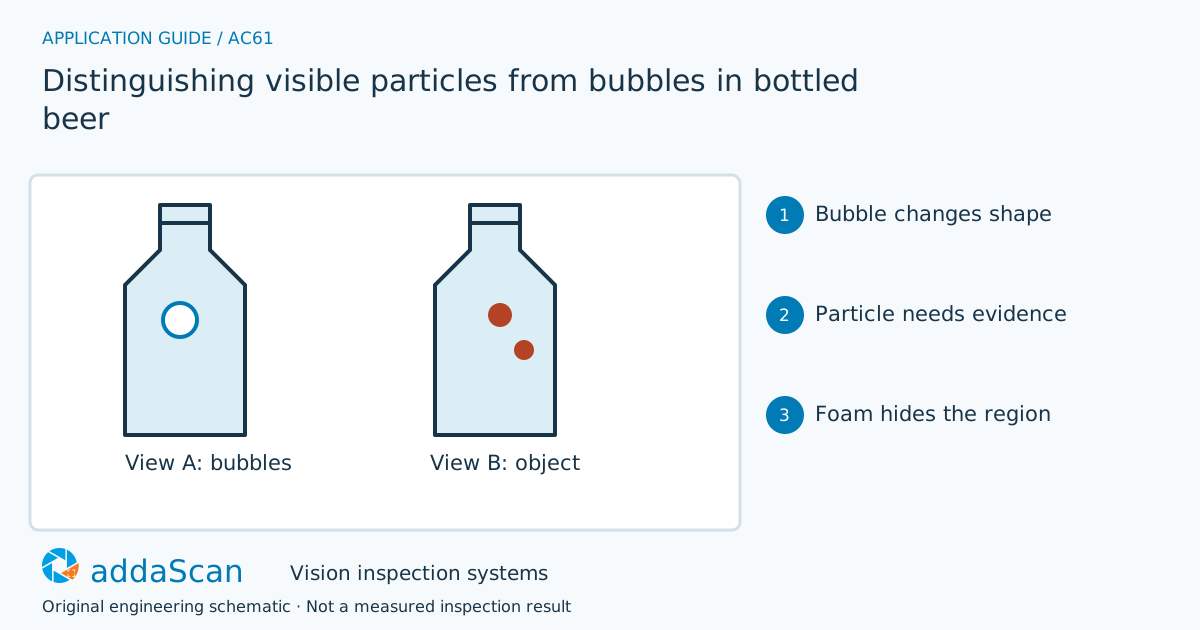
Changing bubble shapes, a persistent suspect object and foam-obscured liquid require different responses. Additional views help only when they reveal usable evidence for the same bottle. Original schematic; no detection rate is shown.
Select an image to view it at full size.
Build the recipe baseline before classifying dark spots
Use transmitted illumination to reveal changes within the liquid, testing wavelength and exposure on the actual bottle colour. A second view can help separate a mark on the wall from an object in the liquid, but it does not make an opaque product transparent. Register the bottle outline and exclude only regions whose inspection scope has been explicitly agreed. Normal yeast sediment in one beer may be unacceptable in another; a single brightness threshold cannot represent both recipes.
Build the sample set around the beer recipe, bottle colour and expected product state after filling. A feature accepted as normal sediment in one product may be a rejection in another. Identify the physical samples independently before using their images to tune a rule; otherwise the system can learn a visual difference without knowing whether it represents a quality fault.
Describe the inspected liquid volume and the regions obscured by foam, labels or glass features. Two views are useful when they expose additional evidence about the same bottle, but two equally blocked views do not complete coverage. Any controlled motion or settling delay must fit the handling sequence and must not introduce an unqualified change in the product appearance.
Choose views from the liquid region you must inspect
Swipe across the table to compare all columns →
| Approach | Useful when | Limit or integration responsibility |
|---|---|---|
| One transmitted view | Stable, clear product with accessible inspection region | Challenge wall marks and bubbles before accepting its coverage. |
| Two views or controlled motion | Differentiate overlapping features and test persistence | Synchronise views to one bottle; confirm motion does not create extra foam. |
Compare transmitted views on the darkest bottle and cloudiest permitted recipe, not only on a clear demonstration bottle. A second view should help test wall association or persistence of a feature. If the required defect cannot be separated from normal product variation, narrow the supported check or evaluate another method rather than describing the station as detecting every foreign material.
A persistent dark feature needs sample evidence
Illustrative scenario: a bright ring changes shape between observations, while a separate dark object remains visible from another direction. Compare those features with labelled bubble and foreign-particle samples instead of classifying by brightness alone.
Hold the bottle when the object remains suspect and retain both images under its event ID. If foam prevents a decision, use the agreed settling and reinspection route. Release requires a complete valid observation and an accepted classification; a missing view stays unresolved.
Keep foam-obscured bottles identifiable while they wait for reinspection. A new clear view can resolve missing coverage, whereas a suspected foreign particle requires a quality disposition. Do not merge those two exception routes into one operator reset that releases all waiting bottles.
Challenge beer recipes before setting defect rules
Swipe across the table to compare all columns →
| Challenge sample or event | Expected behaviour to establish | Evidence to retain |
|---|---|---|
| Clear and naturally cloudy recipes | Use separate baselines; record where transmission becomes insufficient. | Recipe and bottle colour, independently labelled product state, visible-liquid coverage and the acquisition settings used for each recipe. |
| Known particles, bubbles and normal sediment | Retain classification and both images, including false rejects. | Physical sample identity, bubble/sediment/particle label, paired images from the same bottle and the accepted classification rule. |
| Foam and bottle-wall marks | Require an explicit obscured state and prove the reinspection route. | Foam or wall-mark region, unresolved volume, settling/reinspection sequence and the quality disposition linked to the bottle event. |
Repeat both acceptable and defect samples through the actual handling conditions. Include expected startup foam and normal recipe changes. Record confirmed defects, false rejects and unresolved coverage separately so a reduction in rejects cannot conceal an increase in uninspected bottles.
Visible particles are only part of beverage quality
This is a visible-appearance check. It does not establish microbiological safety, dissolved contamination or detection of every foreign material.
Prepare bottles across the actual product range
Share permitted photos or drawings, plus details of bottle colours, recipe variation, normal sediment rules, known defect sample examples and the available time between filling and inspection. Agree any physical sample arrangements after the initial assessment.
Surface defect detection helps define which visible product states can support a decision. For filled beer, feasibility depends on the recipe and optical path through the bottle, not just on camera resolution.
Inspecting visible fill levels on a beverage line concerns the liquid boundary. A valid fill-level result does not resolve particle evidence hidden within the liquid.
Use the cost and scope guide to understand the station boundary. An estimate depends on the required views, product presentation, exception handling and connection to the existing line. A similar camera does not establish the price of this application.
For line conditions around particles, bubbles and product opacity, see bottling and canning inspection.
Compare lighting, processing, interfaces and support in the HIKROBOT and other vision solutions guide. Agree sample testing, acceptance responsibilities and handover through the delivery process.