Application guide by addaScanCompare the inspection task, imaging conditions and validation steps with your own production line.
- Inspection focus
- Bakery shape and colour by recipe
- Primary theme
- Surface defect detection
- Decision evidence
- Touching silhouettes
- Trial priority
- Touching rolls and single large rolls
Separate products before judging their shape and browning
The original English schematic explains the observable features and the proposed decision. The tables below set out the conditions to test on your own line.
Swipe across the diagram to see all details →
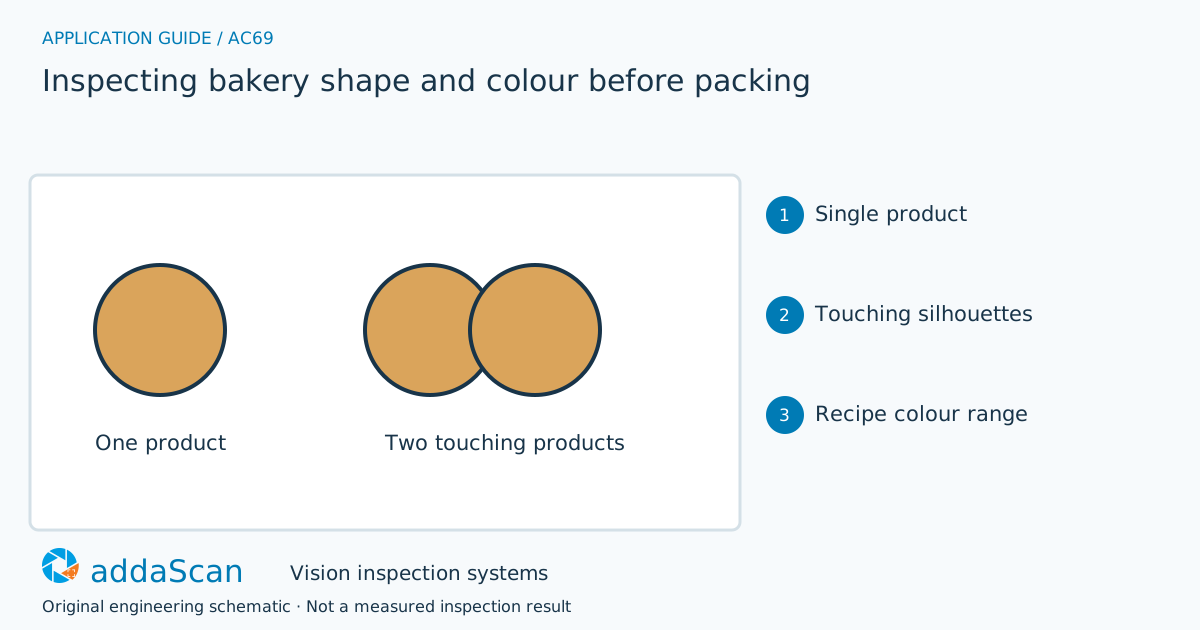
A touching pair can form an oversized silhouette without either roll being oversized. Establish product boundaries before applying recipe-specific appearance rules. Original schematic; internal baking quality is not measured.
Select an image to view it at full size.
Separate presentation faults from bake appearance
Use controlled colour illumination and a stable exposure before setting browning limits. Locate the product independently of the belt and account for normal flour, seeds or toppings. Size measured from a silhouette depends on separation and camera geometry; changing belt height can change apparent size. Keep a recipe reference set across expected bake variation, rather than treating the latest batch as automatically acceptable.
Define whether the measurement applies to each product or to an arranged group. Touching rolls may form a single outline, so a size decision made before separation can reject two acceptable items as one oversized item. Locate the product boundaries or mark the connected group unresolved; a known expected count should not be used to invent an invisible boundary.
Use approved examples for each recipe, including normal flour, toppings and browning variation. Colour comparison requires a controlled illumination and camera state. A new lamp, recipe or exposure may move the measured appearance even when the baked product has not changed. Keep the reference set and acquisition configuration identifiable so production can distinguish process drift from imaging drift.
Choose stable measurements or a qualified appearance model
Swipe across the table to compare all columns →
| Approach | Useful when | Limit or integration responsibility |
|---|---|---|
| Geometric and colour rules | Stable product shape and defined colour bands | Need controlled illumination and separated objects. |
| Appearance model | Variable surfaces and toppings | Needs labelled recipe variation and explicit handling of unseen appearances. |
Geometric features suit stable, separable outlines. An appearance model may describe complex normal variation, but its accepted range must include the real recipe and topping changes. If overlap dominates the failures, improve product separation or inspect at another point before increasing model complexity.
Two touching rolls can resemble one oversized product
Illustrative scenario: two rolls touch and form a large connected outline. Route them for separation rather than classifying that outline as one oversized roll.
Capture the separated products and apply the shape and colour rules to each. Preserve the overlap event so a feed problem can be traced. Following a recipe change, confirm accepted reference samples and run the known defects before releasing the new product flow.
When a group is separated for reinspection, relate the resulting items to the contained group and apply the active recipe to each. After an illumination change, check reference products before releasing production under the old colour boundary.
Challenge flour, toppings and changed lighting
Swipe across the table to compare all columns →
| Challenge sample or event | Expected behaviour to establish | Evidence to retain |
|---|---|---|
| Touching rolls and single large rolls | Distinguish presentation from actual size. | Connected-group image, independently identified rolls, separation result and per-product shape decisions after reinspection. |
| Flour, toppings and bake extremes | Retain colour images and the accepted reference labels. | Recipe and approved appearance examples, flour/topping condition, acquired colour image and the reason for acceptance or rejection. |
| Lamp or recipe change | Repeat the reference test before resuming release. | Old/new illumination or recipe configuration, reference-product results and authorisation to resume the appearance check. |
Evaluate normal variation and actual visible defects separately for each recipe. Include startups, product contact and background crumbs. Record unresolved segmentation alongside defect results so an apparently low rejection rate does not conceal products that were never individually evaluated.
Surface appearance cannot establish internal bake quality
Surface colour does not prove internal cooking, moisture content or food safety.
Prepare approved products for each bakery recipe
Share permitted photos or drawings, plus details of accepted and rejected bake sample examples, recipes, toppings, belt presentation and the current visual grading rules. Agree any physical sample arrangements after the initial assessment.
Bakery product vision inspection covers visible bakery shape, colour and arrangement. Product separation, approved recipe variation and gentle reject handling should be defined together.
Food-tray seal-area contamination inspection examines tray seal-area contamination. Treat any later packaging check as a separate decision from bakery appearance before packing.
Review the scope and cost drivers. This solution lists scope and cost drivers, not a numerical price before feasibility and handling are defined.
For line conditions around bakery shape and colour by recipe, see dairy, juice and bakery lines.
Compare lighting, processing, interfaces and support in the HIKROBOT and other vision solutions guide. Agree sample testing, acceptance responsibilities and handover through the delivery process.