Application guide by addaScanCompare the inspection task, imaging conditions and validation steps with your own production line.
- Inspection focus
- Returnable-crate pocket condition after washing
- Primary theme
- Surface defect detection
- Decision evidence
- Raised obstruction
- Trial priority
- Clean wet crates and residue
Inspect the pockets rather than inferring from the outer frame
The original English schematic explains the observable features and the proposed decision. The tables below set out the conditions to test on your own line.
Swipe across the diagram to see all details →
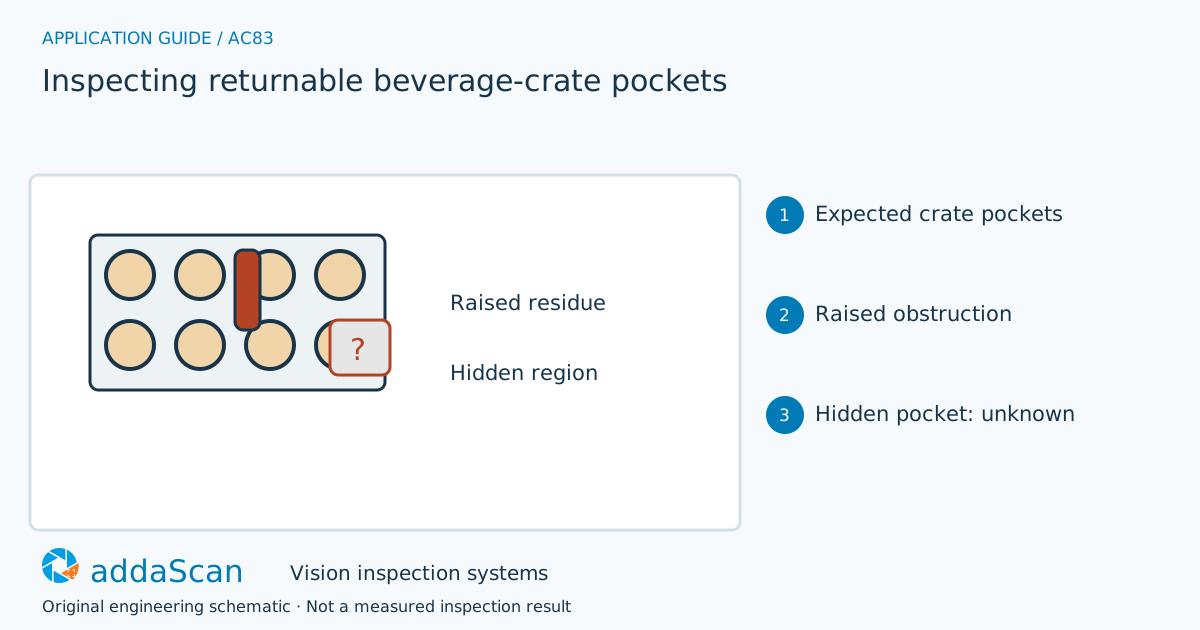
Check each required pocket and structural region. Water, residue, broken geometry and invalid depth are different states and need different responses. Original crate-inspection schematic.
Select an image to view it at full size.
Use the correct crate layout to interpret recesses
Each crate family has intentional openings, ribs and pocket walls. Register that geometry before treating a dark region or missing profile as damage. Multiple views may be needed behind partitions. Wet plastic changes reflection after washing, and a deep recess may be optically hidden even when clean. Record coverage independently of the defect classification so that an incomplete scan cannot pass as an empty pocket.
Identify the crate family and its expected internal geometry before judging pockets. Intentional openings, ribs and drainage features should be part of the reference, while a missing rib or retained object should remain a distinct fault. A matching outside frame does not establish that the correct internal layout was used.
Post-wash water can obscure intensity or depth evidence. Test clean wet crates alongside real visible residue rather than treating every unusual return as dirt. Record valid coverage for each required pocket and structural region. An empty-looking hole in a depth map may be an optical failure, so acceptance needs a qualified observation of the space or surface being checked.
Choose views from internal geometry and wet surface behaviour
Swipe across the table to compare all columns →
| Approach | Useful when | Limit or integration responsibility |
|---|---|---|
| 2D views | Visible debris and gross structural changes | Wet reflections and pocket shadows need challenge samples. |
| Multiple profiles or depth views | Raised obstructions and pocket geometry | Occlusion remains possible; missing points require a separate state. |
Intensity images may reveal visible residue; depth can help with internal shape or occupancy where returns are valid. Neither replaces missing coverage behind a rib. Compare viewing directions and crate presentation using the real washing condition, including drainage time where it affects visibility.
Missing depth is not proof of an empty pocket
Illustrative scenario: a pocket contains a raised feature where a clear seating area is expected. Compare it with the valid crate model and route the crate for cleaning or structural assessment as appropriate.
Rescan the same crate after intervention. If the initial result was missing depth behind a wall, improve the view rather than declaring a hole. Release requires a recognised crate format and valid results for the required pockets.
After clearing residue or changing crate presentation, reacquire the affected regions and confirm the correct crate recipe. Unknown crate types remain on an exception route until their geometry is qualified. Cleaning-machine completion alone does not resolve a failed visual pocket check.
Challenge residue, broken ribs and unknown crate types
Swipe across the table to compare all columns →
| Challenge sample or event | Expected behaviour to establish | Evidence to retain |
|---|---|---|
| Clean wet crates and residue | Separate reflection changes from actual obstructions. | Crate type, clean-wet and residue reference images, pocket-level validity and the distinct residue versus invalid-view decision. |
| Broken ribs and intentional openings | Use format-specific geometry. | Expected rib/opening map, observed broken region, complete required coverage and physical crate disposition. |
| Unknown crate or hidden pocket | Hold until format and coverage are resolved. | Unknown type or hidden pocket, selected recipe, attempted re-presentation and final resolved/held region map. |
Challenge clean water films, retained objects, broken ribs and wrong crate types. Require every named pocket or structural feature to have a valid result. Keep hygiene or microbiological verification outside the visible condition claim.
Visible crate condition does not prove hygienic cleanliness
Optical cleanliness checks do not certify microbiological sanitation or load-bearing strength.
Prepare crate variants and post-wash conditions
Share permitted photos or drawings, plus details of washed crate families, damage and residue sample examples, wetness variation and accessible camera positions. Agree any physical sample arrangements after the initial assessment.
Crate inspection for returnable bottle lines covers the visible crate and pocket station. Decide which wash-line state is being assessed and which regions must be observable before accepting a crate.
Returnable glass bottle inspection inspects the returned bottles themselves. An accepted crate cannot substitute for the bottle inspection required before filling.
Review the indicative station budget and exclusions. Use the crate budget for the stated visible crate and pocket checks; permanent-ID reading and hygiene certification are separate requirements.
For line conditions around returnable-crate pocket condition after washing, see bottling and canning inspection.
Compare lighting, processing, interfaces and support in the HIKROBOT and other vision solutions guide. Agree sample testing, acceptance responsibilities and handover through the delivery process.