Application guide by addaScanCompare the inspection task, imaging conditions and validation steps with your own production line.
- Inspection focus
- A valid print region on mixed-height packs
- Primary theme
- Dimensional measurement
- Decision evidence
- Usable print area
- Trial priority
- Tilted top and edge obstruction
The usable print face is not necessarily the highest point
The original English schematic explains the observable features and the proposed decision. The tables below set out the conditions to test on your own line.
Swipe across the diagram to see all details →
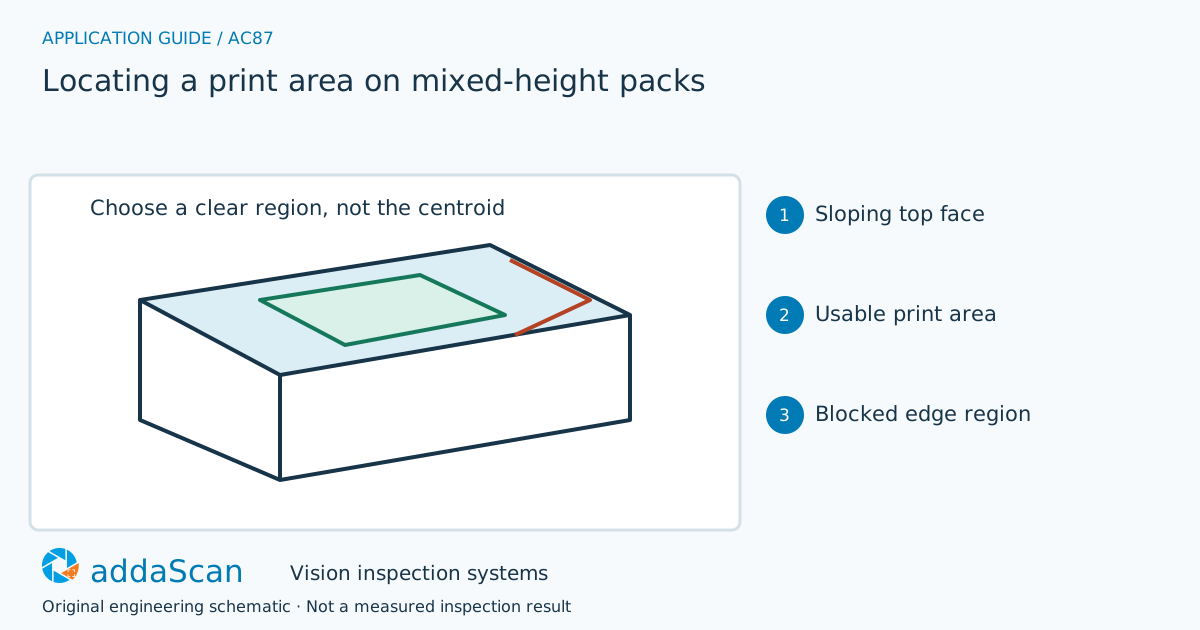
Select a surface region large and correctly oriented enough for the permitted mark. A high point or object centre alone does not define a valid print area. Original localisation schematic.
Select an image to view it at full size.
Define printable geometry and coordinate freshness
The printer may require a bounded standoff, surface angle and clear region around the mark. Height sensing can locate the top surface, but tape, flaps and sloping edges may occupy part of it. Transform the valid region into printer coordinates and account for travel since acquisition. A coordinate that was correct before a conveyor stop may no longer describe the pack after manual movement.
Specify the allowed mark area, clearance from edges and any regions excluded by folds, labels or surface damage. The object centre or highest return is only a localisation feature; it does not prove that the full intended mark fits on a suitable surface. Evaluate the local face pose and usable region under the actual packaging material.
Relate the observation to the printer’s coordinate system and the pack event. If the pack moves after capture, define how the position is updated or when the old command becomes invalid. A correctly located point becomes unsafe for print quality if the face tilts or an obstruction enters before the mark is applied.
Choose a reference that represents the permitted mark area
Swipe across the table to compare all columns →
| Approach | Useful when | Limit or integration responsibility |
|---|---|---|
| Fixed print position | Uniform pack height and constrained pose | Needs mechanical control and adequate print clearance. |
| Vision-guided print region | Mixed heights and variable surfaces | Needs calibrated coordinates, valid-region logic and printer acknowledgement. |
A controlled fixed-height presentation may need only two-dimensional face localisation. Variable height or face angle can require additional geometric evidence and printer-interface support. Compare the complete permitted mark region and motion, not just whether a sensor reports an object centre.
A centred target can still place print across an edge
Illustrative scenario: the pack top is tilted and its apparent centre falls near an obstructed edge. Withhold the print request and keep that pack event unresolved.
Reposition the pack, obtain a fresh region and issue a new request only while its coordinates remain valid. Use downstream readback to confirm the printed content and location. Release after both placement and readback requirements are satisfied.
On printer timeout, determine whether a mark was applied before retrying. A blind repeated command can create duplicate or overlapping print. Use the agreed readback or inspection result to resolve print outcome under the same pack event.
Challenge movement between localisation and printing
Swipe across the table to compare all columns →
| Challenge sample or event | Expected behaviour to establish | Evidence to retain |
|---|---|---|
| Tilted top and edge obstruction | Do not use the geometric centre as an automatic print target. | Pack event, face pose, permitted mark boundary, excluded edge region and the command withheld for insufficient usable area. |
| Pack movement after capture | Invalidate stale coordinates. | Capture and print positions, observed movement, coordinate reference and the rule that invalidated or updated the command. |
| Printer timeout or failed readback | Hold the pack and reconcile any retry. | Print task, acknowledgement/timeout, actual readback image and the decision to retry, hold or reject the pack. |
Include tilted packs whose highest point is unsuitable for printing and packs moving between acquisition and actuation. Verify both command geometry and the resulting mark. Print-face localisation cannot replace the downstream readability check.
A located surface does not prove a readable printed mark
Surface localisation does not establish ink adhesion, curing or code quality.
Define print area, motion and printer acknowledgement
Share permitted photos or drawings, plus details of pack-height ranges, printable areas, printer geometry, conveyor motion and readback requirements. Agree any physical sample arrangements after the initial assessment.
Dimensional measurement helps define position, pose and coordinate validation. The printer’s usable-height and interface conditions must be confirmed separately with its supplier.
Reading codes on reflective shrink-wrapped multipacks examines code reading on reflective wrapped packs. Successful localisation should be followed by the mark-quality or identity check required for the printed result.
Use the cost and scope guide to understand the station boundary. Print-face localisation, any 3D acquisition and the printer or motion interface must be named separately in the station scope.
Compare lighting, processing, interfaces and support in the HIKROBOT and other vision solutions guide. Agree sample testing, acceptance responsibilities and handover through the delivery process.