Application guide by addaScanCompare the inspection task, imaging conditions and validation steps with your own production line.
- Inspection focus
- Unread label positions at a pallet gate
- Primary theme
- Pallet identification system
- Decision evidence
- Unread visible carton
- Trial priority
- Duplicate read plus unread neighbour
Each required carton position needs its own read result
The original English schematic explains the observable features and the proposed decision. The tables below set out the conditions to test on your own line.
Swipe across the diagram to see all details →
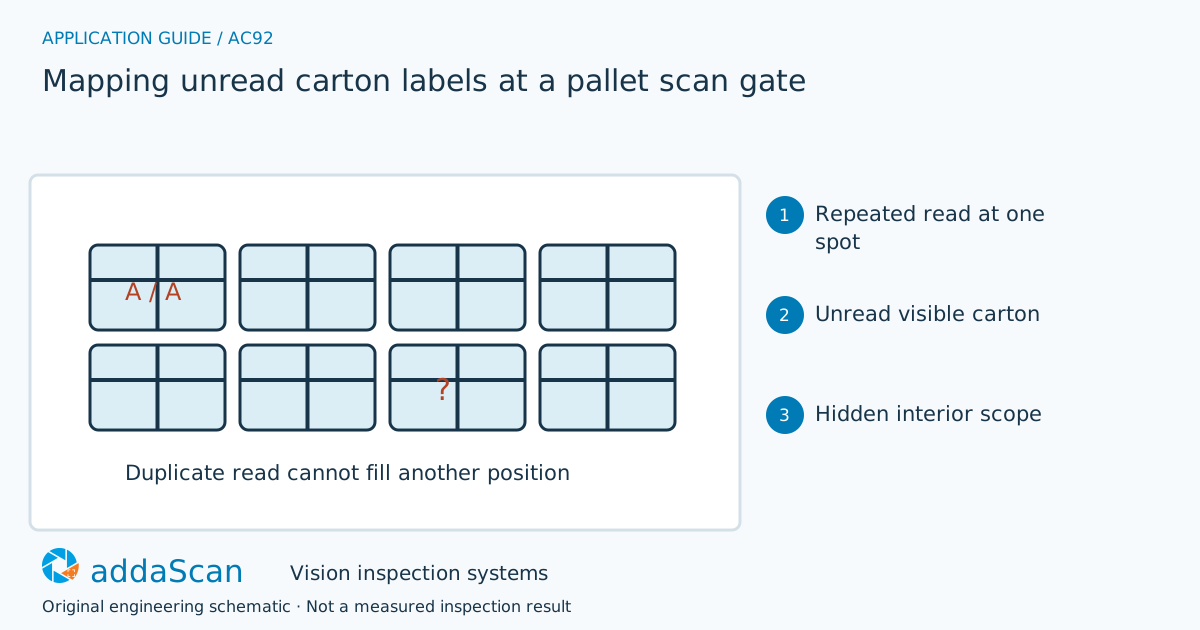
A complete set of carton positions is different from a matching count of reads. Repeated observation of one label leaves another position unresolved. Original position-association schematic.
Select an image to view it at full size.
Build a spatial coverage map before declaring completeness
Locate visible carton faces or expected label zones and associate each result with its position. Deduplicate repeated observations without merging genuinely different cartons that carry similar codes. Distinguish visible-but-unread positions from hidden inner cartons. Full pallet identity may require an upstream aggregation record; an external scan cannot see through the load.
Define whether the task is pallet identity, carton identity or completeness of a specified visible label set. A pallet SSCC can identify the handling unit without establishing which cartons were read. For carton-level coverage, locate the expected carton or label positions and associate each observation with its position. An equal number of decoded strings can include repeated observations of one label.
Separate uniqueness rules from coverage rules. If two cartons legitimately carry the same product code, deduplicating by payload can incorrectly remove a required observation. If a unique serial is expected, the same payload at two locations is a conflict. Both cases require position evidence, plus a clear definition of which carton labels are physically visible at the gate.
Compare pallet identity with carton-position coverage
Swipe across the table to compare all columns →
| Approach | Useful when | Limit or integration responsibility |
|---|---|---|
| Raw code count | Basic scan activity | Duplicates can conceal missing positions. |
| Position-linked unique set | Visible coverage and targeted recovery | Needs reliable label localisation and an explicit hidden-carton scope. |
A pallet-ID station fits SSCC and dispatch matching. Carton-position verification needs additional coverage, localisation and possibly handling to expose the required faces. Hidden inner labels may require upstream aggregation or another controlled process; adding external readers cannot see through the load.
A matching read count can hide an unread neighbour
Illustrative scenario: the raw read count equals the expected count, but one label was read twice and another visible position has no result. Hold completion and highlight the unresolved position.
Link a recovery scan or authorised manual entry to that position, retaining the original image. Recompute the unique positional set before release and reconcile it with the upstream packing record where hidden cartons are included.
Direct a reread to the unresolved position while preserving the pallet identity and the other valid position results. If the load is rebuilt or cartons move, reacquire the affected layout. Record manual resolution without presenting it as an automatically observed label.
Challenge repeated payloads and hidden inner cartons
Swipe across the table to compare all columns →
| Challenge sample or event | Expected behaviour to establish | Evidence to retain |
|---|---|---|
| Duplicate read plus unread neighbour | Flag the missing position despite matching total. | Pallet event, required position map, duplicate observation location, unread neighbour and incomplete-coverage result. |
| Similar or repeated payloads | Use business identity rules rather than blind string deduplication. | Payload uniqueness rule, separate physical label positions, permitted repeats or duplicate-serial conflict and its disposition. |
| Inner cartons hidden by the load | Require upstream aggregation instead of an optical completeness claim. | Hidden-position inventory, observable gate faces, upstream aggregation evidence if used and unresolved coverage explicitly excluded from gate claims. |
Match the expected total with a duplicated read and an unread position, then test repeated product payloads at different positions. Acceptance should report coverage per required position rather than just an aggregate read count.
Visible gate coverage cannot prove hidden carton labels
External gate images do not prove the contents of hidden cartons or the entire pallet interior.
Define the pallet faces and carton positions to verify
Share permitted photos or drawings, plus details of pallet patterns, label positions, identifier rules and upstream carton-to-pallet records. Agree any physical sample arrangements after the initial assessment.
Carton and pallet verification covers carton and pallet identity relationships. The pallet SSCC solution is a different scope from verifying every carton position.
Pallet identity and dispatch-order checks checks pallet identity against the dispatch order. A valid handling-unit identity does not by itself establish carton-label coverage.
Use the cost and scope guide to understand the station boundary. A pallet SSCC station does not automatically include reading every carton position or locating missing reads; scope that coverage separately.
For line conditions around unread label positions at a pallet gate, see logistics and distribution inspection.
Compare lighting, processing, interfaces and support in the HIKROBOT and other vision solutions guide. Agree sample testing, acceptance responsibilities and handover through the delivery process.