Application guide by addaScanCompare the inspection task, imaging conditions and validation steps with your own production line.
- Inspection focus
- Compatible stator and rotor identities
- Primary theme
- Assembly verification
- Decision evidence
- Valid rotor B
- Trial priority
- Two valid but incompatible parts
Both component identities must satisfy one approved pairing rule
Reference imagery and an original English schematic explain the observable features and the proposed decision. The tables below set out the conditions to test on your own line.
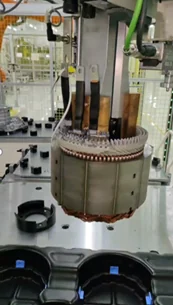
Component presentation affects visible features and access. Compatibility must be checked against authoritative variant rules.
Swipe across the diagram to see all details →
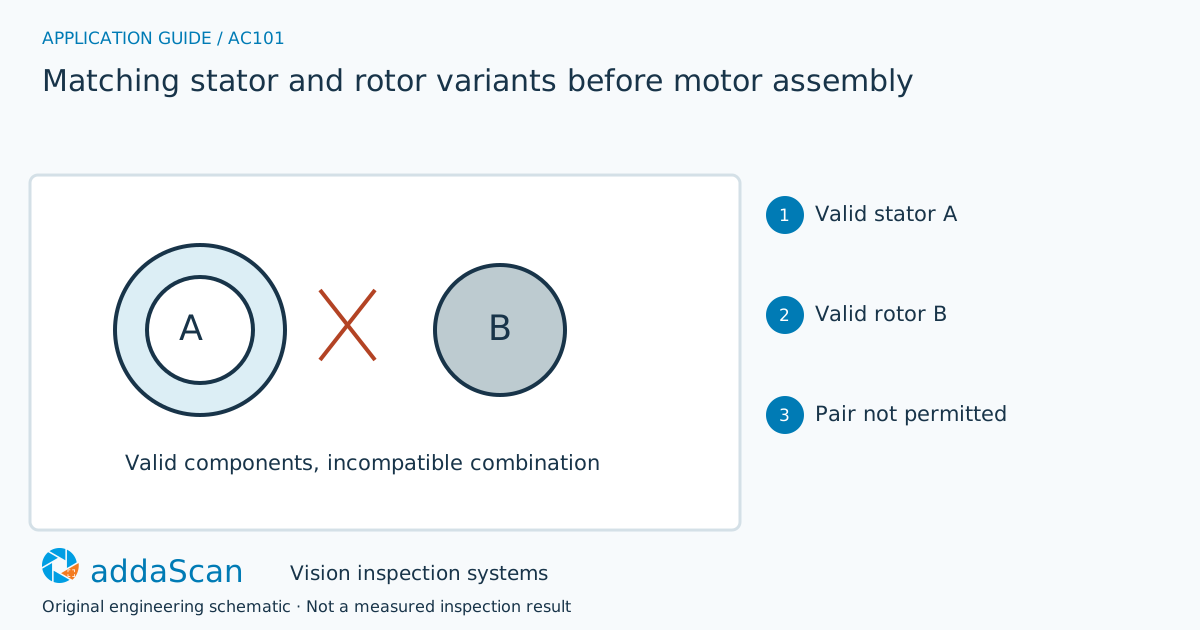
Independent component validity is not the same as an approved stator–rotor combination. Apply the pairing rule to the identified physical pair. Original matching schematic.
Select an image to view it at full size.
Use a pairing matrix with an explicit unknown state
Identify each component through visible features, markings or linked process records, according to what actually distinguishes the variants. Then compare the pair with the current approved matrix and assembly order. Keep matrix version, component identities and evidence together. A classifier trained on visibly different examples cannot resolve variants whose distinguishing characteristic is hidden or electrical.
Define the approved stator/rotor combinations in a controlled pairing matrix, including the source and version of that rule. Recognising both parts independently does not establish compatibility. The station must identify the two components actually presented for assembly and apply the relevant pairing rule to that combination.
Some variants can be visually indistinguishable in the available view. Where appearance does not reveal the distinction, use an appropriate authoritative identifier or a separately controlled supply process. Do not train a visual classifier to infer a hidden specification from accidental surface differences. An unknown identity or unavailable pairing rule should leave the combination unresolved.
Compare visible variant features with authoritative identity records
Swipe across the table to compare all columns →
| Approach | Useful when | Limit or integration responsibility |
|---|---|---|
| Visible-feature classification | Variants with dependable physical differences | Cannot separate visually identical specifications. |
| Identifier and process-record matching | Hidden or otherwise indistinguishable variants | Needs authoritative records and controlled pairing rules. |
Visible feature matching can identify variants with stable exposed differences. Code or record matching is needed where the relevant specification is encoded rather than visible. Compare both against the authoritative product definition and account for incorrectly labelled or replaced components.
Two valid parts can form an invalid motor combination
Illustrative scenario: both components are individually recognised, but their combination is not allowed. Inhibit assembly and retain the two identities and matrix version.
Replace or reconcile the incorrect component, then verify both sides again. If one identity cannot be resolved from appearance, obtain the required traceability record. Release only after the pair is authorised and linked to the assembly event.
Replacing either component invalidates the earlier combination result. Reidentify the physical pair and repeat the matrix check. A rule update also requires controlled activation and treatment of assemblies waiting at the station; a cached pass should not silently survive the change.
Challenge indistinguishable variants and pairing-rule changes
Swipe across the table to compare all columns →
| Challenge sample or event | Expected behaviour to establish | Evidence to retain |
|---|---|---|
| Two valid but incompatible parts | Block the pair rather than pass each separately. | Stator and rotor identities, pairing-matrix version, individually valid component results and the failed combination. |
| Visually identical variants | Require identity evidence beyond appearance. | Indistinguishable physical variants, available identity evidence, unresolved state and the approved alternative identification route. |
| Component replacement or matrix update | Re-evaluate both identities against the correct rule version. | Replacement component or matrix version change, cancelled previous result and freshly evaluated physical pair. |
Include valid but incompatible pairs and changes made after an initial match. Check unknown identities and missing rule data as deliberately unresolved cases. Motor electrical or mechanical performance needs separate testing.
Compatibility identification does not prove motor performance
Variant matching does not prove electrical performance, balance or assembly fit.
Define the source and version of the pairing matrix
Share permitted photos or drawings, plus details of variant identifiers, pairing rules, visible differences and order/traceability messages. Agree any physical sample arrangements after the initial assessment.
Assembly verification and error proofing covers variant identification and assembly interlocks. The product team must supply the approved pairing definition; the camera cannot establish hidden compatibility by itself.
Kit packing: count, orientation and identity separates component identity from pack completeness. A motor pair likewise needs the correct combination, not just one item of each type.
Review the indicative station budget and exclusions. The assembly budget can inform visible identification and pairing checks. Motor performance and electrical tests are separate work.
Compare lighting, processing, interfaces and support in the HIKROBOT and other vision solutions guide. Agree sample testing, acceptance responsibilities and handover through the delivery process.