Application guide by addaScanCompare the inspection task, imaging conditions and validation steps with your own production line.
- Inspection focus
- Carton overlap and vertical edge step
- Primary theme
- Dimensional measurement
- Decision evidence
- Raised upper flap
- Trial priority
- Good overlap with raised edge
Measure overlap in-plane and edge lift out-of-plane
The original English schematic explains the observable features and the proposed decision. The tables below set out the conditions to test on your own line.
Swipe across the diagram to see all details →
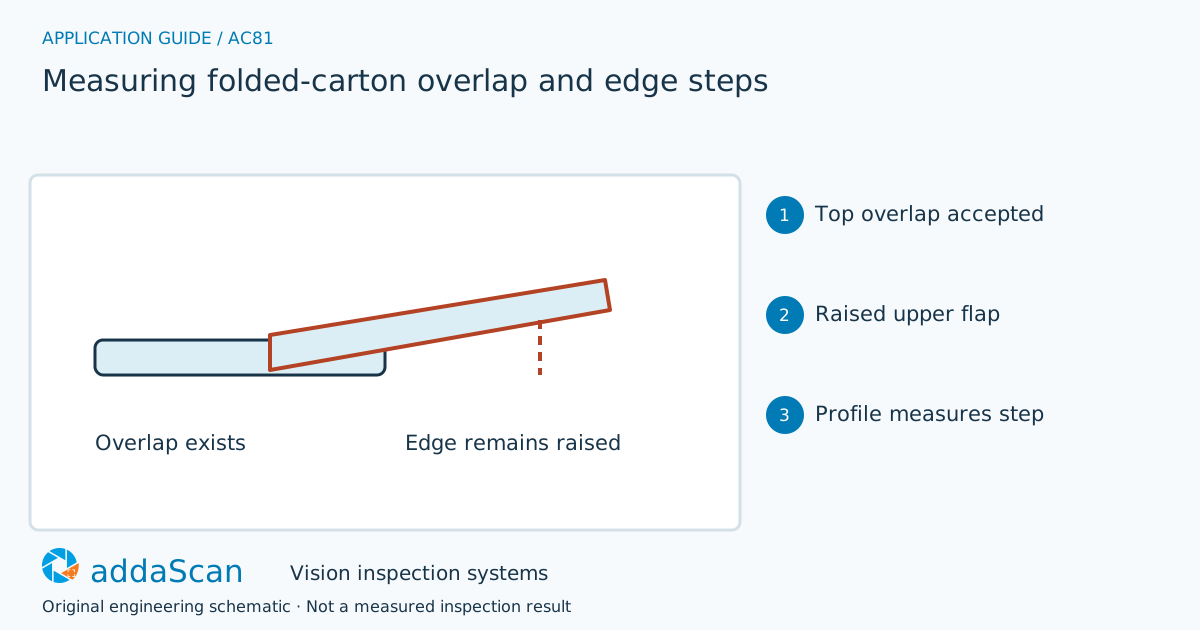
Top-view overlap and a raised edge describe different geometry. Evaluate both against carton features when both are required, retaining invalid height regions. Original schematic; adhesive strength is not measured.
Select an image to view it at full size.
Decide whether the specification is a gap, an overlap or a step
These are different measurements. A two-dimensional view can locate visible edges, but it cannot reliably determine whether the upper flap lies against the lower one. Profile sensing may show the step, provided the board surface returns valid data. Board warp, embossing and fixture pressure affect the result, so use a datum that represents the actual closed assembly and does not flatten away the defect.
Name the two physical edges used for overlap and the surface that defines the height reference. A top-view overlap measurement can be acceptable while one flap remains lifted. Conversely, acceptable board curvature can change absolute height without creating the local step the specification rejects. Keep the two outputs and their datums explicit.
Locate the carton itself before evaluating either feature. Conveyor-height changes, tilted cartons and displaced stops can alter absolute measurements. For profile data, retain which surface was measured and whether shiny print or a fold edge caused a missing return. A flattened height display must not remove the local lift that matters to assembly.
Decide when a top view needs complementary height evidence
Swipe across the table to compare all columns →
| Approach | Useful when | Limit or integration responsibility |
|---|---|---|
| Top-view edge measurement | Gap and overlap in the visible plane | Does not establish vertical seating. |
| Profile plus edge location | Overlap and raised-edge geometry | Needs a defined carton datum and tests of warped board. |
Use a top view where in-plane overlap is the only required decision. Add height evidence where a raised edge matters and the surface can be measured. Compare additional sensing with better mechanical presentation; both require tests on normal board warp and rejected folds.
Sufficient overlap can still conceal a raised edge
Illustrative scenario: top-view overlap is acceptable, yet a profile reveals a raised upper edge. Hold the carton for closure rework and retain both measurements.
After rework, relocate the carton and inspect the full overlap rather than only the original raised point. Release requires valid overlap and step results under the agreed support conditions. A hidden edge or missing profile remains unresolved.
After refolding or reworking, reacquire carton pose and both required features. A corrected overlap does not automatically close the previous height fault. If adhesive or tooling covers the edge during recheck, route it as unresolved rather than accepting the last visible state.
Challenge board warp and changed rework presentation
Swipe across the table to compare all columns →
| Challenge sample or event | Expected behaviour to establish | Evidence to retain |
|---|---|---|
| Good overlap with raised edge | Fail the step independently of overlap. | Carton event, located overlap edges, height reference, raised-edge evidence and separate overlap/step results. |
| Warped but acceptable board | Confirm the chosen datum does not create false failures. | Approved warped-board sample, pose/reference correction, local edge profile and the reason normal warp is accepted. |
| Reworked carton with shifted pose | Re-register and retain complete measurement evidence. | Original failed features, rework action, new carton pose, valid overlap/height acquisition and final disposition. |
Include good overlap with lift, insufficient overlap without lift and acceptable board deformation. Repeat re-seating to show how pose correction affects each result. Any required bond-strength test remains a separate acceptance activity.
Visible carton geometry does not prove adhesive strength
External closure geometry does not measure adhesive bond strength or cure.
Define the carton regions that govern closure acceptance
Share permitted photos or drawings, plus details of folded sample examples, board grades, overlap and step limits, support conditions and gluing sequence. Agree any physical sample arrangements after the initial assessment.
Dimensional measurement defines the geometric evidence for the folded carton. Checks made before folding on a folder-gluer are an adjacent stage, not a price or coverage equivalent.
Checking carton artwork before folder-gluer output verifies carton artwork. Correct print identity does not establish overlap or edge height after folding.
Use the cost and scope guide to understand the station boundary. A folded-carton height check is downstream of the folder-gluer checks made before folding; profile and handling work need separate assessment.
For line conditions around carton overlap and vertical edge step, see plastics and packaging inspection.
Compare lighting, processing, interfaces and support in the HIKROBOT and other vision solutions guide. Agree sample testing, acceptance responsibilities and handover through the delivery process.