Application guide by addaScanCompare the inspection task, imaging conditions and validation steps with your own production line.
- Inspection focus
- Code role and reflection on the pull ring
- Primary theme
- Industrial barcode reader
- Decision evidence
- Production code region
- Trial priority
- Glare, weak marks and rotated rings
Find the intended QR mark on the reflective pull ring
The original English schematic explains the observable features and the proposed decision. The tables below set out the conditions to test on your own line.
Swipe across the diagram to see all details →
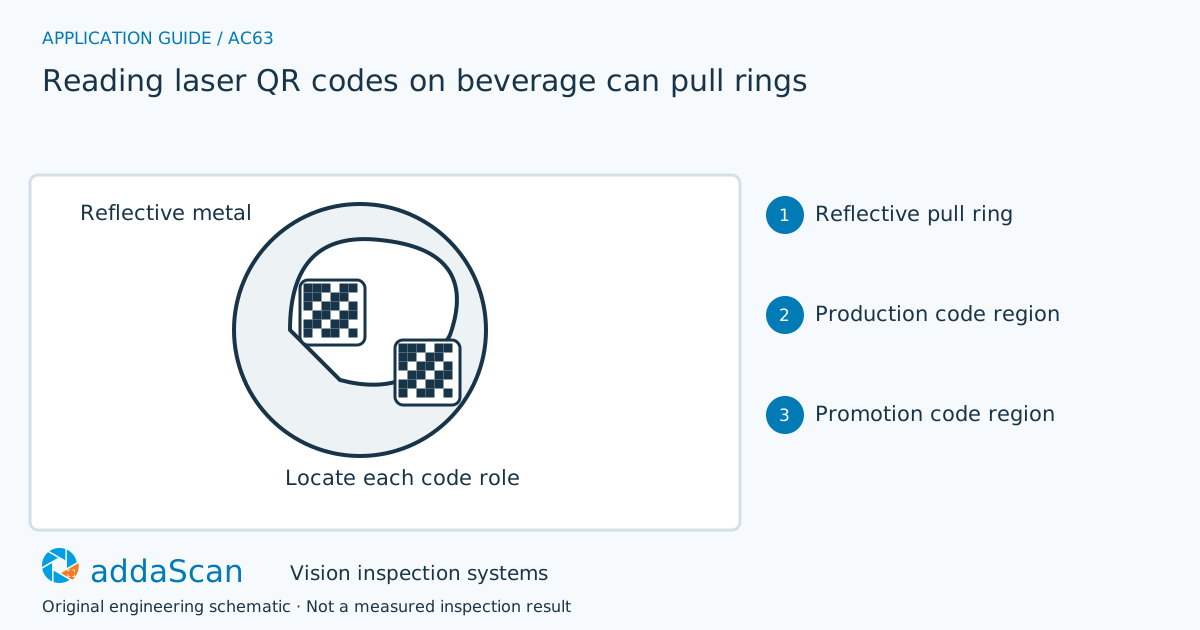
The laser mark must be visible without glare and assigned to its intended role. A valid decode from another symbol is not a successful pull-ring identification. Original schematic; barcode grading is not demonstrated.
Select an image to view it at full size.
Locate the mark before deciding which string belongs to it
Try controlled diffuse, angled and polarised illumination on actual marked rings. Exposure must preserve the module pattern without washing out bright metal or allowing motion blur. Where a ring carries more than one symbol, locate each expected region and associate its decoded content with that position. Returning two strings is insufficient if a promotion code and a production identifier can exchange roles in the downstream record.
Define where each permitted symbol belongs and what its decoded payload means. A packaging line may expose more than one readable code; selecting the first result can bind the wrong business field even when every decoder checksum is valid. Use the physical region or another qualified association rule to assign the symbol role, then validate the expected format and transaction context.
Test lighting through the full permitted ring rotation and can position. A larger sensor can sample a visible mark more finely, but cannot recover modules saturated by glare. Check the weakest acceptable marks at the real working distance and motion. Retain no-read as a distinct state rather than substituting the previous can’s string.
Choose illumination before increasing reader resolution
Swipe across the table to compare all columns →
| Approach | Useful when | Limit or integration responsibility |
|---|---|---|
| Dedicated code reader | Decoding with stable mark presentation | Test illumination, trigger and per-region result handling. |
| Camera and vision software | Locate several marks and apply spatial checks | Own the decoding licence, processing time and PLC data contract. |
Compare illumination arrangements using the same smallest and weakest marks. Select a fixed reader when its field, exposure and outputs cover the task; use a coordinated vision arrangement where localisation or multiple code roles require it. The useful comparison includes trigger and exception handling, not only nominal pixels.
Two readable symbols can still have exchanged roles
Illustrative scenario: both symbols decode, but the result list arrives in the reverse order after the can rotates. Use the registered ring geometry to assign code roles, then check the required relationship.
Hold a can if one region remains unread. A second image must update that same can event rather than create a new one or copy the other string into the missing field. Release only after the required fields and their association are complete.
A repeat acquisition must belong to the held can. If the can has passed the tracking boundary, divert it to a controlled reread route instead of attaching a later decode to its old event. Preserve role conflicts for investigation even if a subsequent view decodes both symbols.
Test weak marks, rotation and repeated acquisition
Swipe across the table to compare all columns →
| Challenge sample or event | Expected behaviour to establish | Evidence to retain |
|---|---|---|
| Glare, weak marks and rotated rings | Save source images and role-labelled strings, including no-reads. | Can event, mark size and ring orientation, original glare/weak-mark image, lighting setting and decode or no-read result. |
| Two valid symbols in exchanged positions | Demonstrate positional association rather than result-list ordering. | Each symbol region, decoded payload, expected role and the detected role exchange despite valid decoding. |
| Repeat image after a no-read | Resolve one event without creating duplicate production records. | Original no-read event, reread location, confirmed can association and final payload accepted for that event. |
Use permitted payloads in deliberately wrong positions as well as physically weak marks. Confirm that the system catches a valid code assigned to the wrong field. Test the reject or reread route at the shortest allowed can spacing.
Decoding a QR code does not verify its print grade
A successful decode is not formal symbol-quality grading. Consumer promotion and traceability fields may require different validation rules.
Prepare marked cans and the expected payload rules
Share permitted photos or drawings, plus details of marked cans, code dimensions and payload examples, permitted rotation, trigger spacing and the definition of each code field. Agree any physical sample arrangements after the initial assessment.
DPM code reading addresses the optical and identification requirements of a mark on metal. Can inspection also covers adjacent can-end date and batch checks, which use a different target and scope.
Visible can-end and seam inspection checks visible lid and seam features. A successful QR read does not establish that the lid or seam is acceptable.
Use the cost and scope guide to understand the station boundary. Pull-ring QR reading has a different mark, optical path and code role from can-end date OCR; do not use the latter station as its quotation.
For line conditions around code role and reflection on the pull ring, see bottling and canning inspection.
Compare lighting, processing, interfaces and support in the HIKROBOT and other vision solutions guide. Agree sample testing, acceptance responsibilities and handover through the delivery process.