Application guide by addaScanCompare the inspection task, imaging conditions and validation steps with your own production line.
- Inspection focus
- Permanent crate ID after washing
- Primary theme
- Industrial barcode reader
- Decision evidence
- Old transport label
- Trial priority
- Readable old label with unread permanent ID
Choose the authoritative ID region on the reusable crate
The original English schematic explains the observable features and the proposed decision. The tables below set out the conditions to test on your own line.
Swipe across the diagram to see all details →
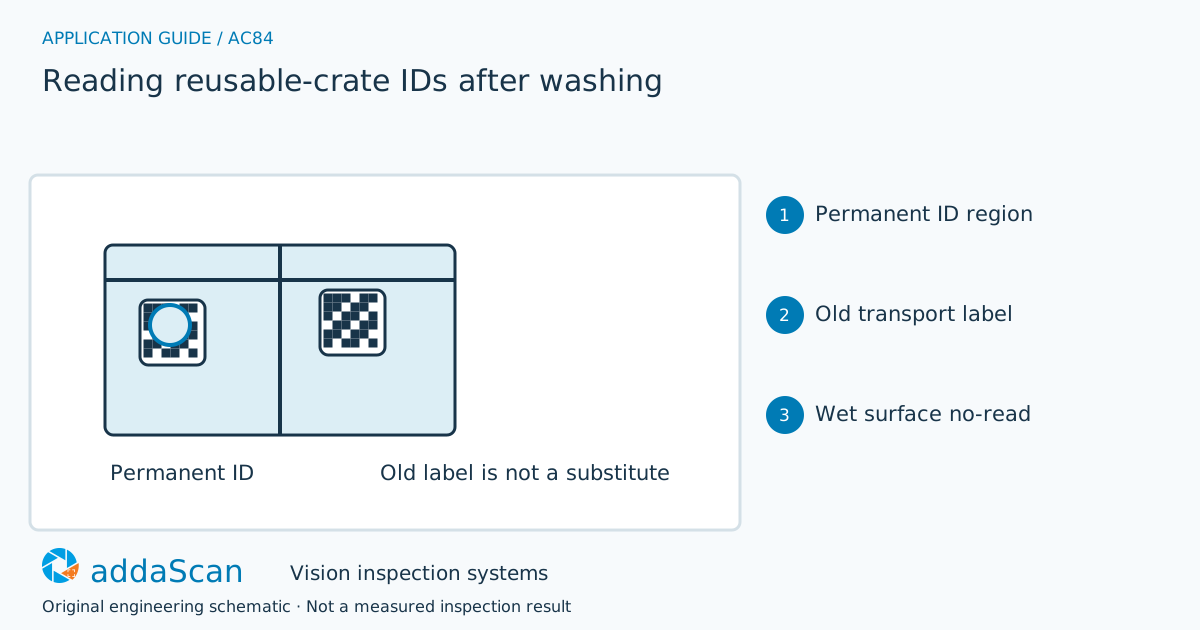
Only the designated permanent ID should identify the reusable crate. A readable transport label cannot resolve an unread permanent mark. Original identification schematic.
Select an image to view it at full size.
Control the read region and the wet-surface contrast
Water droplets, worn marks and dark plastic can reduce contrast or create reflections. Test illumination angles and drainage conditions at the intended station, including newly washed and partly dried crates. Locate the permanent mark relative to the crate geometry and filter results by role as well as syntax. A valid-looking code elsewhere on the crate must not silently replace a no-read in the required region.
Document which mark represents the permanent crate identity and where that mark is allowed to appear. A remaining shipping label can be easier to decode while belonging to a different transaction. Use region, symbology or validated payload rules to select the intended identity, and record a conflict if multiple candidate marks satisfy them.
Test the mark at its expected life and post-wash surface condition. Water, abrasion, low contrast and changing background colour affect visibility. The reader must distinguish an invalid mark observation from an unknown identity returned by the traceability system. A valid decoded string not recognised by the current system needs its own business disposition.
Compare readers using the actual washed mark
Swipe across the table to compare all columns →
| Approach | Useful when | Limit or integration responsibility |
|---|---|---|
| Wide unrestricted read | Convenient acquisition of any visible code | May select an obsolete shipping label. |
| Located permanent-ID region | Role-specific identification | Needs crate registration and tests of wear, droplets and reflections. |
Select optics and illumination from the physical mark and permitted crate presentation. Broadening a search to every visible label can increase the raw read count while reducing identity correctness. Define role selection and system acknowledgement as part of the reader comparison.
An old transport label can decode before the permanent ID
Illustrative scenario: an old shipping label decodes while the permanent crate mark remains unread. Hold the identity event and reacquire the designated region after re-presentation or the agreed drying interval.
If manual entry is permitted, retain the original image, correction reason and operator action with that crate event. Release only after the authoritative ID is resolved and duplicate records are reconciled.
Keep manual correction linked to the original image and failed read. A repeat scan of the same crate must not create a second movement transaction. If the crate was removed and another entered, start a new event rather than applying the pending correction to the new crate.
Challenge wet marks, wear and manual corrections
Swipe across the table to compare all columns →
| Challenge sample or event | Expected behaviour to establish | Evidence to retain |
|---|---|---|
| Readable old label with unread permanent ID | Keep the crate identity unresolved. | Permanent-ID region, old transport-label decode, intended mark result and the reason the old label is excluded. |
| Wet, worn and dark marks | Record read/no-read by required region. | Crate and mark reference, wet/worn appearance, lighting state and decode, no-read or conflicting-role output. |
| Manual correction and repeat scan | Retain provenance and avoid duplicate crate events. | Original image/read, authorised manual correction, crate event and deduplicated final traceability acknowledgement. |
Leave valid but irrelevant labels on challenge crates, then introduce weak permanent marks. Test a repeated scan and removal during manual correction. Mark durability requires its own material and washing evidence beyond a successful camera trial.
A readable ID does not prove mark durability
Identification does not establish crate cleanliness or structural fitness; those require separate checks.
Define the permanent-ID and traceability rules
Share permitted photos or drawings, plus details of permanent and temporary labels, washed sample examples, ID rules and manual-correction procedures. Agree any physical sample arrangements after the initial assessment.
OCR and code inspection covers code-role selection and identity matching. Crate condition inspection checks different physical features and is a separate configuration.
Pallet identity and dispatch-order checks matches pallet identity to dispatch records. Permanent crate tracking also needs an authoritative identity and transaction, without reusing a shipping label by accident.
Use the cost and scope guide to understand the station boundary. Permanent crate identification is distinct from crate-structure and pocket inspection, so its reader and tracking scope need separate pricing.
For line conditions around permanent crate id after washing, see bottling and canning inspection.
Compare lighting, processing, interfaces and support in the HIKROBOT and other vision solutions guide. Agree sample testing, acceptance responsibilities and handover through the delivery process.