Application guide by addaScanCompare the inspection task, imaging conditions and validation steps with your own production line.
- Inspection focus
- Complete steel-slab identity under scale and texture
- Primary theme
- OCR inspection
- Decision evidence
- Readable prefix only
- Trial priority
- Shared prefixes with obscured suffixes
Require the complete identifier used for material routing
The original English schematic explains the observable features and the proposed decision. The tables below set out the conditions to test on your own line.
Swipe across the diagram to see all details →
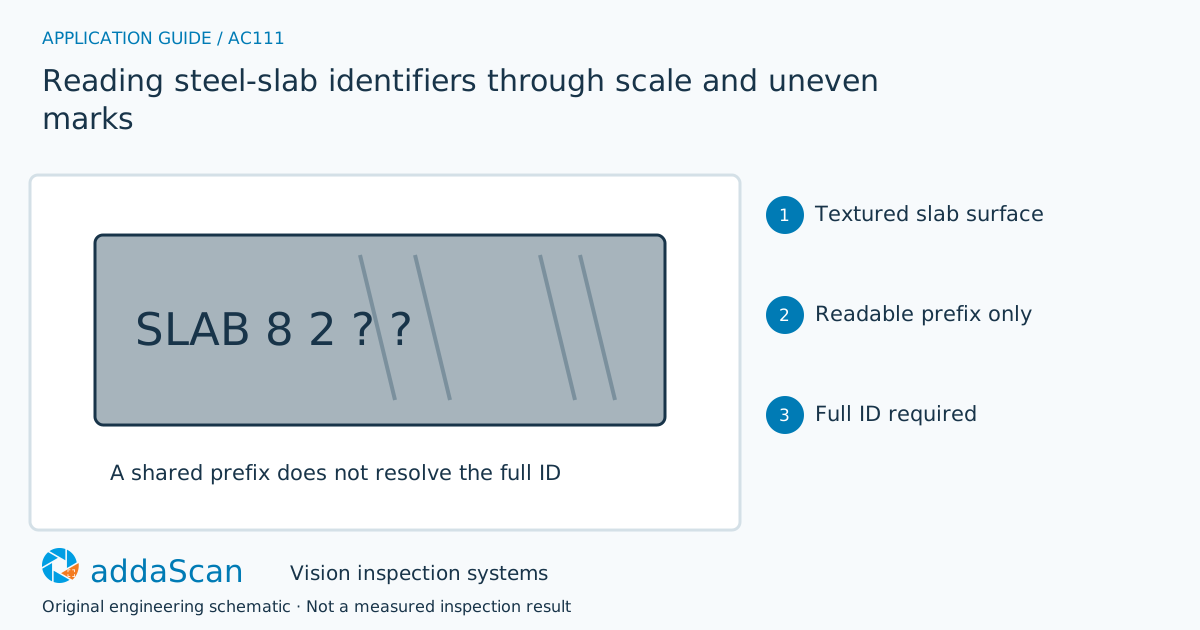
A readable prefix can belong to several slabs. Require the complete routing identifier and preserve evidence for unread or manually resolved characters. Original recognition schematic.
Select an image to view it at full size.
Locate the identifier within the full slab context
Use a view that establishes where the mark lies on the slab before enlarging the reading region. Strong surface texture can resemble character strokes, while inconsistent marking depth or paint changes contrast. Test lighting, exposure and mark location on actual samples. Validate syntax and production-record agreement after recognition, but do not let the database silently guess missing characters from a convenient match.
Define the full identifier required by the material-handling system, including any field boundaries or format checks. Several slabs may share a prefix. A plausible beginning or a dictionary completion must not be accepted as the observed complete identifier when scale or weak strokes hide the suffix. Keep character-level uncertainty visible in the record.
Test acquisition on the real mark and surface state at the inspection point. Scale, uneven marking and permitted contrast variation can alter the visible strokes. Where the process permits cleaning or another view, treat it as a controlled reacquisition. Preserve the original image so a later interpretation can be checked against what was actually visible.
Compare readable characters with a qualified full-field result
Swipe across the table to compare all columns →
| Approach | Useful when | Limit or integration responsibility |
|---|---|---|
| OCR with format checks | Readable complete marks | A plausible format does not resolve missing characters. |
| OCR plus production-record verification | Identity linked to material routing | Needs explicit ambiguity handling and controlled manual correction. |
OCR can extract human-readable marks when the strokes are resolved. Format or database matching can detect conflicts but should not manufacture missing evidence. Compare the complete required field and wrong-neighbour identifiers, including what happens when several valid records match the visible prefix.
A shared prefix cannot identify the correct slab
Illustrative scenario: only a prefix is readable and it matches more than one production record. Hold loading permission and retain both the overall location image and reading crop.
Re-present or reacquire the mark; if manual entry is allowed, compare it with the authoritative record and preserve the correction reason. Release only after the full required identity is resolved for that slab.
A manual correction needs the original image, entered value and authorised disposition linked to the slab event. Recheck the corrected identifier against the intended routing record. Do not overwrite the uncertainty history or apply a pending correction after the next slab arrives.
Challenge obscured suffixes and manual transcription
Swipe across the table to compare all columns →
| Challenge sample or event | Expected behaviour to establish | Evidence to retain |
|---|---|---|
| Shared prefixes with obscured suffixes | Hold rather than choose a convenient database match. | Observed prefix/suffix regions, full expected identifier, competing shared-prefix records and the blocked routing result. |
| Scale, uneven strokes and variable contrast | Retain source images and no-read reasons. | Scale and stroke-condition sample, original acquired image, uncertain characters and the outcome of qualified cleaning or reacquisition. |
| Manual correction | Link the confirmed identifier to the observed slab and audit trail. | Original OCR/image, manually resolved value, slab event, validation against the routing record and recorded correction disposition. |
Use slabs or representative marks with shared prefixes and different suffixes, including weak but plausible alternatives. Test the handover to manual resolution at realistic material spacing. Identification is separate from grade, composition or internal quality verification.
A recognised mark does not establish material properties
Identifier recognition does not verify material grade or internal quality independently of trusted records.
Define authoritative slab identifiers and exception handling
Share permitted photos or drawings, plus details of marking examples, full identifier rules, surface conditions, slab presentation and production-system messages. Agree any physical sample arrangements after the initial assessment.
OCR and code inspection covers expected-field matching and uncertainty handling. Scope the surface acquisition and the material-routing interface together.
Checking continuous inkjet marking on plastic pipe checks continuous inkjet marking on pipe. Both tasks need complete required text, although the marking surface and acquisition conditions differ.
Use the cost and scope guide to understand the station boundary. An estimate depends on the required views, product presentation, exception handling and connection to the existing line. A similar camera does not establish the price of this application.
For line conditions around complete steel-slab identity under scale and texture, see metal-component inspection.
Compare lighting, processing, interfaces and support in the HIKROBOT and other vision solutions guide. Agree sample testing, acceptance responsibilities and handover through the delivery process.