Application guide by addaScanCompare the inspection task, imaging conditions and validation steps with your own production line.
- Inspection focus
- One moving tin, one confirmed placement
- Primary theme
- Assembly verification
- Decision evidence
- Reserve box pocket
- Trial priority
- Same tin in several frames
One observed tin must lead to one confirmed pocket placement
The original English schematic explains the observable features and the proposed decision. The tables below set out the conditions to test on your own line.
Swipe across the diagram to see all details →
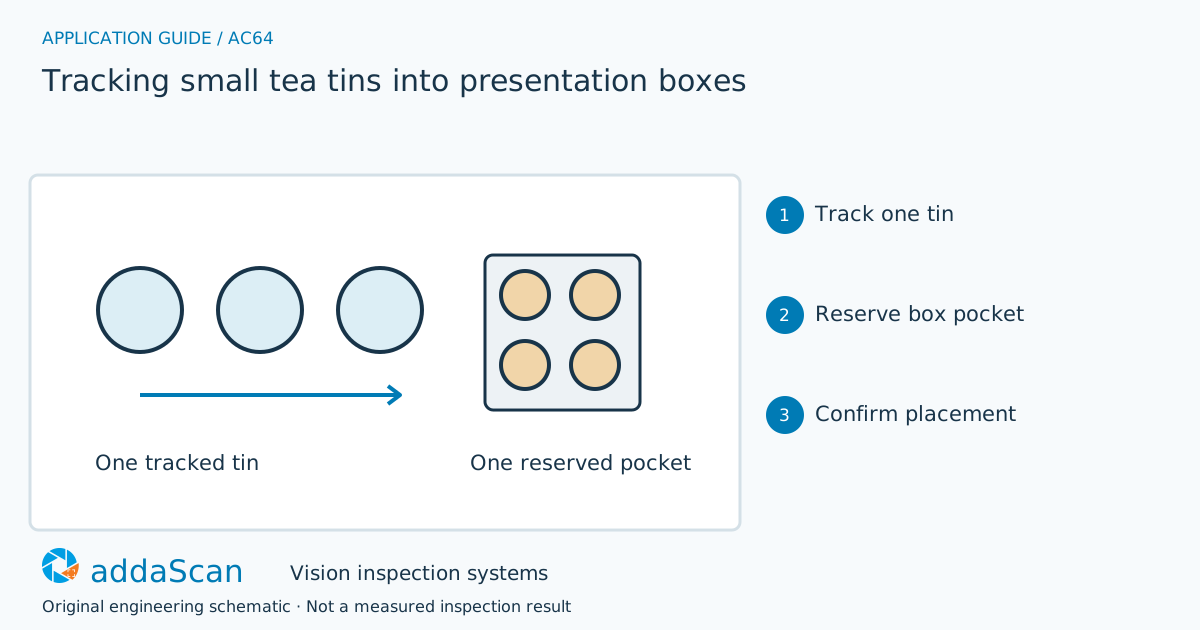
An observed tin, robot task and destination pocket must remain associated until placement is confirmed. Repeated frames are observations of the same target, not extra tins. Original handling schematic.
Select an image to view it at full size.
Choose between indexed presentation and conveyor tracking
An indexed conveyor with repeatable stops may permit fixed-position localisation. Continuous motion needs a calibrated camera-to-conveyor relationship, position updates and an agreed time window for valid coordinates. Shiny tin lids and repeated graphics make appearance-only identity fragile. Combine position and motion with a destination-pocket map, and define how a tin leaving the camera field remains tracked until placement confirmation.
Give the robot interface a task lifecycle: a located tin becomes a candidate, then a reserved target, then a completed or unresolved action. Repeated images of a reserved tin should update its tracked position where appropriate, not create more pick commands. Define where a tin leaves the tracking area and what happens when it leaves before a task is acknowledged.
Identify the receiving box and pocket as well as the tin. A fresh empty box can occupy the same image coordinates as the previous box while still being a new destination. Keep outstanding reservations separate from confirmed occupied pockets. Final box verification is valuable because a robot command being accepted does not show that the tin actually reached the pocket.
Separate moving-object tracking from final box verification
Swipe across the table to compare all columns →
| Approach | Useful when | Limit or integration responsibility |
|---|---|---|
| Indexed pickup | Predictable stop and orientation | Prove settling and restart behaviour before relying on fixed coordinates. |
| Continuous tracking | Tin position changes during handling | Validate encoder reference, coordinate age and robot acknowledgement. |
Compare conveyor tracking with a controlled indexing arrangement on the required presentation and line cycle. Continuous handling adds position prediction and acknowledgement timing; stopping simplifies presentation but changes the production sequence. In both designs, the robot and gripper supplier must define action success and recovery.
A repeated frame must not create another pick
Illustrative scenario: a tin appears in successive images while approaching the pick point. Maintain one target and issue one task.
Reobserve the pickup area and destination pocket, reconcile the robot state and generate a fresh task only for the remaining operation. Release the box when its expected pockets have confirmed contents.
After an interruption, reconcile whether the tin remains on the conveyor, is held by the gripper or has reached a pocket. Do not blindly resend the last command. A restarted box must have a known pocket state before new reservations are issued.
Challenge pending picks during a box change
Swipe across the table to compare all columns →
| Challenge sample or event | Expected behaviour to establish | Evidence to retain |
|---|---|---|
| Same tin in several frames | One target ID and one successful placement record. | Tin track ID, successive frame positions, task reservation and a single pick instruction despite repeated observations. |
| Interrupted pick or missed acknowledgement | Reconcile physical state before any retry. | Pick task ID, last acknowledged action, gripper/placement state and the reconciliation used before retrying. |
| Box change with a pending task | Prevent the old destination ID from carrying into the new box. | Old and new box IDs, pocket reservations, outstanding tin task and the decision to cancel or reassign it. |
Interrupt each action boundary in the proposed sequence and check the physical outcome before resuming. The acceptance record should distinguish duplicate tasks, failed placement and an incomplete box; a correct tin count alone does not cover those failures.
Vision guidance does not prove a successful grasp
Vision coordinates do not provide robot safety functions. Collision avoidance, tooling suitability and safeguarded operation require their own engineering.
Define the robot and box-pocket handshakes
Share permitted photos or drawings, plus details of tin and box sample examples, pocket layouts, conveyor motion, robot interfaces and the current pick/place acknowledgement sequence. Agree any physical sample arrangements after the initial assessment.
Vision station scope and responsibilities helps allocate vision tracking, robot actions and destination confirmation. The final box-presence check can use assembly methods, while grasping and motion remain separately specified responsibilities.
Counting milk cartons after case packing checks packed-carton completeness. Apply the same distinction between a total count and verified positions when checking the finished presentation box.
Use the cost and scope guide to understand the station boundary. Robot tracking, the gripper, box handling and pick/place acknowledgements need an explicit scope beyond a component-presence camera.
For line conditions around one moving tin, one confirmed placement, see meat, staples and dry-goods packing.
Compare lighting, processing, interfaces and support in the HIKROBOT and other vision solutions guide. Agree sample testing, acceptance responsibilities and handover through the delivery process.