Short-shot inspection on moulded caps
A short shot removes material from a moulded cap, while flash adds material outside the intended contour. Extra material projects beyond the normal profile.
A closure inspection system is a camera station after the moulding machine that checks every plastic cap for short shots, flash, a broken or missing tamper band and a missing or misplaced liner before the caps are packed. addaScan builds it on HIKROBOT cameras with backlight and dome lighting over a single-file conveyor or star-wheel, with an air-jet reject. An indicative installed budget for a typical application is R 370 000 – R 1 290 000 excluding VAT, from two views to four.
Plastic closures are made in volume in South Africa. Mpact, one of the cap manufacturers in South Africa, produces a large range of closures at its compression plant in Wadeville, Gauteng, and at its FMCG operations in KwaZulu-Natal and the Western Cape (Mpact). The caps go to filling lines such as those of Coca-Cola Beverages South Africa, which runs 11 plants in six provinces (CCBA). Closures are made by injection moulding or compression moulding in multi-cavity tools, and a fault in one cavity repeats on every cycle until someone sees it.
The typical faults are visible: a short shot where the plastic did not fill the cavity, flash where it ran past the parting line, a tamper band with broken or unformed bridges, a missing or off-centre liner, and caps deformed on ejection. At the filler they become a cap that does not apply, a bottle that leaks, or a tamper band that does not show opening. The food hygiene regulations require prepacked food to be packed so that it cannot be opened without the lid or seal being removed or damaged (R638, 2018). That duty sits with the food packer, not the closure maker; a closure inspection system is one way for the closure plant to check that every tamper band it ships is whole.
For closure makers that run FSSC 22000, version 6 adds print control for packaging manufacturers, including a process to detect and identify printing errors during the run (FSSC 22000 v6); that matters where caps carry print or a code. A bottle cap inspection machine at the closure plant is a different station from the cap check on a filling line, which looks at the cap on the bottle: that is covered under fill, cap and seal inspection.
For incomplete mould filling, use the short-shot inspection guide for moulded closures. It explains which missing edges and bridges can be made visible, how cavity variation affects the sample set, and which hidden or functional defects need other tests.
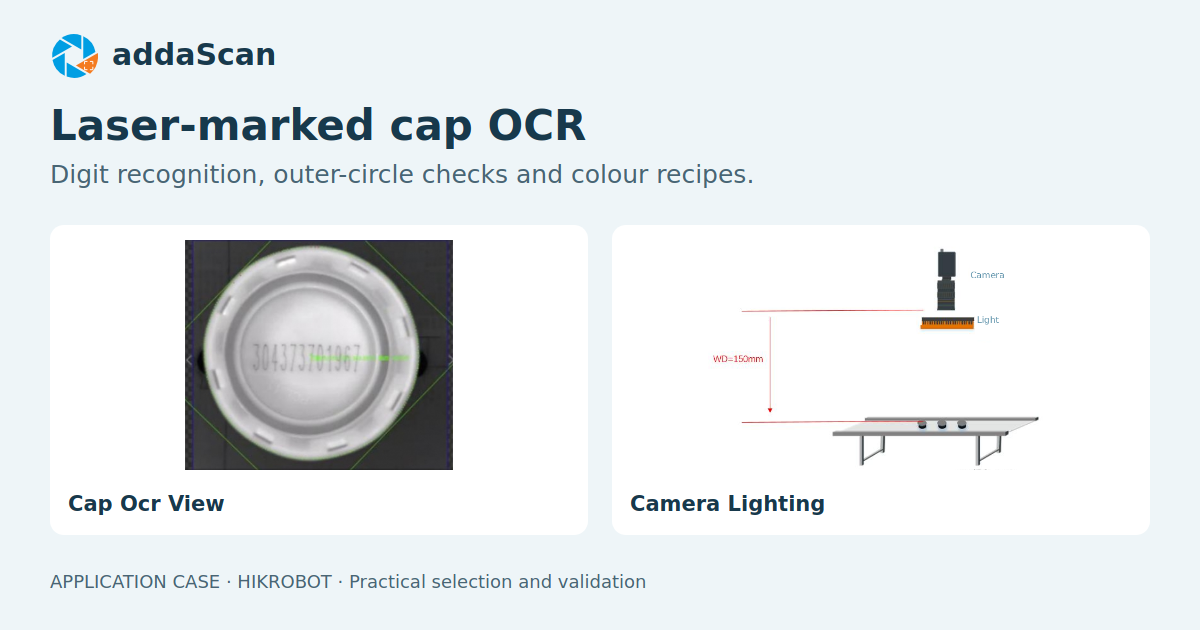
For marked caps, the code and visible outer contour are separate decisions. This application explains digit OCR, image-region reduction and colour recipe changes alongside the broader closure inspection scope.
Read the application guide →| What the line reports | What a station checks | Where it stops |
|---|---|---|
| “Short shots are getting through to the filler” | Cap outline against a backlight from the side, and the inside view: missing material at the skirt, thread or band shows as a gap in the contour. | A small short shot inside the thread that does not change any outline is confirmed on samples only. |
| “Flash on the parting line, the customer complains about sharp edges” | Skirt and band edge against the backlight; flash shows as material outside the taught good outline. | Thin flash on clear or translucent caps is faint against a backlight; each colour is tested on samples. |
| “Tamper bands come off the line with broken bridges” | Bridges between band and shell, from the side views or from the inside view unwrapped into a strip; a broken, missing or unformed bridge is a gap. | A bridge that looks whole but is weak or only partly cut is not found; vision sees shape, not strength. |
| “Liners missing or off-centre in the lined caps” | Inside view under a dome light: liner present, centred and lying flat. | A liner that is present and centred but does not seal is a leak-test question, not a visual one. |
| “One cavity goes bad and we only hear about it when the lot is rejected” | Rejects counted per fault type and shown on the operator screen, so a run of the same fault is visible during the shift. | Faults are tied to a time, not a cavity, unless reading moulded cavity numbers is proven on your caps. |
Caps run single file, open side up, on a conveyor or star-wheel past two to four views: into the open cap, onto the top panel and at the tamper band from the side. Each view has the light that shows its fault. The result per cap fires an air jet that blows failed caps into a reject bin, and a sensor confirms they left.
Swipe sideways to see the whole drawing →
| Component | HIKROBOT example | Role in this station |
|---|---|---|
| Inside view (low) | HIKROBOT SC6000 smart camera, mono, C-mount (MV-SC6016M), running HIKROBOT VisionMaster tools in the camera | Looks into the open cap: liner present and centred, inside of the band |
| Band view (low) | HIKROBOT CS-series 6 MP mono GigE camera (MV-CS060-10GM) with a 12 mm 6 MP lens, on a VC3000 vision controller (MV-VC3302P) | Skirt, tamper band and bridges in outline against the backlight |
| Four views (high) | 4 × HIKROBOT CS-series 5 MP mono cameras (MV-CS050-10GM) with 25 mm 10 MP lenses on a VC3000 controller (MV-VC3704H) | Inside view, top panel and two side views of the band, with deep-learning defect classification |
| Lighting | HIKROBOT flat lights used as backlights (MV-LBSS-H or MV-LBES-H series) for the side views; a dome light for the inside view: HIKROBOT MV-LBES-H flat dome, or the HIKROBOT MV-LGSS hemispherical dome, which addaScan supplies | Backlight turns short shots, flash and bridges into outline checks; the dome stops the curved inside from glaring |
| Trigger | HIKROBOT MV-PE photoelectric sensor (e.g. MV-PE5101) | Fires the cameras for each cap |
| Reject | Not HIKROBOT: air knife or nozzle with a fast-switching solenoid valve; stainless air knife and two valves in the high case | Blows failed caps into a reject bin |
| Transfer and confirmation | Local supply: single-file guide or star-wheel inspection fixture (high case), confirmation sensor, panel and screen | Presents every cap to every view the same way; proves the reject happened |
| Tool or software | What it does here |
|---|---|
| HIKROBOT VisionMaster contour and edge-model defect tools | Compare each cap outline with the taught good cap: missing material (short shot), extra material (flash), a deformed skirt. |
| VisionMaster Ring Expansion | Unwraps the round band in the inside view into a straight strip, so every bridge is checked in the same way. |
| VisionMaster deep-learning classification and anomaly detection (high case) | Sort real defects from colour and texture variation; anomaly detection is trained on good caps only and flags anything unusual. |
| Recipe per closure | One recipe per closure type and colour, selected at mould or colour change. |
| Fault counts and image log | Counts per fault type and saved images of rejected caps for the moulding technician. |
Cameras and lights on a rigid frame over the closure conveyor after the moulding cell, or after band slitting where that is a separate step, isolated from press vibration; covers keep dust and stray granulate off the optics.
A backlight opposite each side camera, a dome light over the inside view and a shroud against the plant lights; translucent and dark colours get their own exposure settings.
One trigger per cap; caps need enough gap that each view sees one cap and the air jet hits the right one. In the high case a star-wheel holds each cap in position.
Pass/fail and fault code per cap to the reject valve directly or through the PLC; the SC6000 lists PROFINET and EtherNet/IP, and the VC3000 controller has opto-isolated digital inputs and outputs.
Air jet into a closed bin with a confirmation sensor and an air-pressure switch; if a camera is not ready or the air drops, caps go to the bin or the conveyor stops, never past unchecked.
Recipe chosen at mould or colour change; the screen shows the last rejected caps with the fault and the count per fault, so a bad cavity shows up during the shift.
Indicative budget for a typical application of this kind. Every project involves custom requirements (your products, line speed, layout, PLC and acceptance criteria), so the final price differs from case to case. A firm price follows the sample test.
The low figure is a two-view station: an SC6000 smart camera looking into the cap and a side camera with backlight for the band, with an air-jet reject into a bin. The high figure adds the top panel and a second side view, deep-learning defect classification, a star-wheel or transfer fixture and reject confirmation. Both assume the caps already run single file; high-speed glass-disc cap sorting machines are a separate machine class that addaScan does not build. Changes to your conveyor, compressed air supply, utilities and VAT are excluded.
Hardware is priced from public list prices converted at the ECB reference rate, plus freight, clearance and margin; engineering at R 900 – R 1 300 per hour. How these ranges are built →
Swipe the table sideways to see the high figure and the basis →
| Cost block | Low | High | Basis |
|---|---|---|---|
| Vision hardware (landed, with margin) | R 166 800 | R 418 000 | Low: SC6000 smart camera with dome light for the inside view, 6 MP side camera with backlight, VC3000 controller. High: four 5 MP cameras with lenses, two dome lights, two backlights, larger controller |
| Software licence | R 33 800 | R 150 000 | HIKROBOT VisionMaster standard licence; high case with the deep-learning tier |
| Local materials and reject | R 50 000 | R 150 000 | Low: mounts, reject guide and bin, cabling, panel. High: transfer and inspection fixture with mounts, air-jet reject with confirmation, panel and screen |
| Engineering (recipes, PLC link) | R 72 000 | R 312 000 | 80 h at R 900 to 240 h at R 1 300 |
| Installation, FAT, SAT, training, documents | R 36 000 | R 124 800 | 40 h to 96 h |
| Project management | R 14 400 | R 62 400 | 16 h to 48 h |
| Travel (Gauteng) | R 3 000 | R 8 000 | Outside Gauteng quoted separately |
| Total (rounded) | R 370 000 | R 1 290 000 | Low: two views. High: four views with deep learning |
The technologies behind this station, how much each matters here, and where each is explained in depth.
| Technology | Role | Why it matters in this scenario | Read more |
|---|---|---|---|
| Smart camera (HIKROBOT SC5000X, SC6000) | Core | The SC6000 runs the inside-view checks in the camera itself, which keeps the two-view station compact. | Choosing a smart camera |
| Area scan cameras with a vision controller | Core | Up to four views on one VC3000 controller cover the inside, the top panel and both sides of the band. | Camera and lens selection |
| Lighting technique | Core | A backlight turns short shots, flash and bridges into outline problems; a dome light stops the curved inside of the cap from glaring. | Machine vision lighting |
| 2D measurement (backlight, telecentric optics) | Supporting | Backlit contour checks compare each cap outline with the good cap, which is how missing and extra material show up. | Dimensional inspection |
| Deep learning (classification, segmentation, DL OCR) | Supporting | Classification separates real defects from colour and texture variation that rule-based tools would reject. | Rule-based vs deep learning |
| PLC link and reject with confirmation | Supporting | Caps are small and close together: the air jet must hit the right cap and a sensor must prove it did. | PLC and reject integration |
Every station is accepted on your products, against numbers agreed in writing before the build. How we deliver →
Good caps in each colour and real fault caps (short shot, flash, broken bridges, missing liner) from your moulds, imaged with the proposed cameras and lights; the result states which faults are reliably seen in which view, and which are not.
Before delivery, marked challenge caps of each fault type are run through the station and must each be rejected, while good caps of every colour pass.
After the moulding cell, at production rate, the challenge caps are run again, and false rejects and escapes are counted over an agreed run of production.
A closure inspection system checks the visible shape of every cap after moulding: short shots, flash, a deformed skirt, broken or missing tamper band bridges, and a missing or off-centre liner where the cap has one. It uses two to four camera views with backlight or dome lighting and blows failed caps into a reject bin. It does not test opening torque, bridge strength or whether the cap seals.
No. A cap vision inspection machine at the closure plant looks at loose caps after moulding: their shape, tamper band and liner. The check on a filling line looks at the cap on the bottle: present, straight and fully applied, with the band intact. The faults overlap, but the handling, lighting and reject are different, so they are different stations. addaScan covers the filling-line check under fill, cap and seal inspection.
An indicative installed budget is R 370 000 – R 1 290 000 excluding VAT, at 2 October 2026 prices. The low figure is a two-view station (an SC6000 smart camera for the inside view and a side camera with backlight for the band) with an air-jet reject. The high figure covers four views, deep-learning defect classification, a transfer fixture and reject confirmation. Both include hardware, software, engineering, installation, FAT and SAT in Gauteng; a firm price follows a sample test on your caps. This is a typical application: every project involves custom requirements, so the final price depends on your products, line and acceptance criteria.
Yes, when a bridge is missing, broken through or not formed, because it shows as a gap between band and shell. The side views image the band against a backlight, and the inside view can be unwrapped with the VisionMaster Ring Expansion tool (HIKROBOT catalogue) so every bridge is checked the same way. A bridge that looks whole but is weak or only partly cut is not found; that needs a torque or pull test.
Usually, with its own exposure settings per colour. Opaque caps give a clean outline against a backlight. Clear and translucent caps let light through, so flash and thin short shots are fainter; black caps hide detail on the top panel. Every colour you run is part of the sample test, and the recipe is switched at colour change so each colour is judged against its own good caps.
After the moulding machine, or after band slitting and folding where that is a separate step, and before the caps are boxed. The caps must run single file and the same way up. addaScan builds the camera station on your conveyor or on a star-wheel fixture; it does not build high-speed glass-disc cap sorting machines. If caps come off the mould in bulk, a feeder that puts them in single file is part of the line, not of this station.
Describe the line, the products and the fault. We test on your good and faulty samples and reply with a feasibility note and a budget.