Fixed code reader
For decoding within a stable field of view and sending parsed data to a defined host. Test print, motion, glare and variable-length fields.
For an Egyptian pharmaceutical packaging line, assess the DataMatrix data, its human-readable text and the product reference as separate checks. addaScan can scope reading and visual verification with the line interfaces. Commissioning serial numbers, maintaining aggregation and reporting to EPTTS require the appropriate serialization and software systems beyond the camera.
Updated 2 November 2026 · Author: Frank Guo
A packing-line station can read the DataMatrix on each carton, split it into GTIN, serial, expiry and lot, and compare those fields and the printed text beside the code with the expected product record. Commissioning serial numbers, building aggregation and reporting to EPTTS are done by the serialization and reporting systems, not by the camera. The field rules below come from EDA’s EPTTS Phase 1 Technical FAQ version 3/0, issued 23 April 2026.
The line provides pack-level evidence; the systems and owners on the right keep the records that EPTTS relies on.
| Item | What the line station provides | Owned by another system or person |
|---|---|---|
| DataMatrix fields (GTIN, serial, expiry, lot) | Decodes and parses each carton and compares the fields with the active job. | The serialization system issues and commissions the serial numbers. |
| Printed text beside the code | Reads the printed text and compares it with the decoded data and the job, including the expiry format rule. | The product owner approves the artwork and the date format. |
| Serial uniqueness and status | Supplies the serial read from each carton with its pack event. | The serialization system decides whether the serial is valid, unique and commissioned. |
| Aggregation | Gives a pack-level observation that a carton passed or was removed. | Aggregation software builds the parent–child records. |
| Reporting to EPTTS | No direct role. | The serialization and reporting systems and the marketing authorisation holder. |
Responsibilities as described in the cited EDA technical FAQ and the line scope; confirm system ownership for your product before acceptance.
Source version and scope are stated below. A line inspection checks selected evidence; the manufacturer retains responsibility for the applicable product specification.
| Task | Reference and camera view | Exception and boundary |
|---|---|---|
| DataMatrix content — EDA FAQ §5 | The FAQ specifies ECC 200 DataMatrix with AI (01) GTIN, (21) serial, (17) expiry and (10) batch/lot. Parse individual fields and compare the expected product and batch. | Decoding does not prove serial uniqueness or commissioning status. Obtain those decisions from the validated serialization reference and interface. |
| Expiry representation — EDA FAQ §5 | AI (17) uses YYMMDD. The FAQ says that when only month/year is known, the encoded date is the last day of that month. It allows a clear local HRI format representing the same date. | For example, June 2026 corresponds to 260630 under that document’s rule. Compare semantic dates, not only identical character strings. The product owner approves the expiry record. |
| Separators and printed interpretation — EDA FAQ §§6–7 | Check variable-field separation in the decoded payload and compare the adjacent HRI with the same data elements. Include serial and lot length variations in the test set. | A photograph of printed parentheses cannot prove correct payload encoding. Validate the actual decoded data and the target system’s parsing rules. |
| Aggregation — EDA FAQ §§8–9 | Define how the inspected pack event is handed to the system managing parent-child records at bundle, carton and pallet levels. | A camera result alone neither creates a valid aggregation hierarchy nor proves that a regulatory event was accepted. |
Recognised print, missing print and misplaced print on medicine cartons. A readable code line in the wrong place is still a reject.

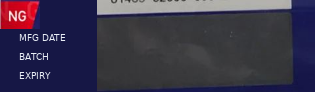

Published application crops used in addaScan’s medicine-carton guide; illustrative values, not Egyptian product data or an addaScan installation. Medicine carton date-code guide
Keep the payload fields attached to the carton event.
Check the relevant fields against the authorised job and the printed interpretation.
For no-read, mismatch or missing host reference, segregate the carton; reconcile in-flight packs and software records before restart.
A normal industrial reader is not automatically an ISO/IEC barcode verifier. Formal print-quality grading needs the specified verifier, calibration and method. This guide does not assert EPTTS approval or guarantee compliance from a camera installation.
The field rules below are attributed to this EDA technical FAQ. Confirm the applicable product scope, current implementation instructions and approved software responsibilities before final acceptance.
Prepare real cartons, code module size, printed text formats, good and faulty payload examples, maximum field lengths and packaging hierarchy. Identify the serialization software, expected record interface, reject controls and who accepts the regulatory data exchange.
Photos, drawings and samples are arranged after initial contact.
Request a Vision Assessment →Compare the relevant method and its limits in these application guides.
Describe the product, the required decision and the factory country. We will use those details to scope the next assessment.