Presence / position camera
Appropriate when the agreed decision concerns a visible stamp region. Test backgrounds and packaging variants that could resemble a mark.
A production-line camera can check whether the specified excise stamp or mark is present, positioned correctly and readable under agreed conditions. It cannot establish tax payment, authenticity, activation or a successful regulatory submission from appearance alone. This guide uses the current KRA and GRA web guidance retrieved on 2 November 2026 for Kenya and Ghana; it does not extend those rules to other countries.
Updated 2 November 2026 · Author: Frank Guo
A bottle reaches the camera with a mark that looks complete, but the associated code cannot be read. Another bottle has a readable mark while the expected host record is unavailable. Neither outcome should be converted to a normal pass. Agree which optical evidence is required, which external system owns verification and what the PLC must do when either result is absent. The example describes a control method; it is not a report of a local installation.
Source version and scope are stated below. A line inspection checks selected evidence; the manufacturer retains responsibility for the applicable product specification.
| Task | Reference and camera view | Exception and boundary |
|---|---|---|
| Kenya — KRA Excise Duty / EGMS guidance | KRA describes secure paper stamps affixed to the product and secure digital stamps printed directly on packaging. Its water-refill FAQ also discusses stamps on refilled or packaged bottles. Confirm the actual product, approved mark form and placement with the responsible operator. | For a paper stamp, inspect the visible area and placement. For a printed mark, test contrast, motion and read position. Do not assume the two formats use the same optics or activation workflow. |
| Ghana — GRA Excise Tax Stamp guidance | GRA lists specified products including alcoholic drinks, non-alcoholic carbonated drinks and bottled water, and describes affixing stamps before sale or release into trade. Obtain the approved stamp specification for the relevant product. | Inspect the supplied mark’s presence and agreed visible condition. GRA’s explanation of a tax stamp does not mean a generic camera can authenticate it or confirm tax status. |
| Placement and damage | Define acceptable position and orientation using the actual packaging and approved sample. Include folds, curved surfaces, glare, partial coverage and missing marks in the trial. | A hidden security feature cannot be verified by a view that does not expose it. Do not infer authenticity from colour or a similar-looking printed region. |
| Reading and host response | If the mark carries a code that the station is authorised to read, specify the symbology, data handling, reference interface and response timing. | Keep no-read, missing mark, host timeout and explicit mismatch separate. The regulatory or verification system must supply any status that cannot be established optically. |
Related solutions: Vision Inspection in Kenya: Labels, Dates & Packs · Vision Inspection & Barcode Readers in Ghana · Label & print inspection
A mark can be present and readable yet carry an identity that has already been used, or be present with its content missing. The camera reports what it sees; validity comes from the issuing system.
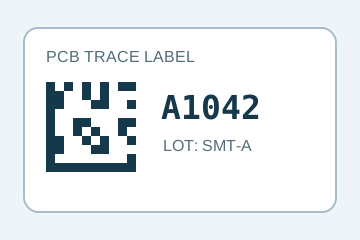
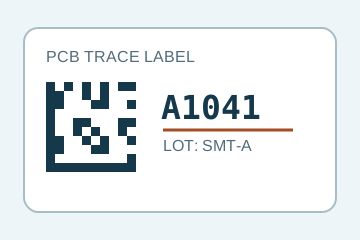

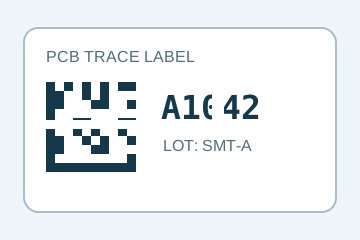
Illustrative SMT-label schematics from addaScan’s serial-verification guide; they show the decision logic and are not KRA or GRA excise stamps. Serial verification on printed labels
Check the intended region on the same bottle or pack event.
Store optical result and any authorised host response as separate evidence.
Reject or hold the unresolved product; after a stop, reconcile in-flight packs and pending host responses before restart.
The source pages do not show a single revision date for every section. Their retrieved text is recorded as of 2 November 2026. Confirm current product classification, mark form and operator obligations before freezing the project; this guide does not publish a complete tax schedule or implementation calendar.
The country sections below cite these separate tax-authority sources. They establish the marking context, while the camera and control decisions remain an engineering specification.
Provide the approved stamp or mark examples, product and package dimensions, placement limits, code specification if available, line speed, lighting access and reject position. Identify who supplies the official marking system and who can authorise or validate its interface.
Photos, drawings and samples are arranged after initial contact.
Request a Vision Assessment →Compare the relevant method and its limits in these application guides.
Describe the product, the required decision and the factory country. We will use those details to scope the next assessment.