Handheld scanner
For warehouses, goods-in and reject tables, where staff present each item.
addaScan supplies HIKROBOT industrial code readers for factories in Kenya from Johannesburg, with USD quotations. Bottling lines are the most common request, so test bottle rotation, cap colour and wet or reflective surfaces before choosing the view and lighting. Cartons, cases and codes marked on parts follow the same rule: the code, surface, distance and speed decide the reader. Equipment supply, PLC comparison and reject confirmation are separate quotation items.
Updated 2 November 2026 · Technical contact: Frank Guo
A cap code reads well on one bottle colour and becomes uncertain after a product change. Confirm lighting, contrast, code presentation and the new expected data. Do not copy a successful recipe to a different cap finish without a challenge test, and do not reuse the last good code when a bottle is not read.
Have samples, photos or a line drawing? Start the assessment now, or send them on WhatsApp.
Request a reader quotationWhatsApp +27 68 925 2696A barcode scanner bought for a shop or warehouse in Kenya is a handheld. On a production line the reader has to decode every bottle, case or part without anyone holding it.
Define the evidence and the failure response before selecting a camera, then test each choice on your own products and line conditions.
| Task | Reference and camera view | Exception and boundary |
|---|---|---|
| Bottle labels and caps | Map where the code can face at the inspection point and test the full rotation, cap colours and wet or reflective surfaces with the intended lens and light. | If one view cannot see the whole code, constrain orientation or add views; a favourable bottle angle is not evidence for all positions. A text-only laser mark needs OCR rather than a barcode reader. |
| Cartons, cases and shrink packs | Read case labels at the case packer or before the palletiser, at the real pack spacing and through shrink film where it covers the label. | A case read confirms the case code, not that the case holds the right units. |
| Codes marked on parts | For codes marked directly on metal or plastic parts, test the real surface finish with suitable lighting; a wide-field fixed reader or a DPM handheld may fit. | A code read on a clean sample does not prove reading after machining, oil or wear. |
| Reader event and removal | Supply the expected SKU from the active recipe and keep the item’s identity through accumulation, bends or line stops. | A no-read must not inherit the previous item’s valid value. Confirm the physical reject, not only the PLC output. |
Related solutions: HIKROBOT code reader selection · Barcode scan tunnels · Excise stamp checks
A laser-marked cap read with OCR and an outline check. A readable mark on one cap colour still has to be tested on the other colours and finishes the line runs.
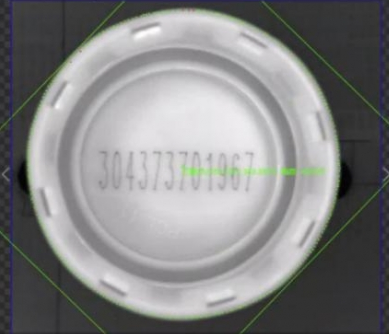
Public HIKROBOT VisionMaster application reference used in addaScan’s cap guide; not an addaScan installation in Kenya. Laser-marked cap OCR guide
Start from the code, surface and mounting space; then choose the series. The quotation names the exact model, lens, light and accessories.
| Series | Vendor positioning | Where it fits this task | Protection and interfaces (vendor list) |
|---|---|---|---|
| ID3000 | Compact fixed reader for high-speed reading; about 1.3–5 MP. The vendor lists GS1 DataMatrix, GS1 QR, EAN/UPC, ITF-14 and Code 128 among its symbologies. | Cap and label codes on fast bottling lines; the IP67 rating with lens cap is relevant on wet lines. | IP67 with lens cap. Lists Profinet, EtherNet/IP, MELSEC, Fins, Modbus, SLMP, UDP, TCP, serial and FTP. |
| ID5000 | Full-featured fixed reader with a large field of view; about 3 MP and up (the series description says up to 20 MP, so confirm per model). | Variable code positions that remain visible within one view. A wider field cannot expose a symbol hidden on the back of a rotating bottle. | IP67 with lens cap; same protocol list as ID3000. |
| ID2000 | Extremely small fixed reader for embedding in machines; about 0.4–1.6 MP in HIKROBOT’s selection guide. | Reading inside a capper, labeller or case packer with little space. | ID2000E IP54, ID2000M IP65. ID2000E lists TCP, serial, FTP, UDP, Profinet, EtherNet/IP and USB. |
| IDH2000 / IDH3000 | Handheld readers for general purposes; about 0.3–1.3 MP. | Quality checks and rework after a no-read or reject. | The handheld table lists EtherNet/IP, Profinet, Modbus, MC/SLMP and Fins; confirm protection per model. |
Positioning, resolution ranges, protection ratings and protocols are as HIKROBOT publishes them in its Machine Vision Smart Product Catalogue 2025 Q4; confirm them for the exact model in the quotation. This website does not claim any official HIKROBOT partnership or distributor status. No public price is given: the quotation lists the reader configuration, accessories, freight and any integration scope. An IP rating alone does not establish washdown suitability; confirm cleaning conditions, housing and connectors for the proposed installation.
HIKROBOT catalogue 2025 Q4 (PDF) · Series guidance; check the current specification for the exact model and firmware before ordering. HIKROBOT code reader selection
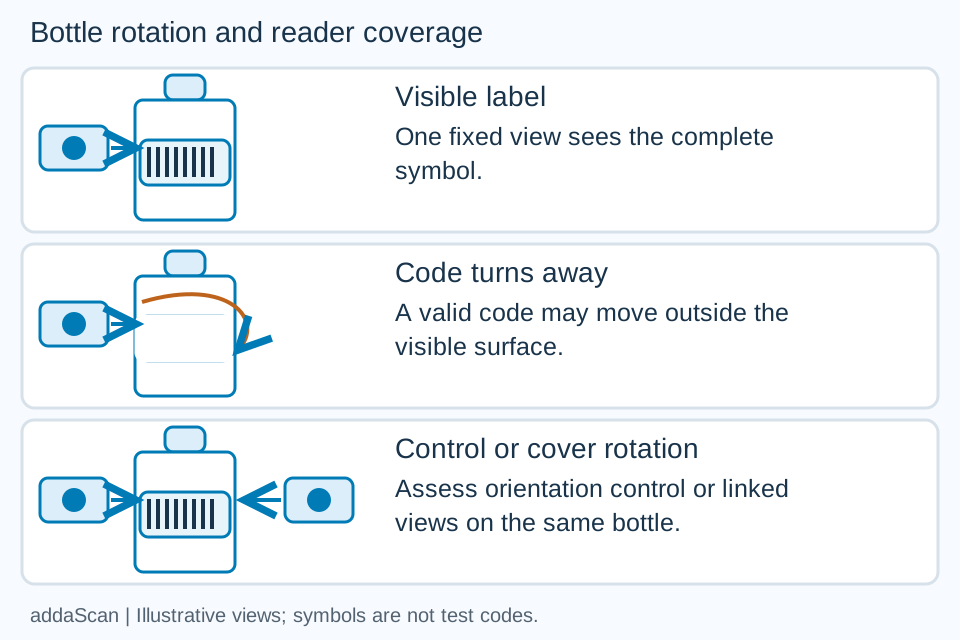
Illustrative coverage study. The views below do not specify camera positions or a measured performance result.
| Test step | Evidence and decision |
|---|---|
| Start with the real bottle | Use the approved symbol on every relevant label material and bottle shape. Identify the rotation permitted at the reader. |
| Challenge the view | Move the symbol from the centre toward the limits of visibility. Add normal reflections and wetness, then test a wrong-SKU label that remains easy to read. |
| Choose the arrangement | Use one view only if all permitted positions are covered. Otherwise assess orientation control or linked views, and demonstrate their shared bottle event. |
| Check the line action | Test no-read, wrong-SKU, reference unavailable and reject-not-confirmed outcomes. Preserve separate reasons for operator recovery. |
Record the sample ID, approved reference, hardware/software settings, expected decision, observed result, physical reject outcome and evidence file. Agree pass criteria before testing.
Download the blank acceptance record (CSV) — Blank planning template; no measured results are supplied.
Read the anonymised envelope verification project and its FAT results
This existing addanode-led project demonstrates reference matching, exception handling and documented factory acceptance. It is not evidence of a local installation or performance on your product.
Bottle rotation decides whether one reader is enough or several views are needed, and cap colours or wet, reflective surfaces decide lighting and lens covers. Those choices change the quotation more than the reader body.
Request an equipment list for the chosen views: reader model and optics, light or polarisation option, mounting and adjustment, trigger, cables and network connection. Quote bottle guidance, recipe handling, PLC integration and reject confirmation explicitly. Wet-area protection and cleaning suitability must be checked for the exact assembly, including connectors.
Check bottle rotation and the cap or label surface at the real mounting point.
Test correct and wrong identifiers across finishes, movement and permitted positions.
Carry the result to the reject and reconcile bottles left in the zone after a stop.
Reader supply, a configured reading point and an integrated station are quoted as different scopes. Freight, import and customs responsibilities, engineering travel, installation, training and support are itemised in USD. How a cross-border quotation is structured
Provide bottles at each label position and cap finish, symbols at the permitted rotation limits, wrong-SKU examples, normal wetness and the code payload specification. Include conveyor layout, accumulation, trigger location, reject distance and recipe-change signals. If the cap carries only text, identify the exact printed fields.
Photos, drawings and samples are arranged after initial contact.
Request a reader quotation →Compare the relevant method and its limits in these application guides.
Describe the product, the required decision and the factory country. We will use those details to scope the next assessment.