Camera fill-level check
Useful when the relevant liquid boundary is consistently visible and the acceptance rule is defined.
addaScan is a Johannesburg-based machine vision integrator that designs vision inspection stations and supplies industrial code readers for factories in Tanzania; where site work is agreed, its engineers travel from Johannesburg, and quotes are in US dollars. Assess labels, caps, date codes and visible fill levels on production lines in Tanzania. The container and product determine what a camera can see. addaScan reviews the full range of bottles, liquids and packaging before recommending an optical check, and separates that decision from legal net-content measurement or other testing methods.
Updated 2 November 2026 · Technical contact: Frank Guo
A clear liquid in a transparent bottle gives a visible meniscus at the first trial. A later product is dark, foamy or packed in an opaque container. The original camera threshold cannot simply be copied to that product. Record insufficient visibility as a distinct result, reassess the method and continue treating cap and printed-code checks as separate tasks.
Have samples, photos or a line drawing? Start the assessment now, or send them on WhatsApp.
Request a Vision AssessmentWhatsApp +27 68 925 2696Define the evidence and the failure response before selecting a camera, then test each choice on your own products and line conditions.
| Task | Reference and camera view | Exception and boundary |
|---|---|---|
| Visible fill level | Test the product/container combinations, foam and label position at the proposed camera view. | If the liquid surface cannot be established, do not issue a fill-level pass from a guessed edge. |
| Caps and visible closure features | Choose a view of seating, tilt and visible tamper features across the container range. | Do not use cap presence as evidence of correct torque or leak tightness. |
| Date and batch codes | Read or verify against the active product and batch specification, including local date formatting supplied by the customer. | Keep correct, wrong and uncertain codes distinct and link each to the rejected product. |
| Packing and carton fields | Compare outer-pack information with the active packing record where the fields are accessible. | Use the customer’s applicable specification; South African export rules are not automatically Tanzanian requirements. |
Related solutions: Fill level, cap & seal inspection · Bottled water line inspection · Yoghurt cup inspection
An optical fill check needs a visible liquid boundary at the camera view. On the same line, a cup lid can be missing or displaced.
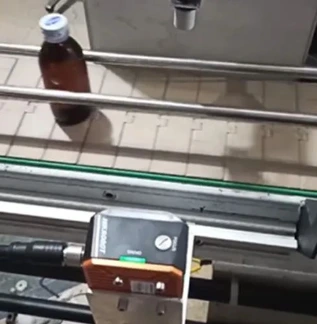
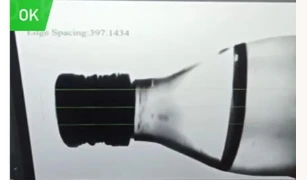


Images from a documented beverage fill-level installation and original yoghurt-lid schematics, from addaScan guides; not a line in Tanzania. An optical level check is not legal metrology. Beverage fill-level inspection · Yoghurt cup lids
The enquiry should state whether the complaint is low visible level, insufficient net quantity, a closure fault or an incorrect date. Combining those complaints under “under-filled bottles” can lead to the wrong acceptance test.
On Tanzanian bottling and edible-oil lines the code may sit on a curved, wet or rotating container, and the case label is read later at a different rate. Choose the reader per reading point: the bottle code, the shrink pack and the outer case can each need a different field and trigger. A reader confirms the code; label artwork, caps and fill levels remain separate inspections.
| Series | Where it fits in this country’s tasks |
|---|---|
| ID2000 | Embedded reading inside a labeller or case packer where space is tight; ID2000M is listed at IP65. |
| ID3000 | Bottle or case codes on a fast line; IP67 with lens cover. |
| ID5000 | Codes on curved bottles or shrink packs that move across a wider field. |
Series positioning, protection and interfaces as published in the HIKROBOT 2025 Q4 catalogue; the quotation confirms the exact model. No official HIKROBOT partnership or distributor status is claimed. HIKROBOT code reader selection
Industrial Barcode Scanners in Kenya · Request a reader quotation →
Test actual transparency, product colour, foam and viewing position.
Keep optical fill level separate from weight, volume and other measurement techniques.
Repeat the agreed challenge checks when the container or recipe changes.
| Scope decision | Information and owner to confirm |
|---|---|
| Container and product matrix | List clear, coloured and opaque containers with the actual product variants. Agree which combinations permit a visible level check and which require a separate measurement method. |
| Wet-line preparation | Confirm lighting access, cleaning conditions and the rejection point. Prepare each container format for site testing rather than accepting a result on one empty bottle. |
Reader supply, a configured reading point and an integrated station are quoted as different scopes. Freight, import and customs responsibilities, engineering travel, installation, training and support are itemised in USD. How a cross-border quotation is structured
Product standards and certification marks in Tanzania sit with the bodies below.
National standards body and product certification.
Regulation of medicines and medical devices.
A camera station can check that a required mark or printed field is present and legible on each pack; whether your product needs it is confirmed with the authority or your certification adviser.
Site work is quoted to the factory’s actual location, for example in Dar es Salaam or Arusha.
Comparing industrial automation companies in Tanzania? addaScan’s part is the inspection: it designs vision inspection stations and supplies industrial code readers, and connects them to the PLC, conveyor and reject device that your plant’s automation team, machine builder or local integrator maintains.
Prepare the complete container and product range, including darker products, foam, labels and damaged caps. Provide line speed, spacing, camera access and details of any existing fill or weight instruments.
Photos, drawings and samples are arranged after initial contact.
Request a Vision Assessment →Compare the relevant method and its limits in these application guides.
Describe the product, the required decision and the factory country. We will use those details to scope the next assessment.