Beverage fill-level inspection
Compare the visible liquid boundary with bottle position, foam and label coverage.
Bottled water line inspection is a camera check of every PET bottle after the capper and labeller. addaScan builds it on HIKROBOT vision sensors or cameras with a reject signal; water quality stays a laboratory test. Indicative installed budgets, excluding VAT: about R 190 000 for two vision sensors that check cap, tamper band and fill line on clear PET and read the date and batch code, using your existing reject; up to about R 930 000 when label views, a second side view, a vision controller and a confirmed pusher reject are added.
Every water bottling plant South African shoppers buy from works under the Regulations relating to all bottled waters, R718 of 28 July 2006 (as amended), made under the Foodstuffs, Cosmetics and Disinfectants Act (R718, 2006). They define bottled water as water packed in sealed containers, require it to be packed in hermetically sealed, sanitised containers that prevent adulteration or contamination, and require it to be labelled under the general food labelling regulations. Those regulations require a batch number on every container that makes the batch traceable, and a date mark that is clearly indicated and may not be removed or altered (R146, 2010). The food hygiene regulations add that prepacked food must be packed so it cannot be opened without the seal or lid being removed or damaged (R638, 2018).
Members of SANBWA, the bottled water association, work to the SANBWA Bottled Water Standard, a single standard that collects the legal and best-practice requirements for bottling water in South Africa and is the basis for SANBWA’s annual member plant audits by an independent third-party food safety organisation (SANBWA). None of these rules names a method of checking. The visible results of a line, a cap on and down, an unbroken tamper band, the right fill line, a straight label and a readable code, are what a camera can check on every bottle.
Water quality is a different matter: the chemical limits and microbiological requirements in R718 are laboratory tests on samples (R718, 2006), and no camera on the line replaces them. For general filling lines, see fill, cap and seal inspection.
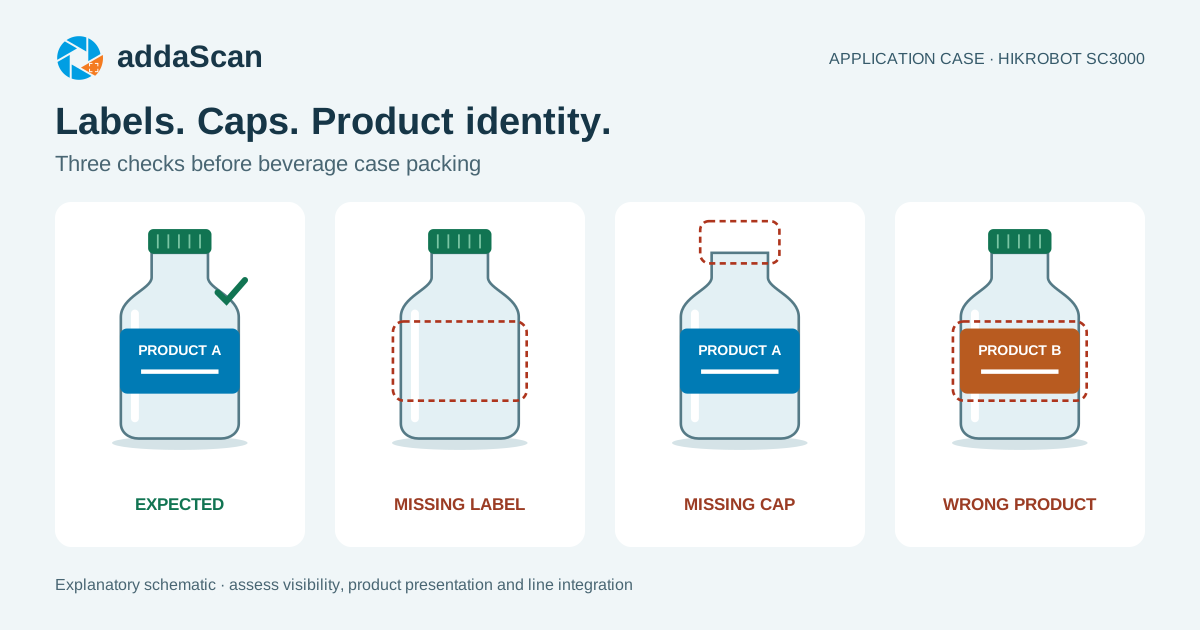
For a related beverage packing task, a published SC3000 application checks labels, caps and product identity. Use it to compare camera views and sample challenges; this water-line scope adds its own fill, closure and code requirements.
See the beverage inspection application →| What the line reports | What a station checks | Where it stops |
|---|---|---|
| “Bottles are leaving the capper with the cap cocked” | Cap present, height and skew, from the side against a backlight, compared with the good bottle taught for this size. | A cap that sits right but is under-torqued or does not seal is a torque or leak test question. |
| “The buyer says the seal ring was broken” | Tamper band present and unbroken below the cap: one side in the low case, both sides in the high case. | In the low case the far side of the band is not seen; a band that looks whole but is weak is not found. |
| “Short fills when the filler valves play up” | The fill line on clear PET against the backlight, inside the limits set for each bottle size. | The camera sees the fill line, not the volume; net content is proven by weighing samples. |
| “Labels coming off the labeller skew or missing” | Label present, straight and the right label for the recipe, from two opposite side views (high case). | Poor adhesion and a label that lifts later are not seen at the station. |
| “The coder blocked and we ran a shift with no date” | Date and batch code present and readable on the cap or shoulder, compared with the expected text for the run. | The code is checked in one position per recipe; a code printed elsewhere on the bottle is not seen. |
Bottles run single file past a side view of the neck and fill line against a backlight, then past the label views and the code check. The result per bottle goes to the existing reject or a line stop; in the high case a pusher moves failed bottles to a table and a sensor confirms each reject.
Swipe sideways to see the whole drawing →
| Component | HIKROBOT example | Role in this station |
|---|---|---|
| Cap and fill view (low) | HIKROBOT SC3000-series 5 MP vision sensor (budget priced on MV-SC3050M) in front of a HIKROBOT flat light used as a backlight (MV-LBES-H series) | Cap height and skew, tamper band and fill line from one side |
| Code check (low and high) | HIKROBOT SC3000-series vision sensor with OCR (MV-SC3050M) and an MV-LRDS-H ring light | Reads the date and batch code and compares it with the run |
| Cameras (high) | 4 × HIKROBOT MV-CS050-10GM 5 MP mono GigE cameras with 25 mm lenses (MVL-HF2524M-10MP) | Two opposite views of neck and fill line; two opposite views of the label |
| Processing (high) | HIKROBOT VC3000 vision controller (MV-VC3704H) running HIKROBOT VisionMaster | Runs all four views and sends one result per bottle |
| Lighting (high) | Two HIKROBOT flat lights used as backlights for the neck and fill views; two MV-LLDS-H bar lights for the label views | Backlight turns cap and fill line into sharp outlines; bar lights give even light on the label |
| Trigger | HIKROBOT MV-PE photoelectric sensor (e.g. MV-PE5101) | Fires the cameras for each bottle |
| Reject | Not HIKROBOT: the existing reject or a line stop with stack light (low); a bottle pusher with confirmation sensor and reject table (high) | Takes failed bottles off the line and proves they left |
| Mounting and panel | Local supply: stainless mounts, shrouds, cabling, panel and operator screen | Holds the views fixed in a wet area and shows rejects to the operator |
| Tool or software | What it does here |
|---|---|
| Edge and position tools (vision sensor client or HIKROBOT VisionMaster) | Cap height and skew and the fill line position, measured from edges in the backlit image against limits set per bottle size. |
| Presence tools on the tamper band | Gaps or missing sections in the band outline below the cap. |
| Label position and pattern check (high case) | Label edges found and compared with the taught position; a pattern match confirms the right label for the recipe. |
| OCR and character comparison | Reads the date and batch code and compares them with the expected text sent by the PLC or entered at the start of the run. |
| Recipe per bottle size and label | One recipe per bottle size, cap and label, selected at changeover. |
| Result and image log | Reject reason per bottle and saved images of rejects for the line team. |
Cameras and lights on stainless mounts after the capper and after the labeller and coder, with splash covers where rinse water or condensation reaches.
A flat backlight behind the neck and fill line, set so clear water and clear PET give a sharp fill line; shrouds keep plant lights and sunlight off the label views.
One trigger per bottle; bottles need a gap at the cameras so each view sees one bottle, and the PLC tracks each bottle from the cameras to the reject.
Pass/fail and reason per bottle by digital I/O to the reject or the line PLC; network protocols only where the chosen device lists them and the line supports them.
The existing reject or a pusher with a confirmation sensor and a full-table signal; if a camera is not ready, bottles are rejected or the line stops, never passed unchecked.
Recipe per bottle size, cap and label chosen at changeover; the expected date and batch text comes from the PLC or is entered at the start of the run; a screen shows the last rejects with the reason.
Indicative budget for a typical application of this kind. Every project involves custom requirements (your products, line speed, layout, PLC and acceptance criteria), so the final price differs from case to case. A firm price follows the sample test.
This is a typical application with custom requirements: your bottle sizes, line speed, layout and acceptance criteria set the final price. The low figure is two vision sensors, one checking cap, tamper band and fill line from one side against a backlight and one reading the date and batch code, signalling your existing reject or a line stop. The high figure adds a second side view, two label views on a controller and a bottle pusher with confirmation. Large cooler bottles, water testing, leak testing, changes to your conveyor, utilities and VAT are excluded.
Hardware is priced from public list prices converted at the ECB reference rate, plus freight, clearance and margin; engineering at R 900 – R 1 300 per hour. How these ranges are built →
Swipe the table sideways to see the high figure and the basis →
| Cost block | Low | High | Basis |
|---|---|---|---|
| Vision hardware (landed, with margin) | R 109 300 | R 383 100 | Low: two SC3000 vision sensors, one with a backlight for cap and fill, one with a ring light for the code. High: four 5 MP cameras with lenses, two backlights, two bar lights, VC3000 controller, code-reading vision sensor |
| Software licence | R 0 | R 40 100 | Vision sensor software is free; high case with the VisionMaster standard licence (no deep learning) |
| Local materials and reject | R 20 000 | R 130 000 | Low: brackets, backlight mount, cabling, stack light, signal to the existing reject or line stop. High: stainless mounts and shrouds, bottle pusher with confirmation and reject table, panel, UPS, screen |
| Engineering (recipes, PLC link) | R 36 000 | R 182 000 | 40 h at R 900 to 140 h at R 1 300 |
| Installation, FAT, SAT, training, documents | R 18 000 | R 93 600 | 20 h to 72 h |
| Project management | R 7 200 | R 41 600 | 8 h to 32 h |
| Travel (Gauteng) | R 3 000 | R 8 000 | Outside Gauteng quoted separately |
| Total (rounded) | R 190 000 | R 930 000 | Low: two vision sensors. High: four views, code check and own reject |
The technologies behind this station, how much each matters here, and where each is explained in depth.
| Technology | Role | Why it matters in this scenario | Read more |
|---|---|---|---|
| Vision sensor (HIKROBOT SC1000–SC3000) | Core | On a small water line, two vision sensors cover cap, band, fill line and code without a controller. | Choosing a smart camera |
| Lighting technique | Core | Clear water in clear PET is hard to see in front light; a backlight turns the cap outline and the fill line into sharp edges. | Machine vision lighting |
| OCR/OCV of printed codes | Supporting | The date and batch code must be present and legible on every bottle; reading it shows a blocked coder at once. | OCR/OCV inspection |
| Label inspection | Supporting | Label present, straight and right for the recipe, from two side views in the high case. | Label inspection |
| Area scan cameras with a vision controller | Supporting | Four cameras on one controller see the cap and band from both sides and the label all round. | Camera and lens selection |
| PLC link and reject with confirmation | Supporting | Light bottles close together need tracking to the right bottle and a reject that proves it acted. | PLC and reject integration |
Every station is accepted on your products, against numbers agreed in writing before the build. How we deliver →
Good bottles of every size and real faults (high and crooked caps, broken bands, short fills, missing and skewed labels, missing and smeared codes), imaged with the proposed cameras and lights; the result states which faults are reliably found and which are not.
Before delivery, marked challenge bottles of each fault type must each be rejected, and good bottles of every size must pass.
On your line, at production speed, the challenge bottles are run again, and false rejects and escapes are counted over an agreed run of production.
The water-line check depends on the bottle geometry, visible liquid boundary and cap features. A change in bottle supplier, decoration or closure can alter the image even when the product specification appears unchanged.
| Decision or event | Check or action | Acceptance boundary |
|---|---|---|
| Cap height or skew | Challenge correctly seated and visibly tilted closures | Do not infer torque from height. |
| Tamper band | Show the specified visible missing/broken condition | An occluded section needs another view. |
| Fill boundary | Test normal wet/reflective production conditions | Keep net-content verification with the appropriate quantity control. |
| New bottle size | Select and verify the correct program and reject tracking | A wrong recipe should not silently pass because the bottle is similar. |
Retain separate evidence for the optical decision and successful rejection of that bottle. A quality hold or reject must be defined for missing images, unexpected spacing and failed removal.
Bottled water line inspection checks the visible result on every bottle: cap present, straight and fully down, tamper band unbroken, fill line within limits on clear PET, label present and straight, and the date and batch code readable. Failed bottles are rejected or the line is stopped. It does not test the water, the seal or the net content.
R718 requires bottled water to be packed in hermetically sealed, sanitised containers and labelled under the food labelling regulations (R718, 2006), which require a traceable batch number and a clear date mark on every container (R146, 2010). A camera can check the visible parts on every bottle: the cap and tamper band are there, and the date and batch code are present and readable. The water itself is tested in a laboratory.
An indicative installed budget is R 190 000 – R 930 000 excluding VAT, at 2 October 2026 prices. The low figure is two vision sensors: one checks cap, tamper band and fill line against a backlight, one reads the date and batch code, signalling your existing reject. The high figure adds a second side view, two label views on a controller and a pusher reject with confirmation. Both include engineering, installation, FAT and SAT in Gauteng. This is a typical application: every project involves custom requirements, so the final price depends on your bottles, line and acceptance criteria.
No. A camera sees whether the cap is there, how high it sits, whether it is crooked and whether the tamper band is whole. It does not see whether the cap is tight or whether the bottle seals. A cap that looks right can still leak, so leak and torque checks stay with your quality team or a dedicated tester.
Whether a machine set includes a camera check depends on the supplier and the order. If yours does not, a camera station can be added after the capper and the labeller as long as there is conveyor length for the cameras and the reject. Ask the machine supplier for a reject input and the space; addaScan then builds the inspection on your line and links it to the reject.
The budget on this page covers clear PET bottles on a single-file conveyor. Sealed water for coolers is within the SANBWA standard’s scope (SANBWA), but large cooler bottles need different handling and mounting, so they are quoted separately after a sample test. Tinted and opaque bottles hide the fill line from a backlight; cap, band, label and code checks still work, and the fill check is tested on samples first.
Describe the line, the products and the fault. We test on your good and faulty samples and reply with a feasibility note and a budget.
Use the country guidance to prepare the line data, interfaces and delivery scope for a project assessed from Johannesburg.
A new container can change the inspection method. Project scope, references and Johannesburg delivery for Tanzania.
Keep the inspection event intact through stops and restarts. Project scope, references and Johannesburg delivery for Uganda.
For Angola, turn a general automation request into specific date, cap, bag-count or dispatch decisions. Country guidance in Portuguese.
Reading codes on rotating and wet bottles.